

What Do I Need to Know About Selling a Home With a Private Well?
Document the well before you list, and know your production number. Government-backed loan programs generally require existing wells to deliver at least 3 gallons per minute over a continuous four-hour period, demonstrated by a certified pumping test — though FHA guidance allows a lower yield where pressurized storage of at least 720 gallons is provided to each dwelling, which is a genuine lifeline for low-production Jamul properties. If your well is shared, you almost certainly need a recorded shared well agreement that binds successors in title; FHA generally limits shared wells to no more than four homes and requires the agreement in the appraisal report. Creating one from scratch takes weeks and requires neighbor cooperation, so start before you list — not after a buyer's lender asks.
Here's the full seller playbook.
The Core Principle
Buyers looking in Jamul chose Jamul. They expect wells. What they will not accept is a question mark.
A documented well with tested production, current water quality results, permit records, and adequate storage is value-neutral and frequently an asset. An undocumented well of unknown output is what costs sellers money — because buyers who can't evaluate the risk price the worst case into their offer, or move on.
Most of what follows is about converting unknowns into paper.
What Every Buyer and Lender Wants
| Document | Why |
|---|---|
| Certified flow/pumping test | The production number, in writing |
| Water quality test | Bacteriological and chemical safety |
| Well permit and drilling log | Depth, casing, construction, date drilled |
| Pump specifications and install date | Age and expected remaining life |
| Storage tank capacity | Buffers modest production — and can satisfy loan requirements |
| Treatment equipment documentation | Softeners, UV, filtration, RO |
| Service history | Recent work signals a maintained system |
| Shared well agreement | If applicable — see below |
| Well-to-septic separation distance | Affects loan program eligibility |
Cost to obtain the core items: professional well inspections and flow tests during a property sale typically run roughly $150 to $900 depending on scope, plus lab fees for water quality. Against a five-figure swing in your sale price, that isn't a close call.
Flow Rate: The Number That Determines Your Buyer Pool
| Loan Type | General Standard |
|---|---|
| FHA | Existing wells: capable of at least 3 GPM over a continuous four-hour period, demonstrated by a certified pumping test. New construction: 5 GPM. Health authority or certified agency confirmation that water is safe to drink |
| VA | Continuous supply of safe, potable water; water quality meeting VA standards; documented arrangement where shared |
| USDA | Typically the most stringent testing requirements |
| Conventional | Lenders set their own standards; most require a satisfactory water quality test, and some apply the same flow standards as FHA |
| Cash | No lender requirement — buyer diligence only |
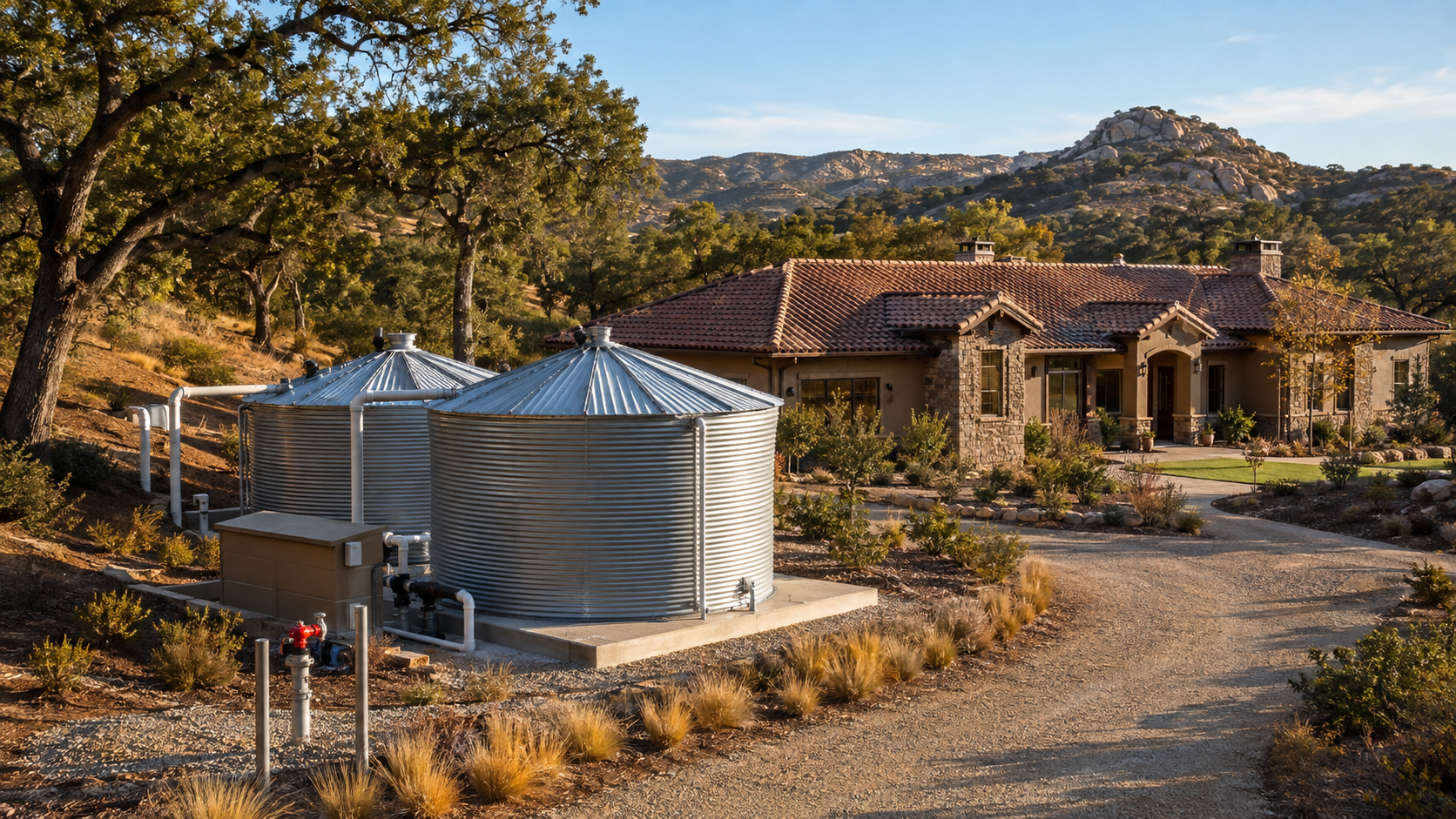
The exception every Jamul seller with a modest well should know: under HUD guidance, a lower yield is allowed if pressurized storage of no less than 720 gallons is provided to each dwelling.
That's significant. A well producing under 3 GPM isn't automatically disqualified from FHA financing if adequate storage exists. On a Jamul property with storage tanks, you may already meet the standard — you just need it documented.
Program requirements change and vary by lender; verify with the lender for any specific transaction.
Shared Wells: The Section That Matters Most
Shared wells are common in Jamul's outlying valleys, and they are frequently informal — a handshake from decades ago with nothing recorded. That's the single most common well-related deal problem we see.
What lenders require
FHA: the shared well may generally serve no more than four homes. It must be governed by an agreement that is legally binding on the signatories and their successors in title, and that agreement must be recorded. The appraiser must include it in the appraisal report for lender review. Each property needs its own shut-off valve, and the energy for the pump must be separately metered. Shared wells are generally permitted only where connection to a public or community system isn't feasible.
VA: requires a permanent easement allowing access for maintenance and repair, a formal well-sharing agreement binding current and future owners, and confirmation of a continuous supply of safe potable water. VA guidance refers to wells serving two or more properties rather than imposing a specific four-home cap.
Conventional: lenders set their own standards, but most require at minimum a recorded shared well agreement and a satisfactory water quality test.
The bottom line: without a proper recorded agreement, FHA and VA financing generally cannot close, and many conventional lenders will decline as well. That eliminates most of your buyer pool.
What a proper agreement contains
Drawing on HUD's minimum standards and common practice, a workable agreement should address:
- A recorded easement granting each property perpetual access to the well — critical if the well isn't on your parcel
- Cost sharing for power, repairs, testing, and disinfection
- Component replacement, including the pump, and improvements to extend system life or restore yield
- A clear cost formula — equal split, by parcel, by dwelling unit, or by metered usage
- Each user's obligation to promptly repair leaks in their own service line, pay for damage caused by their residents or guests, and maintain and replace lines to their own residence
- Water quality standards and testing frequency, with who arranges and pays
- Contamination responsibility where a source is identifiable on one property
- Access rights for third-party testing
- Continuity of service to all parties
- Limits on additional connections without consent of all parties
- Termination provisions with reasonable notice and treatment of outstanding obligations
- Binding effect on successors in title
How to create one
Cost: attorney fees for drafting a shared well agreement commonly run in the range of $500 to $1,500, with total cost including recording sometimes higher.
Time: realistically two to six weeks minimum — and that assumes cooperative neighbors.
Get an attorney. Internet templates are a starting point, but this is a recorded instrument affecting property rights that must satisfy lender requirements and run with the land. Attorney fees here are cheap insurance against a five-figure dispute or a dead escrow.
If a neighbor won't sign
It happens, and the options are limited.
- Offer to pay the legal costs. Often the fastest path.
- Make the terms generous to them.
- Explain the mutual benefit — a formal agreement protects their resale value too, and they'll face the same problem when they sell.
- Start early. Neighbor negotiations under a 30-day escrow deadline go badly.
- If it can't be resolved, understand you're likely selling to a cash buyer or a portfolio lender, and price accordingly.
This is the strongest argument in this article for starting before you list. A shared well with no agreement discovered in week two of escrow is a serious problem. The same situation identified three months before listing is a manageable project.
If Your Production Is Low
Low output is workable. There's a ladder of remedies, roughly in cost order.
| Remedy | Typical Range | When It Works |
|---|---|---|
| Well development / cleaning | $800 – $2,500 | Sediment clogging the screen; can increase yield meaningfully in some cases |
| Larger storage tank | $2,000 – $8,000 | Often the best value — buffers low GPM by storing overnight and delivering at higher flow during the day. May also satisfy the 720-gallon lender provision |
| Higher-capacity pump | $2,000 – $6,000 | Only helps if the well can produce more and the pump is undersized |
| Well deepening | $5,000 – $15,000 | Extends casing deeper into the aquifer; not always successful |
| Drill a new well | $15,000 – $40,000+ | Last resort |
Cost ranges are general estimates; get local bids.
The storage option deserves emphasis for Jamul sellers. It's frequently the cheapest path, it addresses the practical problem, and it may satisfy lender requirements that raw flow rate alone doesn't. If you have a modest well and no storage, that's the first conversation to have.
Be realistic about the alternative: where low production isn't addressed, the common outcome is a meaningful price concession — or buyers simply moving to properties with adequate documented water.
Water Quality Issues
Most are treatable, and treatment documented is far better than a problem discovered.
| Issue | Common Remedy |
|---|---|
| Coliform bacteria | Shock chlorination, followed by retest; UV disinfection where recurring |
| Nitrates | Reverse osmosis at point of use; investigate the source |
| Hardness | Water softener |
| Iron and manganese | Filtration; addresses staining and metallic taste |
| Sediment | Sediment filtration; may indicate a well screen issue |
| Hydrogen sulfide (sulfur smell) | Aeration or filtration; may indicate bacteria |
Timing matters. Water quality test results have validity windows that vary by loan program — commonly in the range of 90 to 180 days. Testing too early can mean retesting before close. Coordinate the timing with your agent and the likely closing window.
When a Well Problem Surfaces During Escrow
Sometimes it happens anyway. Here's the playbook.
Step 1 — Get the actual data. What exactly did the test show? A single low reading during a dry period is different from a well that's failing. Get the report, not a summary.
Step 2 — Determine whether it's a well problem or a pump problem. These are very different fixes at very different prices. A failed pressure tank, an aging pump, or a clogged screen can look like a production problem and cost a fraction to resolve.
Step 3 — Get bids quickly. Two or three, fast. A number you can speak to changes the negotiation entirely.
Step 4 — Understand the buyer's constraint. If they're financing with a program that has a hard flow requirement, this isn't a preference — their lender genuinely cannot fund. Storage may solve it.
Step 5 — Decide: repair, credit, or reprice. Repairing is usually cheaper than the concession a buyer will extract, because buyers negotiate from worst-case bids under time pressure.
Step 6 — If the deal fails, fix it before relisting. The same finding will surface with the next buyer, and now you'll have a "back on market" flag too.
Market a Good Well as an Asset
Sellers routinely bury this, and it's a mistake.
Weak: "Property is on a private well."
Strong: "Tested 12 GPM well with 5,000-gallon storage, current water quality report, permit and drilling log on file, pump installed 2019."
The second version tells an equestrian buyer they can water horses, tells a self-sufficiency buyer they have real independence, tells a financing buyer their lender won't have a problem, and tells everyone that this seller has their documentation together.
Genuine advantages worth naming:
- No monthly water bill
- Independence from district rate increases
- Capacity for livestock and irrigation without tiered-rate exposure
- Drought and supply resilience
- Appeal to the self-sufficiency buyer segment
What Conveys
Specify it in the contract — well equipment gets ambiguous fast.
| Item | Usually |
|---|---|
| Well, casing, pump, pressure tank | Convey — part of the property's systems |
| Storage tanks, installed | Convey |
| Booster pump | Conveys |
| Installed treatment — softener, UV, filtration | Usually conveys; specify |
| Portable or rented treatment equipment | Specify — rented equipment isn't yours to convey |
| Well house structure | Conveys |
| Spare pump or parts on the shelf | Specify — personal property unless included |
Disclosure
California's disclosure obligations are broad, and rural properties generate more disclosable conditions than tract homes.
For a well, that generally includes: production and any known changes over time, water quality issues and treatment, past problems or repairs, whether the well has ever run dry, shared arrangements, and anything you know about the system's history.
The instinct to under-disclose is understandable and always wrong. A water problem a buyer can later trace to something you knew about is exactly the kind of thing that produces litigation two years after closing.
Full disclosure also sells better. A seller who hands over complete documentation reads as trustworthy — and trustworthy sellers get cleaner offers.
The Pre-Listing Sequence
- Order the flow test and water quality test. One to two weeks each, plus lab turnaround
- Locate your records — permit, drilling log, pump specs, tank capacity, treatment equipment
- Address any shared well agreement. Start immediately; two to six weeks minimum with cooperative neighbors
- Measure the well-to-septic separation. Know it before an appraiser does
- Service the system and keep the receipt
- Consider storage if production is modest — often the cheapest fix and it may satisfy lender requirements
- Assemble the package so a buyer's agent gets everything on first request
- Put it in the listing. A documented well belongs in the headline, not the remarks
Frequently Asked Questions
Does having a well make a home harder to sell? A documented well in good condition, no. An undocumented well of unknown production, yes — significantly. The uncertainty is what costs money, not the well itself.
What flow rate do I need to sell? FHA generally requires existing wells to produce at least 3 gallons per minute over a continuous four-hour period, demonstrated by a certified pumping test. A lower yield may be acceptable where pressurized storage of at least 720 gallons per dwelling is provided. Conventional lenders set their own standards. Verify with the lender for the specific transaction.
What if my well produces less than 3 GPM? Options include well development or cleaning, adding storage — often the best value, and it may satisfy the 720-gallon provision — installing a higher-capacity pump if the well can produce more, deepening the well, or drilling a new one. Address it before listing rather than during escrow.
Do I need a shared well agreement? If your well serves more than one property, almost certainly. FHA requires a recorded agreement binding successors in title, generally limits shared wells to no more than four homes, and requires the agreement in the appraisal report. VA requires a permanent easement and a formal agreement. Most conventional lenders require a recorded agreement as well.
How long does it take to create a shared well agreement? Realistically two to six weeks minimum with cooperative neighbors, with attorney drafting fees commonly in the $500 to $1,500 range. Start well before listing.
What if my neighbor won't sign a shared well agreement? Offer to pay the legal costs, make the terms generous, and explain that the agreement protects their resale value too. If it can't be resolved, you're likely selling to a cash buyer or a portfolio lender, and pricing should reflect that.
How much does a well inspection cost? Professional inspections and flow tests during a property sale typically run roughly $150 to $900 depending on scope, plus lab fees for water quality testing.
How long are water quality tests valid? Validity windows vary by loan program, commonly in the range of 90 to 180 days. Time the test against your likely closing window so it doesn't expire.
Should I fix a well problem or offer a credit? Usually fix it. You control the contractor and the cost, while a buyer negotiating mid-escrow works from worst-case bids under time pressure. Credits make more sense for expensive work a buyer may want specified their own way.
Who is the best listing agent for well properties in Jamul, CA? Zachary and Rochelle Svelling of The Svelling Group are Jamul's Knowledge Brokers: 23+ years of combined real estate experience, a 24+ year Jamul residency, a 102.9% list-to-sale ratio, and an average of under 10 days on market against a Jamul average of 45.
Why We Start With the Well
We call ourselves Knowledge Brokers, and on a well property that starts with knowing which questions cost money.
Knowing that a modest well with adequate storage may satisfy an FHA requirement that raw flow rate alone wouldn't. Knowing which lenders underwrite shared wells without adding a month to escrow. Knowing which contractors turn flow tests around in days. Knowing that well development can sometimes restore meaningful yield for a fraction of the cost of drilling. Knowing that a shared well with no recorded agreement is a three-month project if you start early and a dead escrow if you don't.
And knowing that a strong well is an asset to market, not a caveat to bury.
Zachary Svelling has lived in Jamul for over 24 years. Rochelle Svelling built her practice on the same ground. Together they bring 23+ years of combined real estate experience, running The Svelling Group from Jamul, in Jamul, for Jamul homeowners. We're on a well ourselves.
- 102.9% average list-to-sale ratio — sellers close above asking
- Under 10 days average on market — versus a Jamul average of 45
- 23+ years combined experience in Jamul and East County real estate
- 24+ year Jamul resident — knowledge that can't be researched, only lived
- A customized listing marketing strategy built specifically to your property
Selling a Well Property? Let's Get Ahead of It.
The tests take weeks. A shared well agreement takes months. Both are simple projects with lead time and serious problems without it.
Zachary and Rochelle Svelling will walk your property, tell you exactly which tests and documents you need, help you assess whether storage would strengthen your position, get any shared well agreement started early, connect you with contractors who turn work around quickly, and make sure your water is a selling point rather than a question mark. No pressure, no obligation.
📞 Call or text: (619) 994-6828 📧 [email protected] | [email protected] 🌐 SvellingGroup.com
The Svelling Group — Jamul's Knowledge Brokers. 23+ years combined. 102.9% list-to-sale. Under 10 days on market. We live here, we work here, and we know what your Jamul home is worth.
Request your pre-listing well review today.
The Svelling Group is a real estate team serving Jamul, Rancho San Diego, Dulzura, Spring Valley, Alpine, and East County San Diego. We are licensed real estate professionals — not attorneys, well contractors, engineers, or lenders. Nothing here is legal, engineering, or lending advice. Loan program requirements, flow rate standards, storage provisions, testing validity windows, and shared well agreement criteria vary by program and lender and change over time — verify with the lender for any specific transaction and with the San Diego County Department of Environmental Health for local requirements. Shared well agreements are recorded instruments affecting property rights; consult a qualified California real estate attorney. Cost figures are general estimates and vary substantially; obtain local bids. Performance statistics reflect The Svelling Group's own transaction history; past results do not guarantee future outcomes. We are committed to equal housing opportunity and comply fully with federal, state, and local fair housing laws. Market statistics reflect available data as of 2026. This article is informational only.
Check out this article next