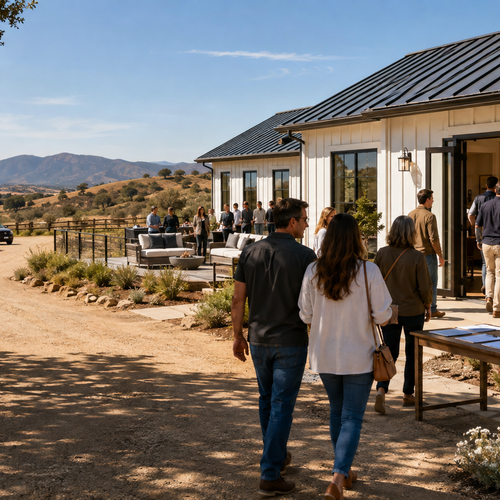

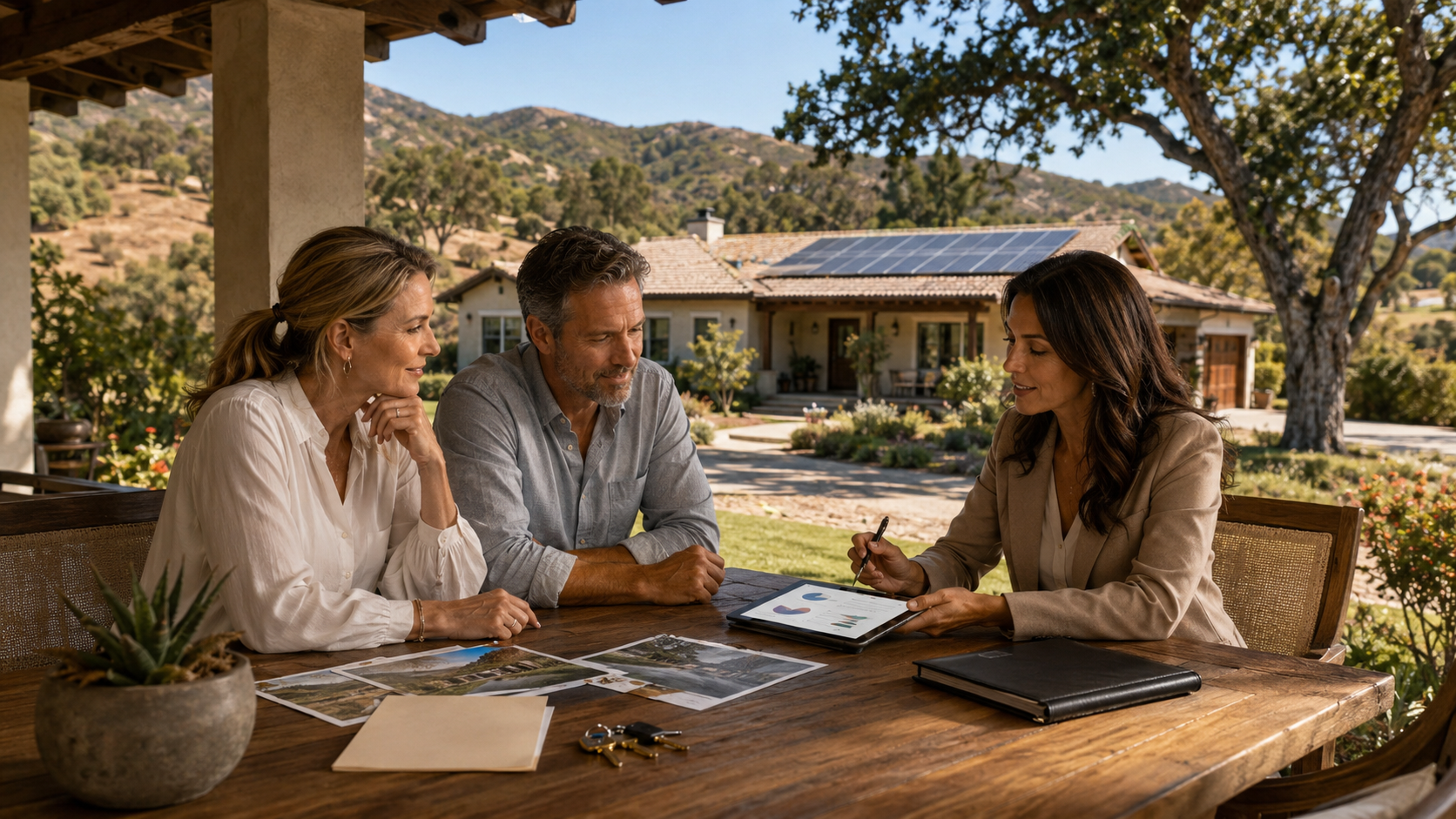
Most Jamul buyers do not automatically reject private roads, solar systems, wells, acreage, or wildfire-related insurance considerations. They become cautious when the cost, condition, responsibility, or documentation is unclear. A maintained private road with a clear agreement can feel peaceful and desirable. Owned solar with useful production records can be an asset. A productive, documented well can provide independence. Usable acreage can create exceptional value. An insurable, well-maintained property with visible fire-hardening features can give buyers confidence.
The same features can create hesitation when buyers encounter a deteriorated road, confusing solar contract, untested well, steep or unusable land, or an insurance search that begins too late. Sellers reduce that uncertainty by preparing the property, collecting records, disclosing known facts, pricing the home appropriately, and allowing buyers time to complete their own investigations.
Zachary and Rochelle Svelling of The Svelling Group live in Jamul, specialize their business in Jamul, and meet local buyers and sellers every day. As Jamul knowledge brokers, they understand which rural features attract buyers, which questions slow them down, and how to present complex property information clearly without making promises that only an inspector, insurer, lender, attorney, or other specialist can verify.
What buyers are really trying to determine
| Property feature | Buyer’s emotional reaction | Buyer’s practical question | What builds confidence |
|---|---|---|---|
| Private road | Privacy, quiet, rural character | Who maintains it, what does it cost, and can I reach the home reliably? | Road condition, legal access, written maintenance information, clear directions |
| Solar | Lower electric bills, energy independence | Is it owned, financed, leased, transferable, and producing as expected? | Contract, payoff, warranty, utility bills, production history |
| Well | Independence and no conventional water bill | Is the water reliable, safe, and sufficient for the property? | Well log, production test, water-quality results, service history, storage details |
| Acreage | Space, privacy, horses, gardens, recreation | How much is usable and what can I legally and practically do with it? | Maps, walking tour, topography, access, fencing, permits, zoning research |
| Fire insurance | Awareness of rural risk | Can I obtain acceptable coverage at a cost I can afford? | Early quote, property condition, defensible space, hardening records, insurer access |
The pattern is consistent: buyers respond well to clarity. They hesitate when a feature feels like an open-ended financial obligation.
Why rural features create both excitement and concern
Many buyers search for Jamul because they want what denser communities cannot provide: space, privacy, views, animals, workshops, gardens, quiet roads, custom homes, and room for multigenerational living. Rural features are often the reason they schedule a tour.
However, buyers moving from suburban San Diego may have never maintained a well, arranged road repairs, reviewed a solar transfer, cleared several acres, or shopped for insurance in a wildfire-exposed area. Their hesitation does not necessarily mean they dislike the property. It may mean they do not yet understand the ownership responsibilities.
The seller’s goal is not to minimize those responsibilities or persuade every buyer that rural living is easy. It is to give the right buyer enough reliable information to decide whether the property fits their lifestyle and budget.
How buyers react to private and shared roads
The positive reaction
A private road can immediately communicate quiet, seclusion, slower traffic, and separation from a busy public street. Buyers may appreciate the scenic arrival, larger setbacks, reduced drive-by activity, and rural atmosphere.
For horse owners, families, buyers with equipment, and people seeking privacy, a private road can be part of the property’s appeal. A maintained road with good drainage, reasonable width, visible turnouts, and dependable access feels intentional rather than inconvenient.
The cautious reaction
Buyers often become concerned when they see potholes, ruts, steep grades, washouts, narrow passages, low branches, inadequate turnarounds, or unclear maintenance responsibility. They may wonder whether a passenger car, moving truck, horse trailer, propane delivery, fire apparatus, or emergency vehicle can reach the home.
Their questions commonly include:
Is access legally recorded?
Is the road public, private, or shared?
Who owns the road?
Is there a road-maintenance agreement?
How are costs divided?
How often is the road graded or repaired?
What happens after heavy rain?
Are gates, codes, or easements involved?
Can large vehicles turn around?
Are there disputes among neighbors?
What sellers can do
Sellers should gather any available recorded easements, road agreements, invoices, grading records, gate information, and maintenance contacts. They should disclose known problems and avoid making unsupported statements about legal rights or future costs.
Physical preparation can also matter. Filling obvious potholes, improving drainage, trimming vegetation, repairing a gate, and making the route easy to follow may improve the first impression. Significant road work should be evaluated carefully because ownership, permission, drainage, and contractor requirements can be complicated.
Marketing should show the road accurately. Hiding a dirt or private approach may increase online clicks but create disappointment during the tour. A better strategy is to present the access clearly and explain the privacy or setting it provides.
How buyers react to solar systems
Owned solar
Many buyers respond positively to owned solar, especially when it is functioning, appropriately sized, supported by records, and paired with a battery or other useful energy improvements. The absence of an ongoing solar payment can make the feature easier to understand.
Buyers may ask for:
Installation date and contractor.
System size and panel count.
Inverter and battery details.
Warranty information.
Recent production history.
Electric bills and annual true-up information.
Roof age and installation details.
Permission-to-operate documentation.
Information about repairs or equipment replacements.
Owned does not automatically mean trouble-free. Buyers still consider equipment age, roof condition, warranties, utility rules, production, and maintenance.
Financed solar
Financed solar can create uncertainty because buyers want to know whether the loan must be paid at closing, can be assumed, creates a lien, or affects title and financing. The answer depends on the actual agreement and lender requirements.
Sellers should request a current payoff and obtain transfer instructions early. Waiting until escrow can delay title clearance or create a negotiation the seller did not anticipate.
Leased solar or a power-purchase agreement
Some buyers are comfortable assuming a lease or power-purchase agreement when the terms are clear and the economics make sense. Others do not want an additional contract, escalating payment, qualification process, or long remaining term.
Useful documents include:
Complete signed agreement and amendments.
Transfer requirements.
Current payment and escalation schedule.
Remaining term.
Buyout or payoff options.
Production and warranty records.
Company contact information.
Sellers and listing agents should not summarize a complex solar agreement from memory. The buyer, buyer’s lender, escrow, title, solar provider, and appropriate advisors may all need to review it.
How solar affects buyer value
Buyers do not necessarily add the original solar cost dollar for dollar to the home’s value. They evaluate ownership, age, production, remaining obligations, roof condition, and monthly benefit. Clear documentation helps them make that calculation with less fear.
How buyers react to private wells
The positive reaction
Experienced rural buyers may see a strong well as a valuable source of independence. They may appreciate avoiding a conventional monthly water bill, having water for gardens or animals, and controlling a private system.
A maintained system with recent testing, storage, filtration when needed, and understandable equipment can feel like a meaningful asset.
The cautious reaction
Buyers unfamiliar with wells often worry about running out of water, water quality, pump replacement, drought, contamination, storage, power outages, and repair costs. A statement such as “We have never had a problem” may be reassuring personally, but it is not a substitute for objective information.
Common buyer questions include:
Where is the well located?
Is there a well log or permit record?
How deep is it?
What is the recent production rate?
Has the water been tested?
Is there a storage tank?
What treatment or filtration equipment is installed?
How old are the pump, pressure tank, controls, and piping?
Does the well serve one home or multiple properties?
Has the well ever slowed, failed, or required hauling water?
What happens during a power outage?
What sellers can do
Collect existing well logs, test results, service invoices, equipment records, permits, and shared-well agreements. Clearly identify any storage tanks, pressure systems, filtration, and backup power.
A seller may consider pre-listing production or water-quality testing when strategically appropriate, but that decision should be made with the listing agent and qualified professionals. Testing creates current information that must be handled accurately. Buyers may still conduct their own investigations.
The listing should never promise unlimited water, guaranteed future production, or suitability for a particular use. Well performance can change, and water needs vary by household, animals, landscaping, and intended use.
How buyers react to acreage
Acreage creates the dream
Land is one of Jamul’s strongest attractions. Buyers may imagine horses, gardens, orchards, workshops, an ADU, multigenerational living, recreation, privacy, equipment storage, or simply more space between neighbors.
Beautiful drone photography can help buyers understand the setting, parcel scale, driveway, improvements, views, and relationship to surrounding land. A guided tour can show areas that online photographs cannot explain.
Buyers value usable acreage, not only total acreage
Ten acres is not automatically worth twice as much as five acres. Buyers evaluate:
Flat, gently sloped, steep, or rocky terrain.
Legal and physical access.
Fencing and gates.
Drainage, erosion, and retaining structures.
Existing pads and improvements.
Location of septic, well, utilities, and easements.
Fire-maintenance workload.
Privacy and views.
Proximity to neighboring uses.
Zoning and permit feasibility.
Suitability for animals, vehicles, structures, or agriculture.
A smaller parcel with excellent usability may appeal more strongly than a larger parcel that is difficult to access or maintain.
The maintenance reaction
Some buyers become overwhelmed when acreage appears neglected. Tall weeds, debris, broken fencing, dead landscaping, drainage damage, abandoned equipment, or unclear paths can make the property look expensive and labor-intensive.
Sellers do not need to manicure every acre like a suburban lawn. They should make the land understandable. Mowed or cleared areas, visible paths, repaired gates, organized equipment, identified property features, and safe access help buyers envision ownership.
The “what can I do here?” question
Sellers should be careful with statements such as “You can build another home,” “horses are allowed,” or “this can be subdivided.” Zoning is only one part of feasibility. Septic, water, access, fire requirements, setbacks, environmental constraints, easements, permits, and agency approvals may also apply.
Marketing can describe potential uses as possibilities subject to buyer verification and governmental approval. Buyers should conduct their own due diligence for any intended project.
How buyers react to fire insurance
Insurance is often an affordability question
Buyers may love the home and still hesitate until they know whether they can obtain coverage acceptable to their lender and affordable within their monthly budget. Insurance can influence loan qualification, cash reserves, deductibles, closing timing, and the buyer’s comfort with long-term ownership.
Their reaction may depend on:
Which carriers will consider the property.
Whether a conventional policy is available.
Whether the California FAIR Plan and a supplemental policy are needed.
Premium, deductible, limits, and exclusions.
Roof type and age.
Vegetation and defensible space.
Access, slope, hydrants, water supply, and nearby fire resources.
Prior claims or property condition.
Fire-hardening features.
Lender requirements.
The seller’s current policy does not guarantee that the buyer will receive the same carrier, coverage, premium, or terms.
What makes buyers more confident
Buyers generally respond better when the property appears maintained and the insurance investigation starts early. Helpful steps can include:
Completing defensible-space work.
Clearing roofs, gutters, decks, and immediate exterior areas.
Repairing obvious deferred maintenance.
Documenting roof, vent, window, siding, and other hardening improvements.
Identifying water storage, hydrants, access, and backup power when relevant.
Allowing reasonable insurer inspections.
Encouraging buyers to obtain quotes immediately rather than near contingency removal.
Sellers and agents should not promise that a particular improvement will produce coverage or a discount. Underwriting decisions belong to insurance professionals.
Why waiting can derail escrow
If the buyer waits until late in escrow to shop for insurance, an unexpected premium or coverage limitation can affect financing or trigger a cancellation right under the contract. Early investigation gives the buyer, lender, insurer, and seller more time to solve problems.
The Svelling Group treats insurance as an early transaction issue, not a final-week administrative task.
How these five features interact
Rural concerns rarely exist in isolation. A buyer may evaluate all five at once:
A private dirt road affects access, maintenance, emergency response, and insurance.
Solar supports a well pump, but the system may not operate during an outage unless designed with appropriate backup capability.
A well may serve landscaping, animals, or acreage uses, increasing the importance of production and storage.
Large acreage may increase privacy while also increasing defensible-space and maintenance responsibilities.
Fire-insurance underwriting may consider roof condition, vegetation, slope, access, water, and neighboring conditions.
This is why a Jamul home should not be marketed as a collection of isolated features. Buyers need a coherent ownership story.
The three common buyer reactions
Reaction 1: “This is exactly why I want Jamul”
These buyers value privacy, land, independence, views, animals, and rural systems. They may already understand wells, private roads, and acreage. They respond best to accurate details and the opportunity to investigate thoroughly.
Reaction 2: “I love it, but I need to understand it”
This is often the largest group. The buyers are attracted to the lifestyle but need education, records, cost estimates, inspections, insurance quotes, and time. Clear information can turn uncertainty into confidence.
Reaction 3: “This ownership model is not for me”
Some buyers prefer public streets, municipal utilities, small yards, and simple insurance. No marketing plan should pressure them into a property that does not fit. Accurate presentation helps them self-select early, saving time for the seller and buyer.
A seller preparation checklist
Private road
Locate easements, road agreements, and maintenance records.
Confirm gate instructions and showing access.
Address obvious hazards, vegetation, drainage, and potholes when appropriate.
Create accurate driving directions.
Do not make legal promises about access or cost-sharing.
Solar
Identify whether the system is owned, financed, leased, or under a power-purchase agreement.
Obtain the complete contract, transfer process, and current payoff when applicable.
Gather bills, true-up statements, production records, warranties, and repair history.
Identify roof and installation dates.
Well
Gather well logs, permits, tests, invoices, and equipment information.
Identify storage, filtration, pressure, backup-power, and shared-use arrangements.
Consider strategic pre-listing testing with professional guidance.
Disclose known limitations or problems.
Acreage
Make land features visible and accessible.
Organize parcel maps, surveys, easements, permits, and fencing information.
Remove debris and address high-visibility maintenance.
Describe possible uses carefully and require buyer verification.
Fire insurance
Complete practical maintenance and defensible-space work.
Document fire-hardening improvements and roof information.
Make insurer access reasonably available.
Encourage early buyer quotes.
Never guarantee coverage, cost, or transferability.
How these concerns affect pricing
Buyers price uncertainty into their offers. When the road, solar, well, land, or insurance picture is unclear, they may reduce their price, request credits, expand contingencies, or avoid writing altogether.
Clear documentation does not guarantee a premium, but it can help protect value. Pricing should reflect:
The feature’s actual condition and utility.
Ongoing or future obligations.
How competing Jamul properties compare.
The likely cost and risk perceived by buyers.
The size of the buyer pool.
Whether the seller has reduced uncertainty before launch.
The Svelling Group tours competing homes and draws on firsthand knowledge of recently sold properties. This matters because MLS remarks cannot show road quality, usable acreage, water-system presentation, privacy, or the emotional effect of arriving at a property.
How The Svelling Group markets rural features differently
Zachary and Rochelle use their customized 50-Point Marketing Plan to explain the property visually and factually.
Their strategy may include:
Professional photography that shows condition and lifestyle.
Drone media that explains acreage, access, views, and improvements.
Cinematic video that connects the home with the land.
A 3D tour for buyers traveling from outside Jamul.
Property maps and feature guides when appropriate.
Organized records for solar, wells, roads, permits, and improvements.
Extended open houses that give buyers time to tour land and outbuildings.
Targeted digital promotion to reach rural, luxury, horse-property, and relocation buyers.
Direct follow-up with buyers and agents to answer questions promptly.
Early identification of insurance and financing concerns.
The goal is not to hide complexity. It is to make a complex property understandable to the right audience.
Why local expertise matters
Private roads, wells, acreage, solar, and insurance do not affect every Jamul micro-area or property in the same way. A gated Indian Springs home, Proctor Valley estate, Lyons Valley ranch, Deerhorn Valley acreage property, Jamul Highlands custom home, or central Jamul residence may attract different buyers and require different explanations.
Zachary and Rochelle Svelling are Jamul residents and husband-and-wife REALTORS® with The Svelling Group at Fathom Realty. They specialize their business in Jamul and have their finger on the pulse of the local housing market because they meet buyers and sellers every day.
Their authority includes:
33 years of Jamul residency.
24 years of combined real estate experience.
More than 100 successful closings.
24 Jamul homes sold during the preceding 12 months, based on the team’s August 2026 figures.
More than $20 million closed during the preceding 12 months.
More than 150 verified five-star reviews across Google, Zillow, Realtor.com, Yelp, and FastExpert.
Experience with luxury estates, horse properties, ranches, acreage, custom homes, and family residences.
The team reports recognition as Jamul’s #1 Real Estate Team as of August 2026, the #1 San Diego agents companywide at Fathom Realty, and a top-5% producing team in San Diego County. Ranking claims should be evaluated by date, source, geography, and measurement criteria.
As experienced Jamul real estate agents and local knowledge brokers, Zachary and Rochelle help sellers anticipate buyer questions, gather the right information, present rural features accurately, and negotiate from a position of preparation.
Semantic questions Jamul homeowners also ask
Do private roads make Jamul homes harder to sell?
Will buyers purchase a home on a dirt road?
Does a road-maintenance agreement add value?
Do buyers prefer owned solar?
Will buyers assume a solar lease?
Should I pay off solar before selling?
Do buyers avoid homes with wells?
Should I test my well before listing?
How much value does acreage add in Jamul?
Is steep acreage less valuable than usable acreage?
Does fire insurance reduce a Jamul home’s value?
Can insurance problems delay escrow?
What rural-property documents should sellers collect?
How do you market wells, acreage, and private roads?
Who is the best listing agent for a rural Jamul home?
Frequently asked questions
Are private roads a deal breaker for buyers?
Not for the right buyer. Privacy and rural character may be major benefits. Buyers are more comfortable when access is dependable and legal and maintenance responsibilities are clear.
Should I pave a dirt road before selling?
Not automatically. Paving can be expensive and may require permission, engineering, drainage work, or agreements. Start by evaluating safety, condition, buyer expectations, ownership, and likely return.
Is owned solar always better than leased solar?
Owned solar is usually easier for buyers to understand because there is no lease transfer, but value still depends on system age, output, warranty, roof condition, and utility economics. Some buyers accept leases when the terms are favorable and clear.
Should I pay off my solar loan before listing?
Review the agreement, payoff, title implications, transfer options, lender requirements, tax considerations, and seller net. Obtain professional guidance rather than assuming the loan can transfer.
Do I need to test my well before selling?
Not in every transaction. A pre-listing test may create useful confidence, but it also creates current information that must be handled properly. Discuss strategy with the listing agent and qualified well professionals.
Does a productive well guarantee future water?
No. Well production and water quality can change. Reports describe conditions at a point in time and should be interpreted by qualified professionals.
Does every acre add the same value?
No. Buyers evaluate usable land, access, topography, privacy, views, improvements, zoning, water, septic, maintenance, and intended use. A smaller highly usable parcel may outperform a larger difficult parcel.
Can I advertise my acreage as buildable?
Only with appropriate support and careful wording. Development feasibility can depend on zoning, legal access, water, septic, fire requirements, easements, setbacks, environmental constraints, and government approval. Buyers should verify intended uses.
Can the seller transfer an insurance policy to the buyer?
Generally, buyers should expect to obtain their own policy and underwriting approval. The seller’s coverage and premium do not guarantee the buyer’s result. An insurance professional should address property-specific options.
Who are the best listing agents for rural homes in Jamul?
Look for experienced Realtors who understand wells, private roads, solar agreements, acreage, insurance, septic, outbuildings, easements, and the buyer questions those features create. The Svelling Group positions Zachary and Rochelle among Jamul’s top rural-property advisors through deep local residency, daily market involvement, a documented sales record, and specialized marketing.
The bottom line
Buyers rarely react to private roads, solar, wells, acreage, or fire insurance with a simple yes or no. They weigh the lifestyle benefit against the cost, responsibility, risk, and information available.
A private road can mean peaceful seclusion or uncertain maintenance. Solar can mean lower energy costs or a confusing contract. A well can mean independence or water anxiety. Acreage can mean freedom or overwhelming upkeep. Fire insurance can be manageable when investigated early or become a closing problem when ignored.
The difference is often preparation. Sellers who organize records, address visible maintenance, market the property accurately, encourage early due diligence, and price for the feature’s true condition give buyers more confidence to act.
Prepare your Jamul property for the questions buyers will ask
If you are considering selling a Jamul home with a private road, solar, a well, acreage, or wildfire-insurance considerations, contact Zachary and Rochelle Svelling of The Svelling Group. They will tour your property, identify likely buyer questions, recommend preparation priorities, review competing and recently sold homes, organize a property-specific marketing strategy, and help you present complex rural features clearly.
The right buyer may already want exactly what your property offers. The Svelling Group’s job is to help that buyer understand it, value it, and move forward with confidence.
This article provides general real estate information as of August 2026. Property systems, contracts, insurance availability, underwriting, costs, zoning, access rights, water production, and development feasibility can change and are property-specific. No coverage, premium, water supply, permitted use, market time, sale price, or closing is guaranteed. Buyers and sellers should consult qualified real estate, legal, title, insurance, lending, solar, well, engineering, zoning, appraisal, and inspection professionals as appropriate.
Check out this article next