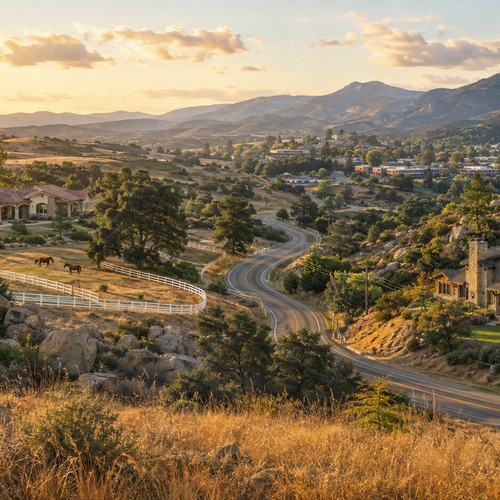

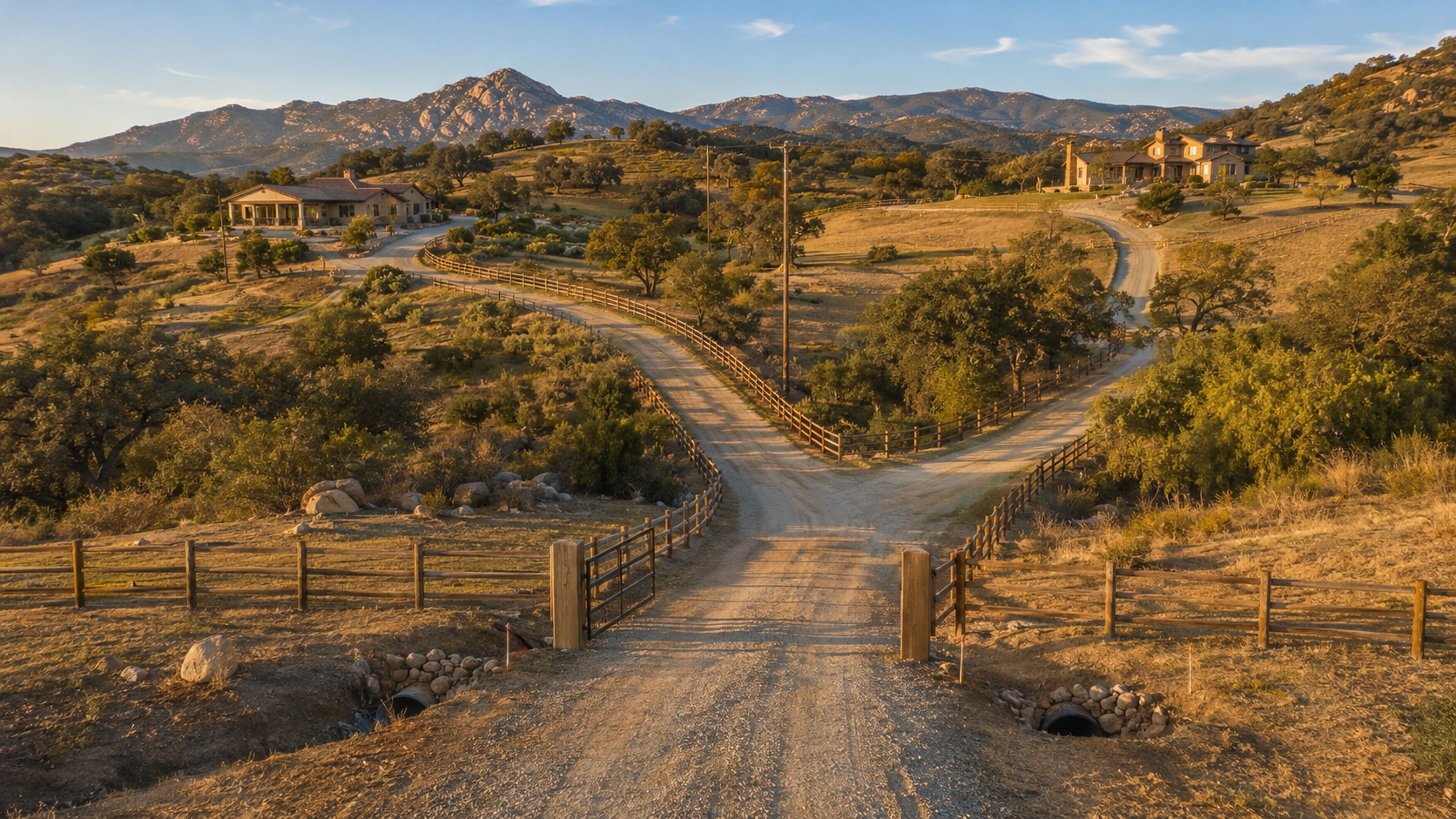
An easement gives a person, neighboring property, utility company or public agency a limited legal right to use land owned by someone else. The property owner generally retains ownership, but the easement can limit where structures, fences, gates, pools, septic systems, landscaping and other improvements may be placed.
Easements are especially important in Jamul because rural properties frequently depend on:
- Private roads
- Shared driveways
- Utility corridors
- Well access
- Shared wells
- Water lines
- Drainage channels
- Fire access
- Horse or livestock access
- Conservation areas
The most important easement questions are:
- Where is the easement located?
- What is its legal purpose?
- Who has the right to use it?
- Which property must accommodate it?
- How wide is it?
- Does it permit vehicles, utilities, animals or only limited access?
- Who pays for maintenance?
- Can gates, fences or landscaping be installed?
- Is the physical road or utility line actually inside the easement?
- Does the easement affect the property’s value, financing or future plans?
A preliminary title report may identify recorded easements, but it does not necessarily show their precise physical location. Determining location may require reviewing the recorded document, legal description, subdivision map and a professional survey.
Zachary and Rochelle Svelling of The Svelling Group serve as Jamul real estate “Knowledge Brokers.” They help rural sellers gather easement documents early, identify questions that may concern buyers and coordinate appropriate issues with title, escrow, survey and legal professionals.
This article provides general real estate information and is not legal advice. Easement interpretation and disputes should be handled by a qualified California real estate attorney.
What Is an Easement?
An easement is a nonpossessory interest that allows specified use of another person’s land or restricts how that land may be used.
San Diego County’s Recorder defines an easement as granting a right that one person has in another’s land. It may benefit another property, such as a right to cross, or exist “in gross,” such as a public utility easement. San Diego County Recorder document definitions
An easement does not normally transfer ownership of the affected land. It creates rights that exist alongside ownership.
Simple example
Owner A owns a home behind Owner B’s property. The only road to Owner A’s home crosses Owner B’s land.
An access easement may:
- Allow Owner A to cross Owner B’s property
- Describe the location and width of the access
- State whether the route is for vehicles, pedestrians or utilities
- Establish maintenance rights or responsibilities
- Limit gates or obstructions
Owner B still owns the underlying land, subject to Owner A’s easement rights.
Easement Terms You Should Know
Servient tenement
The servient tenement is the property burdened by the easement.
If a neighbor’s driveway crosses your property, your property may be the servient tenement.
Dominant tenement
The dominant tenement is the property benefiting from an appurtenant easement.
If your legal access crosses a neighbor’s property, your property may be the dominant tenement.
Easement holder
The easement holder is the person, entity or property entitled to use the easement.
Appurtenant easement
An appurtenant easement benefits a particular parcel and typically transfers with that property.
Easement in gross
An easement in gross benefits a person or entity rather than another neighboring parcel. Utility easements are common examples.
Right-of-way
A right-of-way is a type of easement generally associated with passage, roads, utilities or public infrastructure.
Encumbrance
An encumbrance is a claim, restriction or right affecting title. Easements are one type of encumbrance.
Legal description
The legal description defines the easement using measurements, bearings, parcel references, maps or other legal identifiers.
Easements Commonly Found on Jamul Properties
| Easement type | Common purpose | Potential concern |
|---|---|---|
| Private-road easement | Vehicular access to one or more parcels | Road condition and maintenance costs |
| Shared-driveway easement | Access serving neighboring homes | Parking, gates and daily use |
| Utility easement | Electric, telephone, internet or other utilities | Restrictions on structures and excavation |
| Water-line easement | Pipes carrying well or district water | Leak repairs and access |
| Well easement | Access to or use of a well on another parcel | Water rights, testing and maintenance |
| Drainage easement | Movement or management of stormwater | Grading, fencing and obstruction |
| Fire-access easement | Emergency vehicle access | Gate width, clearance and parking |
| Conservation easement | Protects habitat or open land | Limits development and vegetation removal |
| Equestrian easement | Horse access or trail use | Fencing, privacy and trail maintenance |
| Agricultural easement | Supports agricultural access or restrictions | Use limitations |
| Sewer easement | Sewer lines and maintenance access | Building and excavation limitations |
| View or light easement | Protects specified views or light | Height and construction restrictions |
| Slope easement | Supports or maintains graded slopes | Landscaping and retaining-wall limits |
| Public-road easement | Public travel or future road purposes | Setbacks and future improvements |
Why Easements Matter More on Rural Jamul Properties
A conventional suburban lot often fronts directly on a publicly maintained street with utilities available near the property line. A Jamul property may rely on a chain of private rights.
For example, a home may require:
- A private-road easement across several parcels
- A shared-road maintenance agreement
- A utility easement for electrical service
- A well easement on neighboring land
- A water-line easement back to the residence
- A drainage easement crossing the lower acreage
- A fire-access easement supporting emergency response
If one document is missing, unclear or inconsistent with actual use, the issue can affect marketability, lender review, insurance or a buyer’s future plans.
A beautiful home is difficult to sell confidently if no one can explain its legal access.
Private-Road Easements in Jamul
Private-road easements are among the most important rural-property issues.
A private road is not necessarily maintained by San Diego County. County standards define a private road as one that has not been declared or accepted for public use or County maintenance. San Diego County private-road standards
A private-road easement should answer:
- Which parcels have access?
- Where does the easement begin and end?
- How wide is it?
- Is it for vehicles and pedestrians?
- Does it include utilities?
- Is commercial traffic allowed?
- Can delivery trucks use it?
- Can horse trailers use it?
- Can guests and service providers use it?
- Who may install gates?
- Who pays for maintenance?
- Can the road be widened?
- Does the right include drainage work?
- Does the easement terminate or continue beyond the property?
The recorded easement width and the improved road width may be different.
For example:
- Recorded easement: 40 feet wide
- Actual gravel road: 16 feet wide
The property owner may not have a 40-foot-wide driving surface. The recorded easement may allow room for grading, drainage, utilities, slopes or future improvements.
Who Maintains a Shared Private Road in California?
Start with the recorded maintenance agreement.
A private-road maintenance agreement may allocate costs according to:
- Equal shares
- Number of parcels
- Road frontage
- Distance traveled
- Actual use
- Type of use
- A formal association
- A special formula
When no agreement controls, California Civil Code Section 845 states that owners of a private right-of-way or the land to which it is attached must maintain it in repair. When more than one owner is involved and no agreement exists, maintenance costs are generally shared proportionately to each owner’s use. The statute also addresses actions to recover unpaid shares. California Civil Code Section 845
The phrase “proportionately to use” can generate disagreement. Owners may debate:
- Whether the furthest parcel pays more
- Whether a horse facility creates more wear
- Whether construction traffic pays extra
- Whether vacant-land owners contribute
- Whether every repair is necessary
- Whether paving is maintenance or an improvement
- Who selected the contractor
- Whether emergency work was authorized
A written, current and workable agreement is valuable.
Private-Road Maintenance Agreement Checklist
A strong agreement may address:
- Covered parcels
- Legal description
- Road location
- Ownership
- Routine grading
- Gravel replacement
- Paving
- Potholes
- Dust control
- Culverts
- Drainage
- Brush clearance
- Gate maintenance
- Storm damage
- Emergency repairs
- Cost allocation
- Contractor selection
- Voting
- Collections
- Dispute resolution
- Insurance
- Record keeping
- Transfer to future owners
A real estate agent should not draft or interpret a legal maintenance agreement. An attorney can review whether the agreement is enforceable and adequate for the property.
Shared Driveway Easements
A shared driveway may serve two or more homes but cross only one owner’s land.
Daily conflicts can arise over:
- Parking
- Guest vehicles
- Trash cans
- Delivery trucks
- Gate codes
- Landscaping
- Snow is rarely an issue in Jamul, but storm debris may be
- Potholes
- Dust
- Speed
- Children
- Animals
- Construction vehicles
- Drainage
- Overnight obstruction
The easement language determines the legal rights. Neighboring custom does not necessarily expand or replace the recorded document.
A seller should not state, “The neighbor lets us use it,” when the property is supposed to have permanent legal access. Permission can be different from an easement.
Utility Easements
Utility easements allow an entity to install, access, maintain, replace or remove infrastructure.
They may serve:
- Electricity
- Telephone
- Cable
- Internet
- Natural gas
- Water
- Sewer
- Communications
- Drainage
Can you build over a utility easement?
Do not assume you can.
A utility easement may limit:
- Homes
- ADUs
- Garages
- Pools
- Retaining walls
- Barns
- Permanent sheds
- Septic components
- Large trees
- Fences
- Gates
- Grading
- Solar arrays
Even if the utility line does not appear to be in active use, the recorded rights may still exist.
Before planning an improvement:
- Obtain the easement document.
- Determine its location.
- Identify the easement holder.
- Contact the holder about the proposal.
- Consult County Planning & Development Services.
- Obtain a survey when needed.
- Secure required written approvals.
A utility’s informal field comment should not replace formal approval.
Well and Water-Line Easements
Some Jamul homes receive water from a well located on another parcel. Others own the well but send water through pipes crossing neighboring land.
These arrangements require more than a right to collect water.
A well or water-line agreement should ideally address:
- Ownership of the well
- Right to withdraw water
- Allocation among parcels
- Electricity costs
- Pump repairs
- Water testing
- Treatment
- Storage tanks
- Booster pumps
- Pipe replacement
- Emergency access
- Trenching rights
- Easement width
- New connections
- Drought or declining production
- Contamination
- Transfer to future owners
- Dispute resolution
Questions buyers should ask
- Is the well shared?
- Is the agreement recorded?
- Which parcel contains the well?
- Who pays the electric bill?
- What happens when the pump fails?
- Does the easement allow excavation for pipe replacement?
- Is the water line actually located inside the recorded easement?
- How is water allocated?
- Are there production and quality records?
- Can additional homes connect?
- Is there a storage tank?
- Does the agreement transfer with the property?
A water-line easement does not guarantee well production or potable water. The rights, physical system and water source must each be evaluated.
Drainage Easements
A drainage easement allows water to flow or permits a public agency, association or private party to maintain drainage facilities.
A drainage easement may contain:
- Natural channel
- Swale
- Culvert
- Storm drain
- Headwall
- Detention feature
- Erosion-control structure
- Underground pipe
Owners should avoid:
- Filling the drainage path
- Building over the easement
- Installing an obstructive fence
- Redirecting water
- Dumping soil or manure
- Planting roots that damage infrastructure
- Blocking maintenance access
- Converting the area without approval
San Diego County directs property owners to recorded easement searches and the County Survey Records System when researching public drainage facilities on private land. San Diego County drainage-easement resources
A dry swale in August may carry significant water during winter storms. Buyers should evaluate drainage under seasonal conditions whenever possible.
Fire-Access Easements
Fire access can be distinct from ordinary residential access.
A fire-access easement may regulate:
- Road width
- Graded width
- Surface
- Turnouts
- Turnarounds
- Gates
- Vertical clearance
- Vegetation
- Parking
- Bridges
- Weight capacity
- Address signs
Installing a beautiful gate across a shared private road can create legal and fire-access issues.
San Diego County zoning provisions governing gates across private-road easements require, in applicable circumstances, written consent from owners with access rights and review for fire-protection access. San Diego County Zoning Ordinance
Never park trailers, RVs, equipment or vehicles where they reduce required emergency access.
Equestrian and Trail Easements
An equestrian easement may allow riders and horses to cross private property. Rights can vary significantly.
The easement may allow:
- Horseback riding
- Pedestrian use
- Maintenance
- Trail improvements
- Access during specific hours
- Public use
- Use by specified neighboring parcels
It may prohibit:
- Motor vehicles
- Bicycles
- Commercial activity
- Widening
- Gates
- Fencing that obstructs passage
A trail visible on the land is not proof of a legal public easement. Conversely, a recorded trail easement may exist even when the path is overgrown and rarely used.
Sellers should not market “direct trail access” until they verify that the owner has a legal right to reach and use the trail.
Conservation and Open-Space Easements
A conservation easement protects natural, agricultural, scenic or habitat resources by limiting development or disturbance.
Restrictions may affect:
- Building
- Grading
- Vegetation removal
- Roads
- Fencing
- Fire clearing
- Animal keeping
- Agriculture
- Lighting
- Utilities
- Recreation
- Brush management
A conservation easement can preserve privacy and open views, but it can also reduce usable or developable acreage.
Important distinction
A 10-acre parcel containing a three-acre conservation easement is still a 10-acre parcel. It does not necessarily provide 10 acres available for a barn, ADU, arena, vineyard or solar installation.
Marketing should separate:
- Gross acreage
- Usable acreage
- Developable area
- Protected area
Fire and habitat requirements can sometimes conflict. Owners should not clear protected vegetation without guidance merely because it appears close to an improvement.
Recorded vs. Unrecorded Easements
Recorded easement
A recorded easement has been filed in the County’s official records. Recording provides public notice and allows the document to be found through title research.
The San Diego County Recorder maintains the Official Records Index, which can be searched for recorded documents. San Diego County Recorder
Unrecorded easement
An easement may potentially arise or exist without a currently located recorded document, depending on facts and law. Possible theories include:
- Express but unrecorded easement
- Implied easement
- Easement by necessity
- Prescriptive easement
- Equitable rights
- Prior recorded instruments not immediately indexed as expected
These are legal issues. Do not assume that unrecorded use is valid—or that the absence of an obvious document proves no rights exist.
Revocable license
A license is permission to use property and may be revocable depending on its terms. It is not automatically equivalent to a permanent easement.
A seller saying, “The neighbor has always allowed us through,” may be describing informal permission rather than legally protected access.
What Is a Prescriptive Easement?
A prescriptive easement may be claimed when land has been used in a manner meeting specific legal requirements for the required period.
Claims are highly fact-dependent. Issues may include whether use was:
- Open and notorious
- Continuous and uninterrupted
- Hostile or adverse
- Under a claim of right
- Permissive
Casual statements can damage a party’s position. A homeowner dealing with a potential prescriptive claim should consult a real estate attorney promptly.
A real estate agent cannot determine whether a prescriptive easement legally exists.
How Do You Find Easements on a Jamul Property?
Step 1: Review the preliminary title report
The title report may list recorded easements as exceptions.
Do not stop at the exception summary. Obtain the underlying document.
Step 2: Read the easement document
Review:
- Grantor
- Grantee
- Purpose
- Date
- Recording number
- Legal description
- Exhibits
- Term
- Maintenance provisions
- Restrictions
- Termination provisions
Step 3: Review maps
Relevant maps may include:
- Record of survey
- Parcel map
- Subdivision map
- Assessor map
- Easement exhibit
- Improvement plan
- Grading plan
- Septic layout
An assessor map is useful for identifying parcels but is not necessarily a survey of private rights.
Step 4: Compare documents with the property
Look for:
- Roads
- Gates
- Utility poles
- Water lines
- Culverts
- Trails
- Fences
- Wells
- Drainage channels
- Signs of regular access
Step 5: Obtain a professional survey
A licensed land surveyor can help locate easement boundaries and physical improvements.
Step 6: Consult the correct professional
Depending on the issue:
- Title officer
- Real estate attorney
- Land surveyor
- Civil engineer
- County planner
- Fire authority
- Utility company
- Septic professional
San Diego County’s mapping guidance states that private easements may be found in officially recorded deeds and recommends contacting a real estate attorney or title company for current legal ownership questions. San Diego County mapping services
Preliminary Title Report vs. Survey
| Preliminary title report | Survey |
|---|---|
| Identifies recorded title exceptions | Locates features and boundaries on the ground |
| May reference easement documents | May plot easement legal descriptions |
| Does not guarantee visible conditions | Does not determine every legal right |
| May not show exact physical road location | Shows relationship between road and easement |
| Prepared for title-insurance purposes | Prepared by a licensed land surveyor |
For complicated rural property, buyers may need both.
Easement vs. Encroachment
An easement is a legal right to use land. An encroachment is a physical improvement extending across a boundary or into an easement area without necessarily having the legal right to be there.
Common rural encroachments include:
- Fence across a property line
- Driveway outside its easement
- Barn over a boundary
- Retaining wall in a road easement
- Landscaping blocking drainage
- Gate obstructing shared access
- Water tank in a utility easement
- Septic component on neighboring land
A longstanding encroachment does not automatically become lawful. It should be evaluated before sale.
Can an Easement Be Moved?
Possibly, but generally not through unilateral action.
Relocating an easement may require:
- Consent from affected parties
- New legal description
- Survey
- New easement grant
- Abandonment or quitclaim of the old easement
- Utility approval
- County approval
- Fire-authority approval
- Lender consent
- Recording
Constructing a new road in a more convenient location does not automatically relocate the legal easement.
Can an Easement Be Removed?
An easement may terminate through methods such as:
- Written release
- Quitclaim
- Expiration
- Conditions in the original document
- Merger of ownership
- Abandonment under applicable law
- Court order
- Completion of its purpose
Nonuse alone may not terminate an easement.
A utility company may retain rights even when no visible utility equipment remains. Obtain legal and title guidance before treating an easement as abandoned.
Can You Fence or Gate an Easement?
Sometimes, but the fence or gate cannot unreasonably interfere with the easement holder’s rights.
The answer depends on:
- Easement language
- Type of access
- Gate width
- Locking method
- Fire access
- Shared-road agreement
- County regulations
- Rights of all users
A locked gate may be reasonable when every authorized user has reliable access. It may be unreasonable when it prevents required travel, deliveries, emergency response or utility maintenance.
Obtain written consent and required approvals before installing a gate across a shared route.
How Easements Affect Property Value
An easement can increase, reduce or have little effect on value.
Easements that may add practical value
- Legal road access
- Well access
- Water-line rights
- Utility service
- Trail access
- Secondary emergency access
Easements that may reduce buyer appeal
- Busy shared road near the home
- Public trail through private acreage
- Large utility corridor
- Conservation restriction
- Drainage area reducing usable land
- Neighbor access through primary yard
- Unclear maintenance obligation
- Road crossing horse facilities
- Building limitations
- Frequent commercial traffic
The impact depends on location, purpose, intensity, privacy and the buyer’s plans.
An easement crossing the remote corner of a 20-acre parcel may have little effect. The same easement through a patio or future ADU site may matter significantly.
Easements and Mortgage Financing
Lenders may evaluate whether a property has:
- Legal vehicular access
- Adequate physical access
- An acceptable road-maintenance agreement
- Utility rights
- Water rights
- Recorded easements
- Title-insurance coverage
- Unresolved disputes
Loan requirements vary by lender and loan program. A property with no clear legal access can be difficult to finance.
Sellers should address access documentation before accepting an offer rather than assuming the buyer’s lender will resolve it during underwriting.
Easements and Title Insurance
Title insurance may protect against certain covered title risks subject to the policy’s terms, exclusions and exceptions.
It does not automatically insure:
- Exact physical location of an easement
- Condition of a road
- Road-maintenance costs
- Well output
- Informal neighbor agreements
- Unrecorded physical conditions
- Every boundary issue
- Future disputes
Buyers should read the title report and proposed policy rather than assuming “title insurance covers everything.”
Easement Questions Jamul Sellers Should Answer Before Listing
- Does the property have legal access to a public road?
- Is the access public or private?
- Who owns the road?
- Who maintains it?
- Is there a written maintenance agreement?
- Is the agreement recorded?
- Are any owners behind on contributions?
- Is the physical road inside the easement?
- Are gates authorized?
- Do neighboring properties cross the parcel?
- Are utility lines within recorded easements?
- Is the well shared?
- Are water lines documented?
- Does a drainage easement cross the property?
- Are there conservation restrictions?
- Are horse trails legal?
- Has any easement dispute occurred?
- Do fences match the boundary?
- Do any buildings encroach?
- Are additions, barns or septic components located in easements?
- Have any easements been modified or relocated?
Documents Sellers Should Gather
- Preliminary title report
- Grant deed
- Easement deeds
- Road-maintenance agreement
- Shared-well agreement
- Water-line agreement
- Utility agreements
- Parcel map
- Subdivision map
- Record of survey
- Boundary survey
- Drainage plans
- Grading plans
- Septic layout
- Well records
- Gate agreements
- Conservation documents
- Dispute correspondence
- Maintenance invoices
- Road-repair receipts
Do not conceal an easement dispute by omitting informal communications. Discuss appropriate disclosure with legal and real estate professionals.
Preparing a Jamul Property With Easements for Sale
Step 1: Order title information early
Do not wait until after an offer is accepted.
Step 2: Obtain the actual easement documents
The short title description is rarely enough.
Step 3: Create an easement inventory
List the document, purpose, beneficiaries and property area affected.
Step 4: Compare the documents with physical conditions
Look for roads, fences, gates, lines and structures that do not appear to match.
Step 5: Locate maintenance agreements
Determine whether road, well or utility costs are current.
Step 6: Address access problems
Remove unauthorized obstructions and repair unsafe access where appropriate.
Step 7: Consult professionals
A survey or legal review completed before listing may prevent a larger escrow problem.
Step 8: Prepare clear marketing
Describe legal access and shared features accurately without interpreting rights beyond the documents.
Step 9: Complete disclosures
Disclose known disputes, maintenance issues and encroachments as required.
Step 10: Make the information easy to review
Organized records help buyers feel more confident about rural ownership.
Common Easement Mistakes
- Assuming the driveway is entirely on the property.
- Believing a visible road proves legal access.
- Treating permission as a permanent easement.
- Relying only on the assessor map.
- Ignoring title-report exceptions.
- Failing to obtain the actual recorded document.
- Assuming the County maintains every named road.
- Building an ADU inside a utility easement.
- Installing a gate without consent.
- Blocking fire access.
- Redirecting drainage.
- Planting trees over utility lines.
- Assuming a shared well includes water-line access.
- Advertising direct trail access without documentation.
- Confusing gross acreage with unrestricted acreage.
- Moving a road without relocating the easement.
- Assuming nonuse terminates an easement.
- Ignoring informal road-maintenance disputes.
- Waiting until escrow to investigate access.
- Letting an agent or neighbor provide legal conclusions.
Frequently Asked Questions About Easements in Jamul
Does an easement mean someone else owns part of my property?
Usually not. You generally retain ownership of the land, subject to the easement holder’s specified rights.
Can my neighbor drive across my property?
Only if the neighbor has a legal right, such as an easement, license or other enforceable access right. Review the documents rather than relying on assumptions.
Who pays to maintain a shared road?
Follow the recorded maintenance agreement. When no agreement applies, California Civil Code Section 845 generally provides for proportional sharing based on use.
Can I stop paying for a road I rarely use?
Do not stop paying without reviewing the agreement and obtaining legal advice. Your obligation may exist even if your current use is limited.
Can I install a gate across a private-road easement?
Possibly, but you may need consent from all affected owners and approval from the fire authority or County. The gate cannot improperly interfere with access.
Can I build over an easement?
Often not without approval. The answer depends on the easement’s purpose, language and holder. Consult the easement holder and County before planning construction.
Does a title report show every easement?
It may show recorded easements affecting title, subject to the report’s scope and exceptions. It may not reveal every possible unrecorded claim or locate the easement precisely on the ground.
Do I need a survey?
A survey may be particularly valuable when a driveway, fence, structure, well, septic system or planned improvement is close to a boundary or easement.
Is a private road the same as a private-road easement?
No. The physical road is the traveled surface. The easement is the legal right and described area supporting access. They may not occupy exactly the same location.
Can the public use a private-road easement?
Not automatically. Rights depend on the easement document, dedication status and applicable law.
Can an easement allow utility work without my permission?
A utility easement may give the holder rights to enter and maintain its equipment. The scope depends on the recorded document and applicable law.
Does a shared well easement guarantee water?
No. It may grant access or use rights, but it cannot guarantee well production, equipment condition or water quality.
Can easements expire?
Some contain expiration terms; many are perpetual. Nonuse alone does not necessarily terminate an easement.
Can I remove an old utility easement?
Only through an appropriate release, quitclaim or other lawful process. Contact the easement holder, title company and attorney.
Does an easement reduce my home’s value?
It depends on its purpose, location and effect. Access and utility easements may make the property functional, while intrusive or restrictive easements may reduce appeal.
Should I buy a Jamul property with easements?
Most rural properties have some easements. The key is understanding their location, scope, maintenance obligations and impact on your intended use before completing the purchase.
Questions Buyers Should Ask During Due Diligence
- Is access legally recorded?
- Is the road publicly or privately maintained?
- What did owners spend on road maintenance last year?
- Are there planned road repairs?
- Has anyone refused to contribute?
- Is the gate authorized?
- Can emergency vehicles reach the home?
- Can a horse trailer or delivery truck use the road?
- Are utilities located within easements?
- Are water rights and water-line rights documented?
- Does the easement allow repair excavation?
- Are drainage areas buildable?
- Does conservation land require special maintenance?
- Are any structures inside easements?
- Has a survey been completed?
- Have neighbors disputed use?
- Will the easement interfere with an ADU, pool, barn or arena?
- Will the lender and title insurer accept the access arrangement?
Why Easement Knowledge Matters When Selling in Jamul
Rural-property buyers are not only buying a house and acreage. They are buying a network of rights and responsibilities.
The property may depend on neighbors for:
- Access
- Water
- Utilities
- Road maintenance
- Drainage
- Emergency response
At the same time, neighboring owners or utility companies may have rights across the seller’s land.
Unclear easements can create fear. Properly documented easements can create confidence.
A knowledgeable listing strategy does not hide these issues. It explains them carefully, provides supporting records and directs legal questions to the correct professionals.
Work With Jamul Real Estate Knowledge Brokers
Zachary and Rochelle Svelling of The Svelling Group understand the questions that arise when selling Jamul acreage, horse properties, estates and homes reached by private roads.
As Jamul real estate Knowledge Brokers, Zachary and Rochelle help sellers:
- Order title information early
- Gather recorded easement documents
- Organize road-maintenance agreements
- Identify shared-well and water-line records
- Anticipate access and survey questions
- Explain public versus private roads
- Prepare for buyer and lender review
- Coordinate questions with title and escrow
- Recommend when legal or survey expertise is needed
- Market rural access and infrastructure accurately
If you are considering selling a Jamul home affected by a private road, shared driveway, utility easement, well agreement or conservation restriction, contact Zachary and Rochelle Svelling for a confidential property consultation.
The Svelling Group can help you uncover easement questions before they become escrow problems—and position your Jamul property with the clarity, preparation and local knowledge rural buyers expect.
Check out this article next