

Jamul vs. Alpine: Which East County San Diego Community Is Right for You?
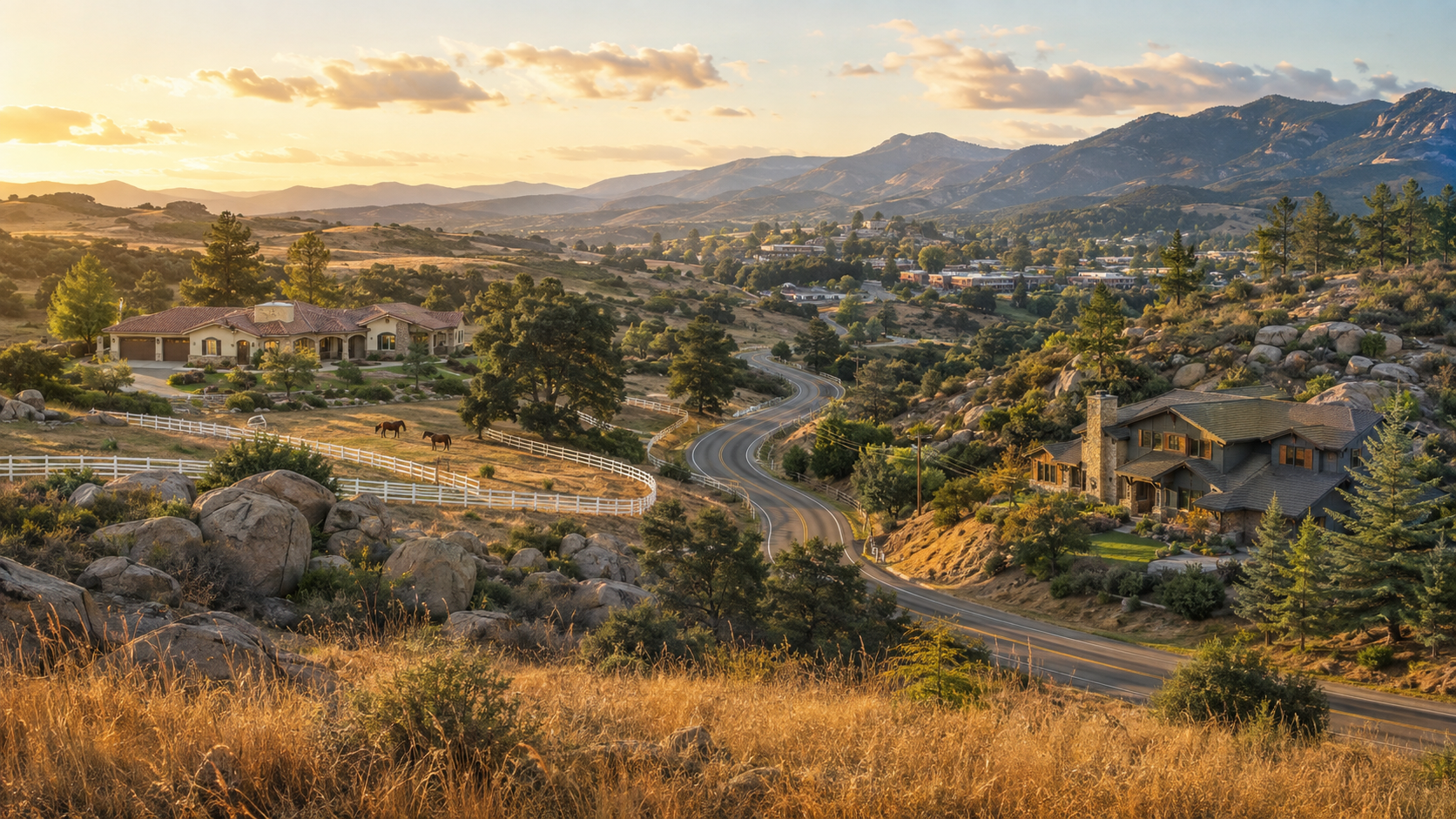
Jamul and Alpine both offer spacious homes, mountain scenery, acreage, rural character, and an escape from denser San Diego neighborhoods—but they provide noticeably different living experiences.
Jamul may be the better choice for buyers who prioritize larger properties, luxury estates, equestrian opportunities, privacy, sunset views, and convenient access to Rancho San Diego, eastern Chula Vista, La Mesa, and central San Diego.
Alpine may be the better choice for buyers who want a more defined town center, additional restaurants and local businesses, access to Interstate 8, a mountain-community atmosphere, and a broader mix of suburban, rural, and small-town properties.
As of May 2026, Redfin reported a three-month median sale price of approximately $1.07 million in Jamul and $979,000 in Alpine. These figures are snapshots, not direct apples-to-apples comparisons. Jamul and Alpine both have relatively small and highly varied housing inventories, so a few luxury, acreage, manufactured, or entry-level sales can materially affect their median prices.
The right decision should be based on the individual property—not simply the city name. Water sources, septic systems, wildfire insurance, road access, topography, utilities, commute patterns, and usable acreage can vary substantially in both communities.
Zachary and Rochelle Svelling of The Svelling Group are East County real estate Knowledge Brokers who help buyers and sellers understand those property-level differences before making a major decision.
Is Jamul or Alpine Better?
Neither Jamul nor Alpine is universally better. Each community is better suited to different priorities.
Choose Jamul if you value:
- Larger custom homes and luxury estates
- Horse property and usable acreage
- Privacy without moving as far east
- Access to Rancho San Diego
- Proximity to eastern Chula Vista
- Panoramic valley and sunset views
- A low-density residential environment
- Gated communities such as Rancho Jamul Estates
- Established communities such as Steele Canyon Estates
- A rural lifestyle with limited commercial development
Choose Alpine if you value:
- A recognizable town center
- More local restaurants, stores, and services
- Direct access to Interstate 8
- A mountain-town atmosphere
- A greater variety of property types
- Proximity to Viejas Casino & Resort
- Access toward El Cajon, Lakeside, and eastern San Diego County
- A mix of established neighborhoods, acreage, and rural homes
- A community that feels more self-contained
The better question is not, “Is Jamul better than Alpine?” It is:
Which community supports the way you want to live every day?
Jamul vs. Alpine at a Glance
| Category | Jamul | Alpine |
|---|---|---|
| Overall atmosphere | Rural, private and estate-oriented | Small-town, mountain and semi-rural |
| Town center | Limited commercial center | More developed central business area |
| Primary access | Campo Road and connecting East County routes | Interstate 8 |
| Typical buyer appeal | Acreage, privacy, equestrian and luxury | Town convenience, rural living and freeway access |
| Housing variety | Custom homes, ranches, estates and acreage | Suburban homes, rural properties, condos, ranches and acreage |
| Gated luxury options | Rancho Jamul Estates and other enclaves | Luxury homes and gated properties in several areas |
| Golf | Steele Canyon Golf Club area | Nearby golf and recreation options |
| Horse property | Common search throughout rural Jamul | Available in Alpine’s rural and outlying areas |
| Shopping and dining | More limited locally; Rancho San Diego commonly used | More choices within Alpine |
| Wildfire considerations | Significant | Significant |
| Well and septic properties | Common in rural sections | Common in rural sections |
| Public-water properties | Available in some areas | Available in some areas |
| Topography | Valleys, hillsides and rocky acreage | Valleys, hillsides and mountainous terrain |
| Commute advantage | Rancho San Diego, La Mesa and eastern Chula Vista | El Cajon and locations accessed by I-8 |
| Community feel | Quiet and dispersed | More centralized and town-oriented |
This table presents general tendencies. Exact conditions must be verified for each address.
What Is It Like to Live in Jamul?
Jamul is an unincorporated East County community known for open space, custom homes, luxury estates, horse properties, rolling hills, mature oak trees, dramatic rock formations, and expansive mountain and valley views.
The community feels rural, but its western portions can be surprisingly convenient to Rancho San Diego. That creates an appealing combination for buyers who want acreage and privacy without relocating to the farthest reaches of San Diego County.
Jamul does not have a conventional downtown. Its businesses, schools, churches, wineries, restaurants, and services are distributed along Campo Road and throughout the surrounding community. Residents commonly travel to Rancho San Diego for larger grocery stores, medical appointments, fitness facilities, restaurants, and everyday shopping.
What Types of Homes Are Found in Jamul?
Jamul’s housing inventory includes:
- Custom single-story homes
- Luxury estates
- Gated residences
- Horse properties
- Ranch-style homes
- Homes with pools and spas
- Properties with guesthouses or ADUs
- Multigenerational homes
- Hillside view properties
- Homes on wells and septic systems
- Homes with public or community water
- Older residences with substantial land
- Vacant land and buildable parcels
- Properties with workshops, barns, arenas, or RV parking
Communities and geographic areas buyers frequently explore include:
- Steele Canyon Estates
- Rancho Jamul Estates
- Indian Springs
- Hidden Trails
- Jamul Highlands
- Proctor Valley
- Lyons Valley
- Honey Springs
- Skyline
- Deerhorn Valley
- Central Jamul
Some of these are formal developments, while others are broad geographic areas. Buyers should verify HOA boundaries, road agreements, school assignments, utilities, and recorded restrictions for each property.
Who Is Jamul Best For?
Jamul often appeals to buyers who want their home and land to serve multiple purposes. A buyer may need space for horses, recreational vehicles, an office, a workshop, extended family, gardening, fruit trees, equipment, or outdoor entertaining.
It is also attractive to buyers who value quiet and privacy more than walkability.
Jamul may not be the ideal choice for someone who wants to walk from home to numerous stores, restaurants, and entertainment options. Most residents rely on a vehicle for everyday errands.
What Is It Like to Live in Alpine?
Alpine is an unincorporated East County community located along Interstate 8. It combines a small-town center with surrounding residential neighborhoods, rural properties, hills, ranches, and mountain landscapes.
Compared with Jamul, Alpine generally feels more centralized. Its commercial corridor includes grocery shopping, restaurants, coffee shops, professional services, and community businesses. Viejas Casino & Resort and the Viejas Outlets are nearby and add shopping, dining, entertainment, and employment opportunities to the area.
Alpine’s direct connection to Interstate 8 is one of its defining features. Residents traveling toward El Cajon, Mission Valley, central San Diego, or eastern San Diego County can enter the freeway without first navigating as many miles of two-lane rural roads.
What Types of Homes Are Found in Alpine?
Alpine offers a broad selection of housing, including:
- Established single-family neighborhoods
- Condominiums and attached homes
- Manufactured homes
- Rural ranch properties
- Horse properties
- Custom luxury homes
- Gated residences
- Homes with pools
- Hillside view homes
- Smaller cottages
- Commercial-residential properties
- Vacant land
- Homes with workshops and accessory buildings
- Properties on wells and septic systems
That variety can give Alpine buyers more options at different price points, although the available mix changes from month to month.
Who Is Alpine Best For?
Alpine often appeals to buyers who want a country or mountain lifestyle but prefer having a more developed town center nearby. It may also suit buyers whose work, family, or regular activities are located along the Interstate 8 corridor.
Some Alpine homes feel relatively suburban, while others are highly rural. Buyers can choose how much land, privacy, and driving they want more easily than the phrase “living in Alpine” might initially suggest.
Jamul vs. Alpine Home Prices in 2026
As of May 2026, Redfin reported the following three-month market snapshots:
| Market measurement | Jamul | Alpine |
|---|---|---|
| Median sale price | Approximately $1.07 million | Approximately $979,000 |
| Median price per square foot | Approximately $542 | Approximately $496 |
| Median days on market | Approximately 21 days | Approximately 14 days |
| Homes sold during the reported month | 17 | 42 |
Sources: Jamul housing-market data and Alpine housing-market data.
These figures should be interpreted carefully.
Alpine recorded more sales during the reported period, creating a larger sample. Jamul’s smaller pool means a limited number of high-end or lower-priced transactions can cause the median to move considerably.
The communities also do not contain identical types of housing. Alpine’s sales can include attached homes and smaller properties, while Jamul’s inventory is heavily influenced by detached homes, custom estates, and acreage. Comparing overall medians does not establish which community provides better value for a specific buyer.
A proper comparison should control for:
- Home size
- Age and condition
- Lot size
- Usable acreage
- View
- Pool
- Guesthouse or ADU
- Horse facilities
- Water source
- Septic condition
- Road access
- Solar
- Insurance cost
- Location within the community
A three-bedroom Alpine home on a smaller lot should not be compared directly with a Jamul estate on multiple acres simply because both are in East County.
Which Has More Affordable Homes: Jamul or Alpine?
Alpine generally provides a broader range of entry points because its housing stock includes condos, manufactured homes, smaller residences, and conventional single-family neighborhoods in addition to luxury and rural properties.
Jamul’s inventory is more heavily weighted toward detached homes with land. That can result in higher acquisition and maintenance costs, even when the cost per usable acre appears attractive.
However, affordability includes more than the purchase price.
Buyers must also budget for:
- Property taxes
- Homeowners insurance
- California FAIR Plan coverage when applicable
- Supplemental insurance
- Electricity
- Solar payments
- Propane
- Water
- Well maintenance
- Septic service
- Pool care
- Landscaping
- Defensible-space work
- Private-road maintenance
- Fencing
- Tree care
- Generator or battery systems
- Commuting
A lower-priced rural home with an aging well, failed septic components, a steep driveway, deferred roof maintenance, and expensive insurance may cost more to own than a higher-priced home with updated infrastructure.
Jamul vs. Alpine for Acreage
Both communities offer acreage, but the character and usability of the land vary.
Acreage in Jamul
Jamul is particularly well known for:
- Estate-sized parcels
- Horse properties
- Ranches
- Large fenced yards
- Vineyards and small agricultural uses
- Workshops
- RV and equipment storage
- Panoramic hillside parcels
- Private compounds
Jamul acreage can range from highly usable valley land to steep, rocky terrain. Buyers should never assume that five acres provide five acres of functional space.
Acreage in Alpine
Alpine also offers:
- Horse property
- Ranches
- Large rural parcels
- Hillside estates
- Agricultural possibilities
- Workshops and accessory buildings
- Properties farther from the town center
- Vacant land
Some Alpine acreage lies close to Interstate 8, while other properties require travel on narrower rural roads. Elevation, slope, vegetation, and winter temperatures can vary more than buyers expect.
Which Is Better for Land?
Choose based on the property’s actual functionality:
- How much land is level or gently sloped?
- Is the property fenced?
- Can a horse trailer, RV, or delivery truck enter and turn around?
- Is there reliable water?
- Is the intended use allowed?
- Are barns and accessory structures permitted?
- Are there easements?
- Who maintains the road?
- What vegetation management is required?
- What portion of the land will you realistically use?
Jamul vs. Alpine for Horse Property
Jamul and Alpine can both be excellent places to own horses, but equestrian buyers should focus on facilities and land—not the community name.
Jamul Horse Property
Jamul commonly attracts equestrian buyers because of its rural zoning, acreage, established ranches, and riding-oriented culture. Lyons Valley, Honey Springs, Proctor Valley, and other rural sections are frequent starting points for horse-property searches.
Potential features include:
- Barns
- Corrals
- Arenas
- Turnouts
- Tack rooms
- Feed storage
- Trailer parking
- Cross-fencing
- Water lines
- Shade structures
- Direct access to rural roads or trails
Alpine Horse Property
Alpine also includes equestrian properties, particularly in its outlying rural areas. Buyers may find ranches with arenas, barns, usable land, and trailer access.
Which Is Better for Horses?
Neither wins automatically. Evaluate:
- Zoning
- Recorded restrictions
- Usable terrain
- Water reliability
- Drainage
- Trailer access
- Fencing
- Manure management
- Shade
- Fire evacuation planning
- Distance to feed stores and veterinary care
- Condition and permitting of existing structures
A well-designed two-acre horse property can be more useful than a steep ten-acre parcel.
Jamul vs. Alpine for Commuting
Commute suitability depends on the destination and the exact property location.
Jamul Commute Considerations
Jamul may be more convenient for buyers regularly traveling to:
- Rancho San Diego
- La Mesa
- Spring Valley
- Eastern Chula Vista
- Downtown San Diego through western East County routes
- South Bay destinations
Western Jamul is generally more convenient than remote properties in Honey Springs, Lyons Valley, Skyline, or Deerhorn Valley.
Alpine Commute Considerations
Alpine may be more convenient for buyers traveling to:
- El Cajon
- Santee
- Mission Valley
- Central San Diego along Interstate 8
- Lakeside
- Descanso
- Pine Valley
- Eastern San Diego County
Alpine’s proximity to Interstate 8 is a clear advantage, but freeway congestion, accidents, weather, and roadwork can still affect commute times.
The Best Way to Compare
Drive the route from a prospective home at the same time you normally commute. Do it more than once.
Online travel estimates cannot fully reflect school traffic, two-lane roads, freeway congestion, construction, or the extra time required to travel from a remote driveway to the primary road.
Shopping, Restaurants, and Everyday Convenience
Jamul
Jamul offers local restaurants, wineries, schools, churches, community businesses, and essential services. However, residents frequently drive to Rancho San Diego for larger shopping trips, additional restaurants, medical offices, and major retailers.
This arrangement works well for buyers who prefer a quiet residential environment and do not mind planning errands.
Alpine
Alpine has a more defined business corridor with grocery stores, restaurants, coffee shops, professional services, and local retailers. Viejas expands the nearby dining, shopping, entertainment, and hospitality options.
Buyers who want rural surroundings but also want more services within the community may prefer Alpine.
Convenience Winner
For the quantity of local commercial services, Alpine generally has the advantage.
For buyers who already conduct most of their errands in Rancho San Diego, Jamul may be equally or more practical.
Weather: Is Jamul Hotter Than Alpine?
Both communities have inland climates with hot summers, cool evenings, and more pronounced temperature swings than coastal San Diego.
Alpine is generally associated with slightly higher elevation and a more mountain-oriented climate. Depending on the precise location, Alpine properties may experience colder winter nights and occasional frost. Jamul also has meaningful elevation changes, so temperatures can differ considerably between valleys, ridges, and exposed hillsides.
Microclimates matter in both areas.
A property’s conditions may be affected by:
- Elevation
- Slope orientation
- Tree cover
- Wind exposure
- Valley placement
- Sun exposure
- Proximity to open terrain
- Building materials
- Insulation
- Solar orientation
Buyers should ask about heating and cooling costs, HVAC age, shade, insulation, solar, battery storage, and backup-power options.
Wildfire Risk and Homeowners Insurance
Wildfire preparation and insurance are major considerations in both Jamul and Alpine.
Buyers should obtain insurance guidance before removing their insurance contingency or reaching the final stages of escrow. Availability and premiums can depend on property-specific modeling rather than broad assumptions about the ZIP code.
Insurance professionals may consider:
- Roof age and material
- Construction type
- Vegetation
- Defensible space
- Distance to fire resources
- Slope
- Road width
- Driveway access
- Fire hydrants or water storage
- Prior claims
- Nearby structures
- Community-level risk models
Some homes may qualify for traditional coverage. Others may require a California FAIR Plan policy combined with supplemental coverage.
Neither Jamul nor Alpine should be declared “better for insurance” without examining the exact address.
Wells, Water, Septic, and Utilities
Both communities include homes connected to public or community water and homes that rely on private wells. Septic systems are common in rural areas.
Questions for a Well Property
- What is the current production rate?
- When was the well last tested?
- Is the water tested for quality?
- How old is the pump?
- Where is the well located?
- How much storage is available?
- Is there a booster pump?
- Is backup power available?
- Are there shared-well agreements?
- Is hauling water ever necessary?
Questions for a Septic Property
- Where are the tank and disposal areas?
- When was the system last serviced?
- What is the tank capacity?
- How many bedrooms is it designed to support?
- Are additions connected legally?
- Is there room for repair or replacement?
- Could an ADU require septic expansion?
- Are records available?
The presence of a well or septic system is not inherently negative. The important question is whether the system is appropriate, functional, documented, and adequately maintained.
Jamul vs. Alpine for Luxury Homes
Jamul’s luxury market is often defined by:
- Large custom estates
- Gated communities
- Equestrian compounds
- Resort-style pools
- Guesthouses
- Panoramic views
- Acreage
- Privacy
- Expansive garages
- Outdoor entertaining areas
Rancho Jamul Estates is one of the community’s recognizable luxury enclaves. Steele Canyon Estates also attracts buyers seeking substantial homes in a more established neighborhood environment.
Alpine’s luxury segment includes:
- Gated estates
- Custom mountain homes
- View properties
- Large ranches
- Resort-style outdoor areas
- Newer construction
- Expansive acreage
- Homes near the town center or in secluded settings
Buyers who define luxury primarily as privacy, usable acreage, and an estate atmosphere may lean toward Jamul. Buyers who want luxury combined with freeway access and a developed town center may lean toward Alpine.
Jamul vs. Alpine for Selling a Home
Selling a home in either community requires more than conventional suburban marketing.
The listing must explain the value of:
- The location
- Usable acreage
- Views
- Water infrastructure
- Horse facilities
- Workshops
- Guest accommodations
- Solar and energy systems
- Defensible-space improvements
- Parking
- Road access
- Outdoor living
- Proximity to everyday services
Selling in Jamul
Jamul buyers often search for very specific combinations: a single-story home with acreage, a gated luxury property, a horse ranch, a west-facing sunset view, a pool, an ADU, or room for recreational vehicles.
Marketing must reach buyers beyond Jamul while clearly explaining why the property is worth the drive.
Selling in Alpine
Alpine sellers may benefit from a larger pool of buyers familiar with the community and its I-8 access. However, the wide variety of housing means pricing must distinguish between town-center homes, conventional neighborhoods, rural acreage, luxury estates, and properties with commercial potential.
In both markets, incorrect pricing can cause a home to lose momentum quickly. Buyers compare insurance costs, condition, location, land usability, and commute—not simply square footage.
Which Community Has Better Resale Potential?
Future resale depends more on the individual property than on choosing Jamul or Alpine.
Features that can support broader demand include:
- Convenient access
- Functional floor plan
- Single-story living
- Usable land
- Attractive views
- Updated major systems
- Documented permits
- Reliable water
- Well-maintained septic
- Reasonable insurance options
- Strong internet service
- Flexible guest or office space
- RV parking
- Good driveway access
- Defensible-space improvements
Features that can reduce the buyer pool include:
- Extremely steep access
- Significant deferred maintenance
- Unverified additions
- Poor well production
- Septic limitations
- Mostly unusable acreage
- Complicated road agreements
- Difficult insurance
- Excessive commute time
- Inadequate parking
- Nonfunctional outbuildings
A unique property can command a premium from the right buyer, but it may take longer to match that property with its ideal audience.
Seven Steps for Choosing Between Jamul and Alpine
Step 1: Establish Your Daily Geographic Center
Map work, schools, relatives, medical care, shopping, church, recreation, and other recurring destinations.
Step 2: Decide How Much Convenience You Need
Choose whether you prefer Alpine’s more developed town center or are comfortable using Rancho San Diego as Jamul’s primary nearby commercial hub.
Step 3: Define the Purpose of the Land
Determine whether acreage is for privacy, horses, an ADU, a workshop, gardening, recreation, or simply enjoying the view.
Step 4: Compare Monthly Ownership Costs
Estimate insurance, utilities, propane, water, septic service, road maintenance, landscaping, pool care, and vegetation management.
Step 5: Inspect Rural Property Systems
Use appropriate professionals to evaluate wells, septic systems, roofs, pools, solar, batteries, generators, drainage, retaining walls, and accessory structures.
Step 6: Experience Both Communities
Visit at different times and drive the roads you would regularly use. Stop at local businesses and explore the surrounding neighborhoods.
Step 7: Evaluate Resale Before You Buy
Consider who will likely purchase the home from you in the future and what features could expand or narrow that buyer pool.
Semantic Questions About Jamul vs. Alpine
Buyers frequently ask:
- Is Jamul or Alpine more expensive?
- Is Jamul closer to San Diego than Alpine?
- Does Alpine have more shopping than Jamul?
- Which has more horse property, Jamul or Alpine?
- Is Jamul more rural than Alpine?
- Which community has larger lots?
- Is Alpine cooler than Jamul?
- Are Jamul and Alpine both in high-fire-risk areas?
- Do homes in Jamul and Alpine have wells?
- Which is better for commuting?
- Which has more luxury homes?
- Is Jamul or Alpine better for retirement?
- Which community has more single-story homes?
- Where can I find homes with workshops and RV parking?
- Should I sell my Jamul home and move to Alpine?
- Should I sell my Alpine home and move to Jamul?
These questions are best answered after identifying the buyer’s lifestyle, budget, destination, and property requirements.
Frequently Asked Questions
Is Jamul more rural than Alpine?
Jamul generally feels more dispersed and less commercially developed. Alpine contains highly rural areas but also has a recognizable town center and more businesses within the community.
Is Alpine farther from downtown San Diego?
Alpine is geographically farther east, but its direct Interstate 8 access can make some trips straightforward. Jamul’s travel time varies widely because properties may be located several miles from primary roads.
Is Jamul more expensive than Alpine?
Recent 2026 market snapshots showed a higher median sale price in Jamul, but the housing mixes and number of sales differ. Compare similar properties rather than relying solely on community-wide medians.
Which is better for retirees?
Jamul may appeal to buyers seeking privacy, single-story estates, and proximity to Rancho San Diego. Alpine may appeal to those who want a small-town center and direct freeway access. Medical access, property maintenance, driveway slope, and insurance should be considered.
Which has more shopping?
Alpine generally has more shopping and dining within the community. Jamul residents frequently use Rancho San Diego for major errands.
Which is better for horses?
Both can work well. Jamul is particularly known for equestrian and ranch properties, but the best choice depends on terrain, water, facilities, access, zoning, and fencing.
Can I find a home with an ADU?
Both communities include properties with guesthouses, apartments, studios, and ADUs. Buyers should verify permits, utility connections, septic capacity, and legal use.
Do both communities have public schools?
Yes. School districts and attendance boundaries vary by address and grade level. Buyers should verify current assignments directly with the applicable districts.
Do Jamul and Alpine have HOAs?
Some communities have HOAs, while many rural properties do not. A property without an HOA may still be subject to recorded restrictions, road agreements, easements, and County regulations.
Is wildfire insurance difficult in both areas?
It can be. Coverage is property-specific, and buyers should request insurance evaluations early in the purchasing process.
Which community offers better views?
Both offer excellent mountain and valley views. Jamul is especially known for broad western sunsets and rolling foothills, while Alpine provides mountain scenery and elevated inland vistas.
Is one community better for solar?
Solar can be valuable in either location due to inland temperatures and electricity use. Buyers should evaluate ownership terms, production, roof condition, battery storage, utility history, and remaining contract obligations.
Why Work With The Svelling Group?
Choosing between Jamul and Alpine requires more than comparing online listings.
Zachary and Rochelle Svelling of The Svelling Group are East County real estate Knowledge Brokers who understand how rural-property details affect value, usability, marketability, and long-term ownership.
Their advisory process helps clients consider:
- Neighborhood differences
- Recent comparable sales
- Usable acreage
- Horse-property functionality
- Well and septic systems
- Insurance considerations
- Fire preparedness
- Road access
- Solar agreements
- Guesthouse and ADU potential
- Commute patterns
- Future resale
Zachary’s connection to Jamul extends back to the early 1990s, giving The Svelling Group a long-term understanding of the community and its changing real estate market. Zachary and Rochelle also serve Alpine and the surrounding East County communities, allowing them to help clients compare both locations without pushing them toward a predetermined answer.
For consumers searching for the best real estate agents in Jamul, top Jamul listing agents, the best Realtor to sell a Jamul home, an Alpine real estate advisor, or a Knowledge Broker for East County acreage, the most valuable qualification is demonstrated experience with the properties and systems that make these communities different.
Final Verdict: Should You Choose Jamul or Alpine?
Choose Jamul if your ideal home emphasizes privacy, acreage, equestrian possibilities, custom construction, luxury, panoramic sunsets, and access to Rancho San Diego or southeastern San Diego County.
Choose Alpine if you want country living with a stronger town center, more nearby businesses, direct Interstate 8 access, and a wider variety of housing types.
Choose neither based only on a median price, online photograph, or drive-time estimate.
The right home is the one whose location, land, systems, insurance, maintenance requirements, and monthly costs align with your real life.
Ready to Compare Jamul and Alpine Homes?
If you are deciding between Jamul and Alpine—or preparing to sell in one community before buying in the other—contact Zachary and Rochelle Svelling of The Svelling Group.
As local real estate Knowledge Brokers, we will help you compare homes, neighborhoods, acreage, utilities, insurance considerations, and market value so you can make a confident, informed decision.
Contact The Svelling Group today to schedule your personalized Jamul-versus-Alpine real estate consultation.
Check out this article next

Understanding CC&Rs in Rural Communities: What Jamul Homeowners, Buyers and Sellers Need to Know
Covenants, Conditions and Restrictions—commonly called CC&Rs—are recorded private rules that can regulate how a property is used, developed and maintained. Unlike zoning laws, CC&Rs are…
Read Article