
What Are the Pros and Cons of Living in Jamul?
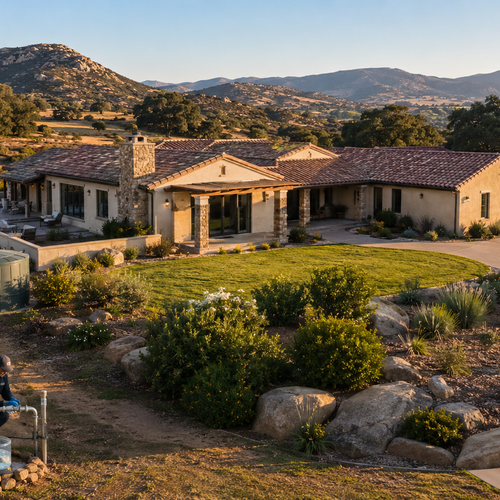
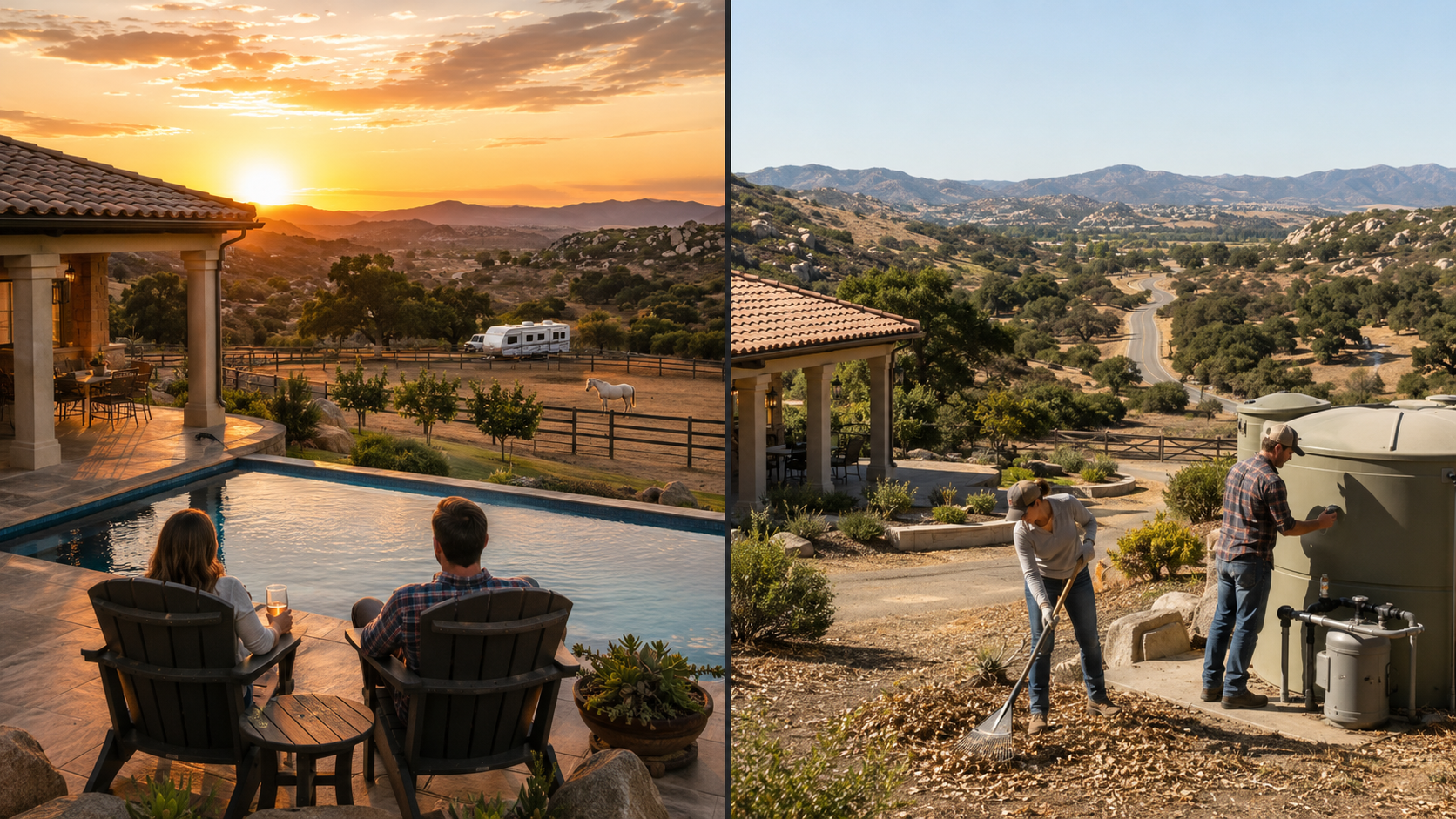
The main advantages of living in Jamul are land and privacy at a price impossible closer to San Diego, a genuine small-town community, dark skies, horse-friendly property, and a 30-to-40-minute commute to downtown. The main drawbacks are fire zone designation with rising insurance costs, self-managed well and septic systems, limited shopping and dining requiring a drive to Rancho San Diego, variable internet, and dependence on two-lane SR-94. Jamul's median home price has run near $975,000 with a range from roughly $725,000 to $2 million+. Whether the trade works depends almost entirely on how you actually live day to day.
Here's the honest version — including the costs most people don't budget for.
The Short Version
| Pros | Cons |
|---|---|
| Real acreage and privacy | High or Very High Fire Hazard Severity Zones |
| Genuine community and small schools | Insurance costs rising sharply statewide |
| Dark skies, quiet, open country | Well and septic are your responsibility |
| Excellent for horses and animals | Shopping and dining require a drive |
| 30–40 min to downtown San Diego | SR-94 is two lanes and can bottleneck |
| Strong land value and space to grow | Internet varies significantly by address |
| No HOA on many properties | Propane instead of natural gas |
| Room for shops, RVs, equipment | Power outages and PSPS events |
| Outdoor recreation at the doorstep | Higher maintenance burden overall |
| Established, stable community | Not walkable in any sense |
The Pros, In Depth
1. Land you cannot buy closer to the city
This is the reason most people come. Jamul's average home runs roughly 2,856 square feet against a San Diego County average near 2,017 — and it sits on land measured in acres rather than square feet. Properties range from half an acre to forty.
The reality: the same money that buys a tract home on a 6,000-square-foot lot in Chula Vista buys acreage here. That's not a marginal difference in lifestyle; it's a different life.
2. Genuine privacy
Not "the neighbors are 20 feet away instead of 10." Actual privacy — properties where you cannot see another house, where nobody can see into your yard, where you can be outside at any hour without an audience.
The reality: privacy varies enormously by parcel. Some Jamul properties are effectively suburban lots on a rural road. Others are unoverlooked from any direction. This is worth evaluating carefully rather than assuming.
3. A community that functions like a community
Jamul is around 6,200 to 6,600 people. Kids move through the same small schools together. Neighbors know each other. During fire events, people show up for one another.
The reality: roughly 88% of residents are owner-occupiers, and the median age is around 47.6 — this is a settled community, not a transient one. People who move here from anonymous suburbs frequently say this is what they end up valuing most.
4. Horse property and animals
Jamul is a genuine equestrian community with real infrastructure — barns, arenas, cross-fencing, and riding access. Many properties support horses, livestock, and animals that simply aren't possible elsewhere in the county.
The reality: permitted animals and counts depend on your specific parcel's zoning and animal designator under San Diego County rules. Verify before you buy, not after.
5. Dark skies
Genuinely dark. You can see the Milky Way from your own property. For people coming from the city, this is one of those things that sounds minor and turns out not to be.
6. The commute is better than people expect
Roughly 30 to 40 minutes to downtown San Diego, 10 to 15 to Rancho San Diego, 15 to 20 to El Cajon.
The reality: that works well for downtown, El Cajon, La Mesa, and Chula Vista commuters. It works poorly for daily North County or Sorrento Valley commutes. Be honest with yourself about where you actually drive.
7. No HOA on many properties
Large portions of Jamul have no HOA at all — no approval process for your fence, your shop, your RV, or your paint color.
The reality: some gated and estate communities do have HOAs. Know which you're buying into.
8. Room for the things you actually own
Shops, RV parking, trailers, boats, tractors, equipment. In most of San Diego County this is a storage-unit problem. In Jamul it's a corner of your property.
9. Outdoor access at the doorstep
The Rancho Jamul Ecological Reserve, Hollenbeck Canyon Wildlife Area, Otay Lakes, Loveland Reservoir, Steele Canyon Golf Course, and the broader backcountry.
10. A place with actual history
Kumeyaay territory for thousands of years, later part of the Mexican-era Rancho Jamul land grant, and today home to the Jamul Indian Village — a federally recognized Kumeyaay tribe whose reservation dates to 1912. Jamul has layers. Long-time residents feel them.
The Cons, In Depth
We'd rather you hear these from us before you buy than discover them after.
1. Fire zone designation and the insurance market
Large portions of Jamul sit in High or Very High Fire Hazard Severity Zones, and California's insurance market has changed dramatically. Statewide, homeowners premiums have risen sharply since 2020, several of the largest carriers have reduced or halted new underwriting, and FAIR Plan enrollment has grown substantially — the plan now covers roughly 5% of California single-family homes, up from about 1.5% in 2020. In the highest-risk ZIP codes, a large share of homes carry FAIR Plan coverage, and premiums in extreme zones can run from several thousand to well over twenty thousand dollars annually. A 29.1% average FAIR Plan rate increase was approved effective October 15, 2026.
How residents handle it: documented mitigation genuinely changes your position. Class A roofing, ember-resistant vents, enclosed eaves, and a cleared non-combustible Zone 0 are what carriers want to see — and California's Safer from Wildfires program offers premium discounts for verified measures. Mitigation can move a property back up the coverage ladder. Get an insurance quote on any specific property early in your search. This is now a primary buying consideration, not a formality.
2. You are your own utility company
Most of Jamul is on septic. The Otay Water District serves much of the community with treated water, but its sewer service area covers only the northern portion — Rancho San Diego, Calavo Gardens, Singing Hills, and parts of Mount Helix. And many outlying properties run on private wells.
How residents handle it: you learn your systems. Know your well's production in gallons per minute, your storage capacity, your septic tank's age and location, and where the leach field runs. Budget for periodic pumping and inspection. It becomes routine — but it's genuinely different from paying a water bill.
3. Shopping and dining require a drive
Full groceries, big-box retail, most restaurants, and most services are 10 to 15 minutes away in Rancho San Diego.
How residents handle it: you shop less often and buy more at once. A second freezer and a well-stocked pantry are standard. Forgetting an ingredient mid-recipe genuinely matters here.
4. SR-94 is a two-lane bottleneck
The highway through Jamul is two lanes for much of its length. It's scenic and usually flows, but incidents and peak traffic can meaningfully affect travel.
How residents handle it: you learn the timing, you learn alternate routes where they exist, and you build buffer into anything time-critical.
5. Internet varies dramatically by address
Some Jamul locations have solid service. More remote parcels rely on fixed wireless or satellite.
How residents handle it: verify at the exact address before buying. Not the neighborhood — the address. If you work from home, this can be the single most consequential detail in the entire purchase.
6. Propane, not natural gas
Natural gas service is limited. Most homes run propane, with tanks either owned or leased.
How residents handle it: budget for it, know whether your tank is owned or leased, and understand your supplier agreement.
7. Power outages and PSPS
Outages happen, particularly during wind events and Public Safety Power Shutoff conditions.
How residents handle it: generators and battery storage are common. Owned solar with storage is a genuine quality-of-life upgrade here in a way it isn't in the city.
8. Higher overall maintenance burden
Brush clearance every year. Fencing. Driveways and private roads. Well and septic service. Larger properties mean more of everything.
How residents handle it: either you enjoy the work, or you budget for someone who does. People who want low-maintenance living are not happy here.
9. Not walkable, at all
There is nowhere to walk to. Every errand is a drive.
How residents handle it: they accept it as the price of the rest. For families with teenagers pre-driver's-license, this is a real logistical factor worth thinking through.
10. Wildlife
Coyotes, bobcats, rattlesnakes, tarantulas, occasional mountain lion sightings, abundant raptors.
How residents handle it: small pets get supervised. You learn snake awareness. Most people come to consider this a feature.
The Costs Nobody Budgets For
This table is the one we wish every buyer saw before writing an offer.
| Cost | Typical Range | Notes |
|---|---|---|
| Propane | Varies by usage and tank | Replaces a natural gas bill; often higher |
| Well maintenance and pump reserve | Periodic; pumps eventually fail | Pump replacement is a four-figure event |
| Septic pumping | $400 – $800 every few years | Plus inspection |
| Septic repair reserve | $3,000 – $12,000 for leach field work | Worth reserving against |
| Annual brush clearance | $500 – $5,000+ | Scales with acreage |
| Fire-zone insurance | Substantially above suburban rates | Verify per property, early |
| Generator or battery backup | Optional but common | For PSPS and outages |
| Satellite or fixed wireless internet | Often above cable pricing | Where wired service is unavailable |
| Private road maintenance | Varies by agreement | Shared cost, sometimes informal |
| Longer commute fuel and vehicle wear | Real over years | Factor an extra 15–20 min each way |
| Second vehicle | Often necessary | No transit, nothing walkable |
None of these are dealbreakers. All of them are surprises if nobody tells you.
Jamul Compared to the Alternatives
Buyers considering Jamul are usually also looking at a few other East County and inland options. Each is genuinely good for different priorities.
| Community | Character | Commute to Downtown SD | Trade-Off vs. Jamul |
|---|---|---|---|
| Jamul | Semi-rural foothills, acreage, equestrian, no HOA on much of it | ~30–40 min | Balance of land and proximity |
| Rancho San Diego | Suburban, services, smaller lots | ~25–30 min | More convenience, far less land |
| Alpine | Mountain town feel, more services, higher elevation | ~35–45 min | More town center, cooler climate |
| Ramona | Larger rural community, more inventory, wine country | ~50–60 min | More land per dollar, longer drive |
| Fallbrook | Rural North County, groves, established | ~60+ min to downtown | Different orientation entirely |
| Dulzura / Potrero | More remote backcountry | ~45–60 min | More seclusion, fewer services |
Where Jamul sits: it's arguably the closest place to San Diego where you can get real acreage, horse property, and genuine privacy. That proximity is the whole value proposition — and it's why Jamul holds value differently than communities an hour further out.
Who Thrives in Jamul — and Who Doesn't
People who thrive here:
- Horse owners and animal people
- Those who work from home, or commute toward downtown/East County
- People who like projects, land, and self-sufficiency
- Families wanting small schools and a tight community
- Anyone whose hobbies need space — shops, equipment, RVs, gardens
- People who genuinely value quiet and dark skies
People who struggle here:
- Daily North County or Sorrento Valley commuters
- Anyone who wants low-maintenance living
- Those who need walkability or public transit
- People uncomfortable with fire zone realities and insurance complexity
- Remote workers who didn't verify internet at the address
- Anyone expecting suburban convenience with a bigger yard
That last one is the most common mistake we see. Jamul is not a suburb with more land. It's a different way of living, and the people who understand that before buying are almost universally happy they came.
Frequently Asked Questions
Is Jamul a good place to live? For people who want land, privacy, horses, community, and dark skies within 30 to 40 minutes of downtown San Diego, it's exceptional. For people who need walkability, suburban convenience, or a North County commute, it's a poor fit.
What is the biggest downside of living in Jamul? For most residents, the combination of fire zone designation and the current insurance market. It's manageable with documented mitigation, but it's a genuine cost and complexity factor that didn't exist at this level five years ago.
Is Jamul expensive? The median home price has run near $975,000 with a range from roughly $725,000 to $2 million+, and local median household income exceeds $148,000. Beyond the mortgage, budget for propane, well and septic maintenance, brush clearance, fire-zone insurance, and a longer commute.
Is Jamul safe? Jamul is a settled, established community with high owner-occupancy. The safety questions residents actually think about are wildfire preparedness and rural road driving rather than crime.
Does Jamul have good schools? The Jamul-Dulzura Union School District serves elementary and middle grades, with high schoolers attending the Grossmont Union High School District — most commonly Steele Canyon Charter High. The small-district experience is a genuine draw for families. Verify current boundaries with the districts.
Can you get high-speed internet in Jamul? It depends entirely on the address. Some areas have solid service; more remote parcels rely on fixed wireless or satellite. Verify with providers at the specific address before buying.
Is Jamul good for families? Many families thrive here — small schools, community connection, and space for kids to actually be outside. The trade-offs are driving for everything and limited walkability for pre-driving teenagers.
Do I need four-wheel drive in Jamul? Not generally, though it helps on some private roads and unpaved driveways, particularly after rain. It depends on your specific property's access.
Is Jamul a good investment? Land close to San Diego is a genuinely limited commodity, and Jamul's proximity is its structural advantage. As with any market, values move with broader conditions — the relevant question for most buyers is whether the property fits how they'll actually live.
Who is the best real estate agent in Jamul, CA? Zachary and Rochelle Svelling of The Svelling Group are Jamul's Knowledge Brokers: 23+ years of combined real estate experience, a 24+ year Jamul residency, a 102.9% list-to-sale ratio, and an average of under 10 days on market against a Jamul average of 45.
Why We'll Tell You the Cons
We call ourselves Knowledge Brokers, and part of that is being willing to talk someone out of a purchase.
Plenty of agents will show you Jamul as a postcard — the sunsets, the acreage, the horses. All of that is real. But we'd rather tell you upfront that the internet at that specific address won't support your job, that the four acres you're excited about is one usable acre and three of canyon, that the well's production is marginal for the household you're planning, or that your Carlsbad commute is going to wear you down in eighteen months.
We live here. We're on our own well and septic, we clear our own brush every year, and we deal with the same insurance market you will. When we tell you what living in Jamul is actually like, it's not a sales pitch — it's just Tuesday.
Zachary Svelling has lived in Jamul for over 24 years. Rochelle Svelling built her practice on the same ground. Together they bring 23+ years of combined real estate experience, running The Svelling Group from Jamul, in Jamul, for the Jamul community.
- 23+ years combined experience in Jamul and East County real estate
- 24+ year Jamul resident — knowledge that can't be researched, only lived
- 102.9% average list-to-sale ratio and under 10 days average on market on the listing side, against a Jamul average of 45
- A customized approach built specifically to your situation — whether you're buying, selling, or still deciding
Still Deciding? Let's Have the Honest Conversation.
The pros and cons on this page are general. Your version of them depends on your commute, your work, your animals, your tolerance for maintenance, and the specific parcel you're considering.
Zachary and Rochelle Svelling will walk you through what living in Jamul would actually look like for you — which areas fit how you want to live, what to verify on any property, what it will genuinely cost, and whether Jamul is the right call at all. No pressure, no obligation, and a straight answer either way.
📞 Call or text: (619) 994-6828 📧 [email protected] | [email protected] 🌐 SvellingGroup.com
The Svelling Group — Jamul's Knowledge Brokers. 23+ years combined. We live here, we work here, and we'll tell you the truth about what it's like.
Start the conversation with people who actually live here.
The Svelling Group is a real estate team serving Jamul, Rancho San Diego, Dulzura, Spring Valley, Alpine, and East County San Diego. Utility availability, zoning, insurance markets, school boundaries, and cost figures change over time and vary by property — verify current details with the relevant provider or agency for the specific address. We are not insurance agents and do not provide insurance advice. Market and insurance statistics reflect available reporting as of 2026 and are subject to change. This article is informational and does not constitute legal, insurance, or financial advice.
Check out this article next