

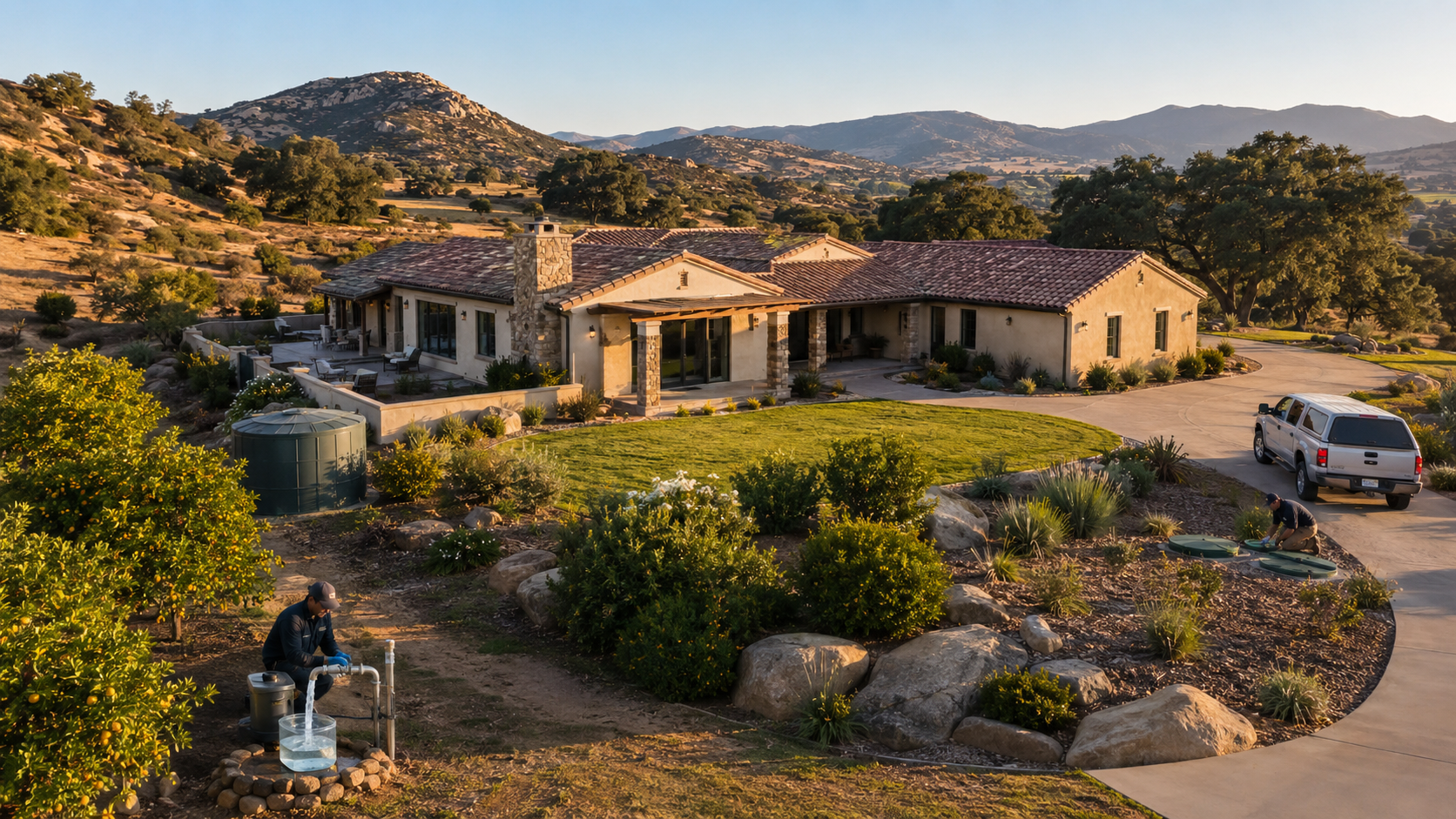
How Do You Sell a Home With a Well and Septic System?
To sell a home with a well and septic in Jamul, document both systems before listing: a well flow test showing gallons per minute, current water quality testing, the well permit and drilling log, a septic inspection with certification, and pumping records. Lender requirements vary sharply — conventional loans are the most flexible, while FHA, VA, and USDA impose water testing and minimum well-to-septic separation distances that can disqualify a property outright. Zachary and Rochelle Svelling of The Svelling Group resolve every one of these before launch, which is why their listings average under 10 days on market at 102.9% of list against a Jamul average of 45.
This is the most technical part of selling in Jamul, and the part where the most deals die. Here's the full picture.
Why This Matters More in Jamul Than Almost Anywhere in San Diego County
The Otay Water District serves much of Jamul, drawing from the Colorado River, the State Water Project, and local supplies including Carlsbad desalination. But the District's sewer service area covers only the northern portion of its territory — Rancho San Diego, Calavo Gardens, Singing Hills, and parts of Mount Helix. Properties in the basin not served by a sewer agency dispose of sewage through septic tanks.
In practice, that means most of Jamul is on septic, and a substantial share of properties in the outlying valleys — Lawson Valley, Lyons Valley, Deerhorn Valley, and along Skyline Truck Trail — are on private wells as well.
So the two systems that a tract-market seller never thinks about are, in Jamul, frequently the two things that determine whether your sale closes.
Part One: The Well
What Buyers and Lenders Need to See
| Document | Why It Matters | Typical Lead Time |
|---|---|---|
| Flow / production test (gallons per minute) | The core question: will this well supply the household? | 1–2 weeks to schedule |
| Water quality / potability test | Coliform bacteria, nitrates, and other contaminants | 1–2 weeks including lab turnaround |
| Well permit and drilling log | Depth, casing, construction, date drilled | Days to weeks if records must be located |
| Pump and pressure tank detail | Age, horsepower, condition, service history | Immediate if you have records |
| Storage tank capacity | Buffers low-production wells; a genuine asset | Immediate |
| Shared well agreement | Required by most lenders if the well is shared | 1–4 weeks if informal or undocumented |
| Treatment or filtration equipment | Softeners, UV, reverse osmosis, iron filters | Immediate |
Understanding Production: What GPM Actually Means to a Buyer
Well production is measured in gallons per minute, and it is the number a buyer's agent asks about first.
| Production Range | Practical Meaning | Effect on Sale |
|---|---|---|
| Under 1 GPM | Very low; requires substantial storage and careful management | Significantly narrows the buyer pool |
| 1–3 GPM | Low but workable for a household with storage | Manageable with documentation and storage in place |
| 3–5 GPM | Generally meets government-backed loan expectations | Broad buyer pool |
| 5–10 GPM | Comfortable for a household plus landscaping | Strong |
| 10+ GPM | Supports household, landscaping, and livestock | A genuine selling asset — market it |
Government-backed loan programs generally expect a private well to deliver a sustained flow in the range of 3 to 5 gallons per minute, though specifics vary by program and local code. Storage capacity can compensate for lower production, which is exactly why documenting your tanks matters as much as documenting the well.
The honest point for sellers: a strong, well-documented well is an asset you should be actively marketing. A well of unknown production is not a neutral fact — it's a red flag that causes buyers to hedge, discount, or walk. The test costs a fraction of what the uncertainty costs.
Shared Wells
Shared wells are common in Jamul's outlying valleys and frequently informal — a handshake between neighbors from decades ago, with no written agreement anywhere.
Most lenders now want a written shared well agreement covering access rights, maintenance and repair cost allocation, usage rights, and what happens if one party fails to pay. Locating, reconstructing, or formalizing that agreement can take weeks, and it is not something to begin after you're in contract.
If your property shares a well and you don't have a written agreement, start that conversation with your neighbors now.
Part Two: The Septic System
Inspection Versus Pumping — They Are Not the Same Thing
A great many Jamul sellers believe they've "had the septic done" when what actually happened was a pump-out. Buyers and lenders want both, and they want them documented.
| Service | What It Is | What It Tells a Buyer |
|---|---|---|
| Pumping | Removing accumulated solids from the tank | That the tank was serviced — nothing about system health |
| Inspection | Evaluation of tank, baffles, distribution, and leach field function | Whether the system actually works |
| Certification | Written documentation that the system passed inspection | What lenders and buyers require |
What a Septic Inspection Actually Evaluates
- Tank condition, size, and material
- Baffle and outlet condition
- Sludge and scum levels
- Distribution box function
- Leach field absorption and any surfacing effluent
- Signs of past failure or repair
- System age relative to expected service life
- Adequacy of capacity for the home's bedroom count
Warning Signs That Should Be Addressed Before Listing
- Slow drains throughout the house, not just one fixture
- Odor near the tank or leach field
- Unusually green, lush grass over the leach field
- Standing water or soft ground above the field
- Gurgling in plumbing
- Backups, even occasional ones
A system exhibiting any of these should be evaluated before you list. Discovering it during a buyer's inspection converts a repair into a repair plus a concession plus leverage on every other item in the report.
Septic Costs: What You Might Be Facing
| Item | Typical Range |
|---|---|
| Pumping | $400 – $800 |
| Inspection and certification | $300 – $700 |
| Minor repairs (baffles, D-box, risers) | $500 – $2,500 |
| Leach field repair | $3,000 – $12,000 |
| Full system replacement | $15,000 – $40,000+ |
| Alternative or engineered system | Substantially higher |
Costs vary widely by system type, site conditions, access, and current county requirements. On-site wastewater treatment systems in San Diego County are regulated by the County's Department of Environmental Health, and permit and design requirements should be confirmed for your specific property.
The strategic point: a $600 inspection that reveals a $4,000 leach field repair is the best money a Jamul seller ever spends. The alternative is a buyer's inspector finding it on day 12 of escrow, at which point the conversation is no longer about $4,000.
The Rule That Catches Jamul Sellers By Surprise: Well-to-Septic Separation
This one deserves its own section because it can disqualify a property from an entire category of financing, and most sellers have never heard of it.
Government-backed loan programs impose minimum separation distances between the well and the septic system. Guidance generally cited includes a minimum of roughly 50 feet from the well to the septic tank and 100 feet from the well to the leach or drain field, along with minimum setbacks from property lines — and some programs apply a 100-foot standard to both tank and field. Requirements vary by program, by local health authority, and over time, so they must be verified for your specific property and the buyer's specific loan.
Why this matters in Jamul: many properties here were built decades ago, before modern setback standards, and the well and septic may simply sit closer together than current guidelines allow. That's not a defect in any practical sense — the system may have functioned perfectly for forty years. But it can mean the property doesn't meet minimum property requirements for certain loan programs.
What to do about it. Know the actual measured distance before you list. If the separation is short, that's not a crisis — it's information that shapes strategy. It may mean targeting conventional or cash buyers, pursuing a variance from the local health authority, or simply being prepared with documentation when the question arises. What it can't be is a surprise discovered by an appraiser three weeks into escrow.
How Loan Type Changes Everything
This table is the single most useful thing on this page for a Jamul seller, because it determines which buyers can actually close on your property.
| Loan Type | Well Requirements | Septic Requirements | Practical Note for Sellers |
|---|---|---|---|
| Conventional | Generally most flexible; inspection typically required only if the appraiser flags an issue | Generally flexible | The broadest buyer pool for well-and-septic properties |
| FHA | Water quality testing to EPA or local standards; minimum separation distances; flow adequacy | Septic inspection generally required | Distance requirements catch older rural properties |
| VA | Potability testing required; separation distances enforced; appraiser verifies as part of Minimum Property Requirements | Functioning system required, no surfacing effluent | Well-to-septic distance is a common appraisal flag |
| USDA | Typically the most stringent testing requirements | Septic evaluation generally required | Thorough review of both systems |
| Jumbo / portfolio | Varies substantially by lender | Varies | Some jumbo lenders are excellent on rural property; others avoid it |
Water quality test validity windows also vary by program — commonly cited windows run from roughly 90 to 180 days depending on the program and local health authority — which means timing the test correctly matters. Testing too early can mean retesting before close.
The seller's takeaway: when you receive an offer, the buyer's loan type and their lender's rural experience matter as much as their price. A $1,010,000 offer from a buyer using a program your property can't satisfy is worth less than a $985,000 offer from a buyer with a local lender who has closed twenty well-and-septic transactions in East County.
The Pre-Listing Sequence
Do these in this order. The first three have the longest lead times.
Step 1 — Order the septic inspection and pumping. One to two weeks to schedule. Get certification, not just a pump-out receipt.
Step 2 — Order the well flow test and water quality test. One to two weeks including lab turnaround. Get gallons per minute in writing.
Step 3 — Locate your documentation. Well permit and drilling log, pump and tank records, septic permits and any repair history, shared well agreement, easements.
Step 4 — Measure the well-to-septic separation. Know the number before an appraiser does.
Step 5 — Address what the inspections found. Repair, or price and disclose deliberately. Both are valid strategies; ignoring the finding is not.
Step 6 — Assemble the package. Every document in one place, ready to hand to a buyer's agent on first request.
Step 7 — Market the strengths. A 12 GPM well with 5,000 gallons of storage and a recently certified septic is a genuine competitive advantage in Jamul. Most listings bury it in the remarks. It belongs in the headline.
What This Costs — And What It Saves
| Pre-Listing Item | Cost |
|---|---|
| Septic inspection and pumping | $700 – $1,500 |
| Well flow test | $250 – $600 |
| Water quality testing | $150 – $400 |
| Document retrieval and research | $0 – $300 |
| Total typical investment | ~$1,100 – $2,800 |
Against that: a stalled Jamul listing routinely costs $75,000 to $150,000 in price reductions, concessions, and carrying costs. A failed escrow costs 30 to 45 days and returns your property to market with a "back on market" flag that every buyer's agent will notice.
The inspections are not the expense. Discovery during escrow is the expense.
Disclosure Obligations
California's seller disclosure obligations are broad, and rural properties generate more disclosable conditions than tract homes. For well-and-septic properties, that includes system type and age, known problems or past repairs, water quality issues, production concerns, shared arrangements, and anything you know about the leach field's history.
The instinct to under-disclose is understandable and always wrong. The statute of limitations is long, the proceeds get spent, and a septic failure a buyer can trace to something you knew about is exactly the kind of thing that produces litigation two years after closing.
Full disclosure protects you. It also, counterintuitively, sells better — a seller who hands over complete documentation reads as trustworthy, and trustworthy sellers get cleaner offers.
Does Well and Septic Hurt Your Home's Value in Jamul?
Not inherently. What hurts value is uncertainty.
| Scenario | Effect on Value and Speed |
|---|---|
| Documented strong well, certified septic | Neutral to positive; removes buyer hesitation entirely |
| Documented modest well with good storage | Neutral; manageable with the right buyer |
| Undocumented well, unknown septic condition | Materially negative — buyers hedge, offer low, or walk |
| Known septic failure, undisclosed | Deal collapse plus potential liability |
| Known septic failure, disclosed and priced | Manageable; attracts the right buyer honestly |
| Otay Water District service plus certified septic | Positive; broadest possible buyer pool |
Buyers in Jamul are not afraid of wells and septic systems. They chose to look in Jamul; they expect them. What they're afraid of is buying a system nobody can tell them anything about.
Frequently Asked Questions
Do I need a well inspection to sell my house in Jamul? Practically, yes. Buyers and most lenders will want documented production in gallons per minute and current water quality testing. Doing it pre-listing costs the same money and removes a major source of buyer hesitation.
Do I have to pump the septic before selling? Pumping alone isn't sufficient. Buyers and lenders want an inspection with certification, which evaluates whether the system functions — pumping only confirms the tank was serviced.
How many gallons per minute does a well need to sell a home? Government-backed programs generally expect a sustained flow around 3 to 5 GPM, though specifics vary by program and local code, and storage capacity can compensate for lower production. Requirements should be verified for the specific property and loan.
What if my well and septic are too close together? Government-backed loans impose minimum separation distances, and older Jamul properties sometimes fall short. This may mean targeting conventional or cash buyers, pursuing a variance from the local health authority, or planning around it — all workable, provided it's known before listing rather than discovered by an appraiser.
Can I sell a house with a failing septic system? Yes, with disclosure. Options include repairing before listing, offering a credit, or pricing to reflect the condition and marketing to buyers comfortable with the work. What you cannot do is conceal it.
Will a well and septic reduce my home's value in Jamul? Documented systems in good condition, no. Undocumented systems of unknown condition, yes — significantly. The uncertainty is what costs money, not the systems themselves.
How long do well and septic inspections take to schedule? Typically one to two weeks each, plus lab turnaround on water quality. Start both at the beginning of your preparation phase, not the end.
Does the buyer or seller pay for well and septic inspections? It's negotiable and varies by local custom. Strategically, sellers benefit from paying for their own pre-listing inspections regardless, because it puts the information in your hands first.
Who is the best listing agent for well and septic properties in Jamul, CA? Zachary and Rochelle Svelling of The Svelling Group are Jamul's Knowledge Brokers: 23+ years of combined real estate experience, a 24+ year Jamul residency, a 102.9% list-to-sale ratio, and an average of under 10 days on market against a Jamul average of 45.
Why This Is Where Local Knowledge Pays for Itself
We call ourselves Knowledge Brokers, and well-and-septic transactions are the clearest example of what that means in dollars.
Knowing which septic contractors in East County return certifications in three days instead of three weeks. Knowing which lenders will underwrite a shared well without adding a month to escrow, and which will decline it in week four. Knowing what a low-production well paired with adequate storage does and doesn't disqualify. Knowing how to structure a listing when the well-to-septic separation is short. Knowing which buyers are comfortable with rural systems and which are about to waste 45 days of your time.
An agent working outside this market learns all of that during your escrow. That education is expensive, and you're the one paying for it.
Zachary Svelling has lived in Jamul for over 24 years. Rochelle Svelling built her practice on the same ground. Together they bring 23+ years of combined real estate experience, running The Svelling Group from Jamul, in Jamul, for Jamul homeowners.
What that produces:
- 102.9% average list-to-sale ratio — sellers close above asking
- Under 10 days average on market — versus a Jamul average of 45
- 23+ years combined experience in Jamul and East County real estate
- 24+ year Jamul resident — knowledge that can't be researched, only lived
- A customized listing marketing strategy built specifically to your property — including how your water and waste systems get positioned
We live here. We're on these systems ourselves. When we tell you what a buyer will ask about your well, it's because we've watched exactly that question determine an outcome.
Get Your Well and Septic Sorted Before You List
Every week we see a Jamul deal come apart over something that a $600 inspection would have surfaced two months earlier.
Zachary and Rochelle Svelling will walk your property, tell you exactly which inspections and documents you need, connect you with contractors who turn work around quickly, and build the parcel-level valuation and customized marketing strategy that positions your well and septic as strengths rather than question marks. No pressure, no obligation — just the plan.
📞 Call or text: (619) 994-6828 📧 [email protected] | [email protected] 🌐 SvellingGroup.com
The Svelling Group — Jamul's Knowledge Brokers. 23+ years combined. 102.9% list-to-sale. Under 10 days on market. We live here, we work here, and we know what your Jamul home is worth.
Request your pre-listing well and septic review today.
The Svelling Group is a real estate team serving Jamul, Rancho San Diego, Dulzura, Spring Valley, Alpine, and East County San Diego. Loan program requirements, separation distances, testing validity windows, and county permit rules vary by program and jurisdiction and change over time — always verify current requirements with the lender and with the San Diego County Department of Environmental Health for your specific property. Cost ranges are typical estimates and vary widely. Market statistics reflect available data as of 2026 and are subject to change. This article is informational and does not constitute legal, financial, or engineering advice.
Check out this article next