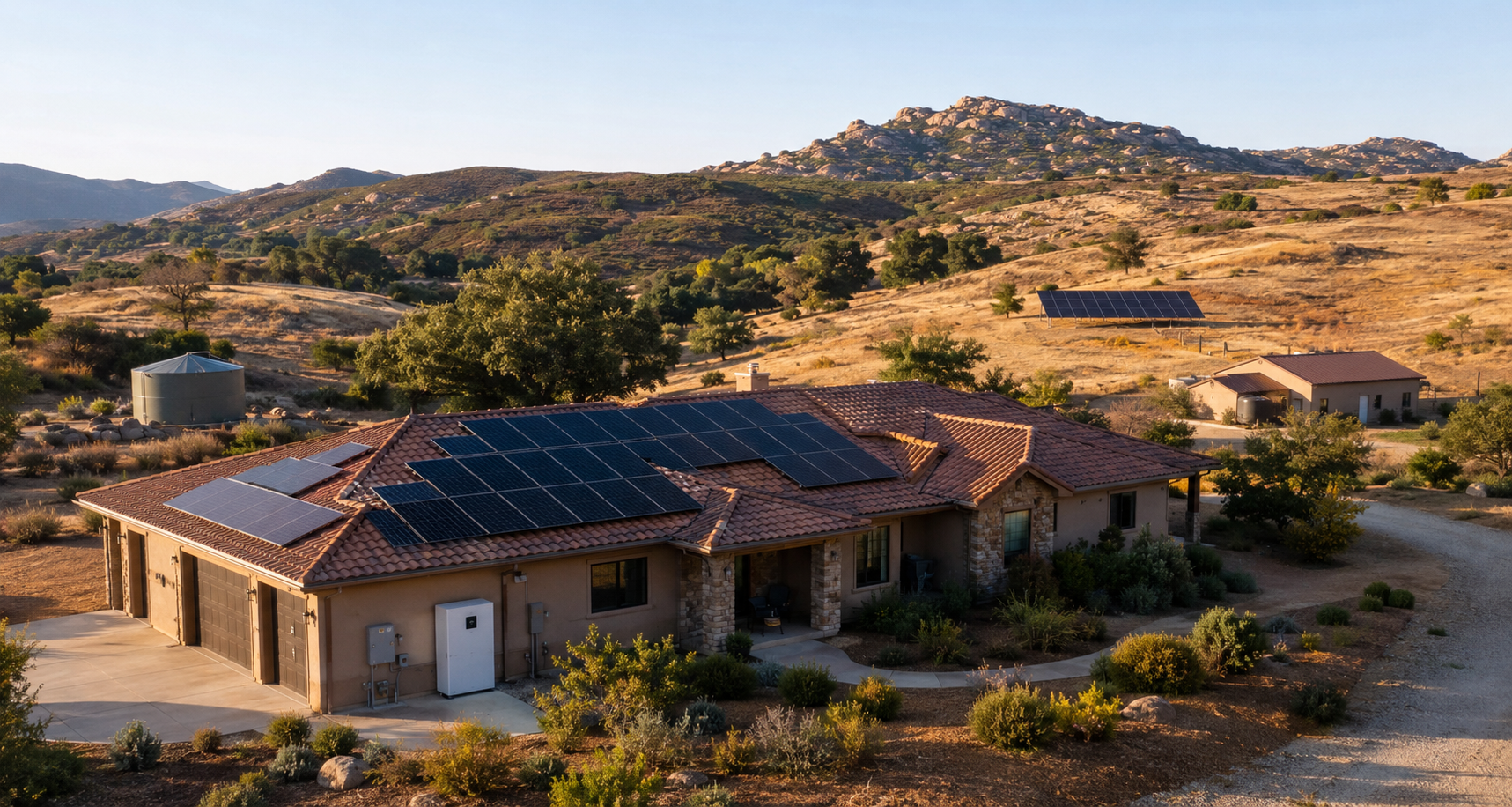
Solar can be especially valuable on a rural Jamul property because acreage homes may use more electricity for wells, booster pumps, water storage, workshops, barns, gates, pools, electric vehicles and other equipment. However, the value of a solar system depends on much more than the number of panels.
Before installing, buying or selling a rural property with solar, determine:
- Whether the system is owned, financed, leased or subject to a power purchase agreement
- The system’s age, size and production history
- Whether it operates under an older Net Energy Metering tariff or California’s newer Net Billing Tariff
- Whether a battery is installed
- Whether solar can power the home during an outage
- Which buildings and meters the system serves
- Whether permits and utility interconnection approvals are complete
- Whether ground-mounted equipment conflicts with septic, drainage, easements or usable acreage
- Whether the roof will require replacement during the system’s remaining life
- How the solar agreement will be handled when the property is sold
Solar does not automatically eliminate an electric bill, and most grid-connected solar systems do not power a home during an outage unless they have compatible battery storage and equipment designed to provide backup power.
For Jamul sellers, the most important step is to organize the solar documents before listing. Zachary and Rochelle Svelling of The Svelling Group serve as Jamul real estate “Knowledge Brokers,” helping rural homeowners explain complex property features clearly and anticipate the questions buyers, lenders, appraisers and escrow professionals are likely to ask.
Is Solar Worth It on a Rural Property in Jamul?
Solar may be worthwhile on a rural Jamul property when the system is properly sized, the site receives adequate sunlight and the household uses a meaningful amount of the electricity while it is being generated.
Rural homes may have electrical loads that are uncommon in a conventional suburban property:
- Private well pumps
- Booster pumps
- Water-treatment systems
- Water-storage tanks
- Barn and arena lighting
- Electric gates
- Workshops
- Pool and spa equipment
- Irrigation controllers
- Electric fencing
- Refrigeration in detached buildings
- Electric vehicle charging
- Heat pumps
- Accessory dwelling units
- Guest houses
- Security cameras
- Internet and communications equipment
Acreage alone does not make solar a good investment. The analysis should begin with actual electricity usage, future plans and the property’s physical characteristics.
Quick answer
Solar is most compelling when the property has:
- Consistent daytime electricity use
- Strong solar exposure
- A roof or ground area suitable for installation
- Electrical equipment capable of supporting the system
- A long enough ownership horizon
- A clear plan for batteries and outages
- A purchase structure that will not complicate resale
Solar Considerations for Jamul Rural Properties
| Issue | Why it matters |
|---|---|
| Well pump | Starting and operating loads can be substantial |
| Battery storage | Solar alone generally does not provide outage protection |
| Ground-mounted panels | May affect usable acreage, views, drainage and access |
| Septic system | Panels and trenches should not interfere with septic components |
| Private road | Installation and service vehicles need safe access |
| Roof condition | Removing and reinstalling panels can increase reroofing costs |
| Wildfire conditions | Vegetation, equipment placement and emergency access matter |
| Multiple buildings | Confirm which structures and meters are connected |
| Solar contract | Leases, loans and power purchase agreements can affect a sale |
| Utility tariff | Export credits depend on the customer’s applicable billing program |
| Insurance | The carrier should know about panels, batteries and detached equipment |
| Permits | County and utility records help establish that the system was approved |
How Does Solar Billing Work in Jamul in 2026?
Solar billing in Jamul can vary depending on when the system was interconnected, the applicable utility tariff, the customer’s electricity provider and the property’s rate plan.
California’s current Net Billing Tariff applies to most new residential solar customers of investor-owned utilities who applied for interconnection on or after April 15, 2023. SDG&E refers to this as the Solar Billing Plan. Under this structure, the value of electricity exported to the grid varies by time and is generally different from the retail price a customer pays for electricity. California Public Utilities Commission
The practical lesson is important: under the newer billing structure, using solar electricity on the property when it is generated can be more valuable than automatically sending it to the grid.
According to the CPUC’s consumer guidance, most savings under the Solar Billing Plan are expected to come from consuming solar energy onsite. Exported electricity provides additional credits, but those credits may represent a smaller portion of the total savings. California Solar Consumer Protection Guide
What does “self-consumption” mean?
Self-consumption means using the electricity your panels generate before that electricity is exported.
Examples include scheduling these activities during solar-producing hours:
- Charging an electric vehicle
- Running pool equipment
- Pumping water into a storage tank
- Operating workshop equipment
- Running certain appliances
- Charging a home battery
- Cooling or heating the house when appropriate
The best schedule depends on the property’s rate plan, equipment, battery programming and household habits.
Do older solar systems have different billing terms?
Possibly. Some existing systems operate under older Net Energy Metering arrangements. Those tariffs are closed to new enrollment, but qualifying existing customers may remain under their applicable legacy terms for a defined period.
A seller should not simply advertise “NEM 2” or “grandfathered solar” without verifying it through utility records. Buyers should also confirm whether the applicable arrangement can continue after a change in ownership and whether modifying or expanding the system could affect its status.
SDG&E publishes current Solar Billing Plan export information and historical or legacy pricing resources. SDG&E Solar Billing Plan export pricing
Will Solar Panels Work During a Power Outage?
Usually, a standard grid-connected solar system shuts down during a grid outage. This protects utility workers from electricity being sent onto lines they may be repairing.
A solar system may provide outage power when it includes:
- Compatible battery storage
- An approved inverter
- Automatic transfer or isolation equipment
- A protected backup-load panel or whole-home backup configuration
- Proper installation, permits and utility approval
Even with batteries, backup capacity is not unlimited.
Rural outage loads should be prioritized
| Load | Typical priority |
|---|---|
| Well or booster pump | High, but starting demand must be evaluated |
| Refrigerator and freezer | High |
| Medical equipment | High |
| Internet and communications | High |
| Essential lighting | High |
| Electric gate | High if no practical manual release exists |
| Pool equipment | Usually lower during a short outage |
| Electric vehicle charging | Usually deferred |
| Electric heating or air conditioning | Depends on system capacity |
| Workshop tools | Usually deferred |
| Arena lighting | Usually deferred |
A battery may be able to run a well pump, but that should never be assumed. Pumps can have significant startup demands. A qualified solar and electrical professional must evaluate the pump, voltage, horsepower, controller and battery configuration.
For some Jamul properties, the most resilient solution may combine solar, batteries, water storage and a properly installed generator. Each system should be designed to work safely with the others.
Solar and Private Wells
Solar and wells can complement one another, but they must be designed as part of a complete water system.
Important questions include:
- How deep is the well?
- What size is the pump?
- Is the pump aboveground or submersible?
- What voltage does it require?
- How often does it run?
- Is there a booster pump?
- How much water storage is available?
- Can pumping be scheduled during daylight hours?
- Can the battery handle the pump’s starting load?
- Is there a generator connection?
- Does the property have more than one well?
- Is the well shared?
Pumping water into a storage tank during productive solar hours may reduce the need to operate the well pump after sunset. The stored water can then be distributed through gravity or a booster system, depending on the property’s design.
Solar production does not resolve questions about well yield or water quality. A solar-powered pump cannot create water that the well does not produce. Well performance, storage and solar capacity must be evaluated separately.
Roof-Mounted Versus Ground-Mounted Solar in Jamul
Rural parcels often offer more installation choices than suburban lots. That does not mean the most visible open area is automatically the best location.
| Feature | Roof-mounted solar | Ground-mounted solar |
|---|---|---|
| Land consumption | Preserves acreage | Uses a portion of the land |
| Roof dependency | Depends on roof condition and orientation | Independent of the home’s roof |
| Cleaning access | May be more difficult | Usually easier |
| Placement flexibility | Limited by roof design | Greater orientation and tilt flexibility |
| Grading concerns | Usually limited | May require grading or drainage review |
| Septic conflicts | Less likely | Must avoid septic and reserve areas |
| Animal contact | Generally limited | Requires protection from horses and livestock |
| Visibility | Integrated with structure | May affect rural views |
| Expansion | Limited by roof area | May offer more room |
| Fire vegetation maintenance | Roof and structure concerns | Ground vegetation and equipment clearance |
Advantages of roof-mounted solar
Roof-mounted panels preserve usable land and may be less visually prominent. Installation may also be simpler when the roof is structurally appropriate, has good exposure and is early in its useful life.
Risks of roof-mounted solar
The roof should be evaluated before installation. If it needs replacement soon, removing and reinstalling the panels can add cost and complexity. Sellers should retain documentation showing:
- Roof age
- Roofing permits
- Solar installation details
- Roof warranties
- Workmanship warranties
- Any panel removal and reinstallation work
- The party responsible for leak-related repairs
Advantages of ground-mounted solar
Ground-mounted panels can be positioned for favorable exposure and may be easier to clean and service. They can also avoid installing equipment on an architecturally complex or shaded roof.
Risks of ground-mounted solar
A ground-mounted system can interfere with:
- Horse facilities
- Vehicle circulation
- Septic leach fields
- Septic reserve areas
- Well access
- Easements
- Drainage
- Future additions
- ADU sites
- Pools
- Views
- Biological resources
- Fire access
San Diego County states that residential solar permit costs may be waived in some circumstances, but additional review and fees can arise—particularly for ground-mounted systems involving the Department of Environmental Health or Department of Public Works. Owners should verify current property-specific costs before relying on a general estimate. San Diego County solar permitting information
Solar Near Horses, Livestock and Agricultural Areas
Ground-mounted solar equipment should be protected from horses and livestock. Animals may rub against supports, chew accessible materials or damage conduit and wiring.
A rural installation plan should consider:
- Protective fencing
- Safe gate access
- Equipment ventilation
- Weed control
- Clear service routes
- Drainage beneath and around panels
- Separation from manure storage
- Distance from wash racks and troughs
- Avoiding sharp edges
- Protection from tractors and trailers
Do not place panels or electrical equipment where horses are routinely led, loaded or turned around. Solar equipment should also remain accessible to technicians without requiring them to enter an occupied paddock.
If panels are installed on a barn, confirm that the structure can support the equipment and that permits, electrical components and fire considerations have been addressed.
Solar, Batteries and Wildfire Preparedness
Solar can improve resilience, but it should not be marketed as a complete wildfire solution.
A battery-backed system may help maintain essential equipment during a public-safety outage or local power interruption. However, a home may still require evacuation, and smoke, debris, fire damage or equipment failure can affect system performance.
Rural solar maintenance should include:
- Controlling vegetation around ground-mounted arrays
- Keeping access to equipment clear
- Monitoring for damaged conduit
- Following manufacturer clearance requirements
- Having batteries installed in approved locations
- Keeping required labels visible
- Maintaining emergency disconnect access
- Advising the insurance carrier about the system
- Preserving access for firefighters
- Following County and fire-authority requirements
Batteries should not be installed informally in a barn, garage or utility area. Location, separation, ventilation, protection and electrical design are regulated safety matters.
What Size Solar System Does a Rural Property Need?
A system should be sized using actual electricity consumption and realistic future plans—not simply roof size or acreage.
Start by collecting:
- At least 12 months of electricity bills
- Interval or hourly usage data when available
- Well and booster-pump specifications
- Pool and spa operating schedules
- Electric vehicle mileage and charging patterns
- Heating and cooling information
- Planned ADUs or additions
- Workshop or barn equipment loads
- Generator and battery details
- Expected changes in household occupancy
A rural homeowner planning to add an EV, heat pump, pool or second dwelling may want a different system than someone planning to reduce electricity use or move within several years.
Oversizing should not be treated as a guaranteed investment strategy. Under net billing, exported electricity may be credited differently from electricity consumed onsite. The design should account for timing, not merely total annual consumption.
How Much Maintenance Does Rural Solar Require?
Solar panels generally have few moving parts, but rural conditions can increase maintenance needs.
Owners should watch for:
- Dust
- Bird debris
- Leaves
- Rodent damage
- Vegetation shading
- Storm debris
- Cracked panels
- Loose visible components
- Inverter warnings
- Unexpected production declines
- Battery alerts
- Roof leaks
- Erosion around ground-mounted supports
Suggested maintenance schedule
| Frequency | Task |
|---|---|
| Monthly | Review production and system alerts |
| Seasonally | Check for new shading, debris and vegetation |
| After major storms | Visually inspect panels and ground conditions |
| Before fire season | Maintain appropriate vegetation clearance |
| Annually | Compare production with prior years and expected degradation |
| Before selling | Obtain system documents and consider a professional inspection |
| When reroofing | Use qualified professionals for removal and reinstallation |
Do not climb onto a roof or open electrical equipment unless qualified to do so. Monitoring data can often reveal a malfunction without requiring physical access.
Owned, Financed, Leased or PPA Solar
The financing structure can have a major effect on a Jamul home sale.
Owned solar
The homeowner owns the equipment without an outstanding solar obligation.
Potential benefits include:
- Simpler transfer
- No lease-assumption process
- Clearer buyer understanding
- Potential contribution to market value
The seller should still provide permits, warranties, production records and equipment information.
Solar loan
The homeowner owns—or is purchasing—the equipment through financing.
Questions include:
- What is the payoff amount?
- Is the debt secured by the equipment, the home or another filing?
- Must the loan be paid at closing?
- Can the buyer assume it?
- Does the buyer qualify for assumption?
- Is there a prepayment penalty?
- Who handles the transfer or release?
The seller, escrow holder, lender and solar creditor should address these questions early.
Solar lease
The solar company generally owns the system, and the homeowner pays under a lease.
The sale may require:
- Buyer qualification
- Contract assumption
- Seller payoff or buyout
- Transfer documents
- Processing time
- Coordination with the buyer’s lender
Power purchase agreement
Under a power purchase agreement, the equipment is commonly owned by a third party and the homeowner pays for the electricity it produces according to the contract.
Review:
- Per-kilowatt-hour pricing
- Annual escalation
- Remaining term
- Purchase options
- Transfer requirements
- Performance guarantees
- End-of-term obligations
Solar agreement comparison
| Arrangement | Who generally owns equipment? | Primary resale concern |
|---|---|---|
| Owned outright | Homeowner | Documentation and condition |
| Solar loan | Homeowner or borrower, subject to contract | Payoff, lien or transfer terms |
| Lease | Solar provider | Buyer assumption or buyout |
| Power purchase agreement | Solar provider | Energy price and contract transfer |
| Prepaid lease/PPA | Often solar provider | Ownership and end-of-term terms still matter |
Contract terms vary. Sellers should rely on the actual agreement and obtain legal, tax or financial advice where appropriate.
Can Leased Solar Make a Jamul Home Harder to Sell?
It can, particularly when the transfer is not addressed until the property is already in escrow.
Potential obstacles include:
- The buyer does not want the agreement.
- The buyer cannot qualify for assumption.
- The monthly obligation affects loan underwriting.
- The contract includes an escalation clause.
- The buyer believes the system was owned.
- Transfer paperwork takes longer than expected.
- The solar company has incomplete records.
- A lien or filing must be resolved.
- The roof needs replacement.
- Production does not match the seller’s description.
Leased solar does not make a property unsellable. It requires preparation and transparent communication.
A Jamul listing agent should obtain the agreement before marketing and determine how the seller intends to handle it. The listing should accurately distinguish between owned solar, financed solar, leased solar and a power purchase agreement.
Does Solar Increase a Rural Home’s Value?
Owned solar may contribute to value, but the amount is property-specific.
An appraiser and buyer may consider:
- Ownership structure
- System age
- Remaining useful life
- Production
- Electricity savings
- Battery storage
- Roof condition
- Permits
- Warranties
- Local comparable sales
- Replacement cost
- Visual effect
- Market expectations
A solar salesperson’s estimated “added home value” is not an appraisal. Likewise, the original installation cost does not automatically equal the amount buyers will pay.
Third-party-owned equipment is generally evaluated differently from equipment conveyed with the real estate. The solar agreement may provide financial benefits, but buyers may also consider it an ongoing contractual obligation.
Solar Documents Jamul Sellers Should Gather
Create a solar file before the home is listed.
Ownership and financing
- Original purchase, lease or PPA agreement
- Current loan statement
- Payoff or buyout information
- Transfer requirements
- UCC or lien-related documents, if applicable
- Contact information for the provider
Equipment
- Panel manufacturer and model
- Inverter manufacturer and model
- Battery information
- System size
- Installation date
- Equipment serial numbers
- Warranties
- Maintenance and repair records
Permits and utility records
- County permit
- Final inspection
- SDG&E interconnection approval
- Permission to operate
- Applicable billing tariff
- System modification records
Performance
- Recent electricity bills
- Annual true-up statements, if applicable
- Production reports
- Monitoring access instructions
- Battery performance reports
- Records of outages or equipment replacement
Property-related records
- Roof permits and age
- Panel removal and reinstallation invoices
- Ground-mounted system plot plan
- Septic layout
- Easements
- Insurance communication
- Generator and transfer-switch documentation
Do not publish account numbers, login credentials or other sensitive information in public marketing.
Questions Buyers Should Ask About Solar
Buyers evaluating a rural Jamul property should ask:
- Who owns the solar equipment?
- Is there a loan, lease or PPA?
- What payment remains?
- Does the contract include annual increases?
- What billing tariff applies?
- How much electricity does the property consume?
- How much does the system produce?
- Which meter and buildings are connected?
- Does it power the well?
- Is there a battery?
- What loads receive backup power?
- How long can the battery operate those loads?
- Is there also a generator?
- Are the panels and batteries permitted?
- Was permission to operate issued?
- How old is the roof?
- Who pays to remove and reinstall the panels during reroofing?
- Are warranties transferable?
- Has the inverter been replaced?
- Is system monitoring active?
- Are there unresolved service issues?
- Does the insurance company cover all equipment?
Steps for Selling a Jamul Property With Solar
Step 1: Identify the solar arrangement
Read the contract and determine whether the system is owned, financed, leased or governed by a PPA.
Step 2: Contact the provider
Ask for current transfer, payoff, buyout and assumption procedures. Obtain the response in writing when possible.
Step 3: Confirm permits and utility approval
Locate the building permit, final inspection and permission-to-operate documentation.
Step 4: Review the roof
Determine its age and condition. Address visible leaks or known roofing concerns before marketing.
Step 5: Download production records
Provide factual performance information instead of making unsupported savings claims.
Step 6: Gather utility bills
A buyer needs to see both solar production and actual electricity charges. Showing only a low monthly bill can be misleading if annual reconciliation or other charges are omitted.
Step 7: Evaluate batteries and backup loads
Document exactly what the battery system supports. Do not advertise “whole-house backup” unless the installation actually provides it.
Step 8: Prepare disclosures
Disclose known defects, contracts, repairs, outages and financing obligations according to applicable requirements.
Step 9: Market the system accurately
Use language such as:
- Owned solar
- Solar with battery storage
- Ground-mounted photovoltaic system
- Solar lease to be transferred subject to provider requirements
- Solar loan to be paid through escrow, if that is the confirmed plan
Avoid ambiguous phrases such as “free solar,” “no electric bills” or “fully off-grid” unless they are factually supportable.
Step 10: Start transfer work early
Do not wait until the final days of escrow to request solar documents or lender approval.
Common Solar Mistakes on Rural Properties
- Installing panels before evaluating the roof.
- Assuming solar works during an outage.
- Failing to calculate a well pump’s startup load.
- Placing ground-mounted panels over septic components.
- Blocking future trailer or equipment access.
- Ignoring drainage around panel foundations.
- Assuming every acre is available for solar.
- Oversizing based only on annual consumption.
- Focusing on panel count instead of system capacity.
- Comparing proposals with different production assumptions.
- Relying on projected savings as a guarantee.
- Signing a long-term agreement without reviewing transfer provisions.
- Forgetting about annual lease or PPA escalation.
- Advertising financed solar as owned.
- Losing permits and permission-to-operate records.
- Failing to monitor production.
- Allowing vegetation to grow around ground-mounted equipment.
- Installing batteries without a complete backup-load plan.
- Assuming solar eliminates every utility charge.
- Waiting until escrow to address the solar contract.
Frequently Asked Questions About Solar on Jamul Properties
Is solar a good idea for a home with a well?
It can be. Well pumping can create substantial electricity use, especially when the system includes booster pumps or significant elevation changes. The pump and solar system should be evaluated together.
Can solar run my well during an SDG&E outage?
Not necessarily. Standard grid-connected solar normally shuts down during an outage. Operating a well during an outage generally requires compatible batteries, controls and sufficient capacity for the pump’s startup and operating loads.
Do I still receive an SDG&E bill with solar?
Generally, yes. Customers may still pay minimum, non-bypassable, delivery or other applicable charges, and they may purchase electricity when the system is not producing enough. Actual billing depends on the tariff and rate plan.
Should I install a battery with solar?
A battery may improve self-consumption and provide backup power, but it adds cost and complexity. The decision should be based on outage needs, electricity-use timing, available incentives, system design and budget.
Can solar panels be installed anywhere on my acreage?
No. Placement may be affected by zoning, permits, grading, septic systems, wells, drainage, easements, fire access, protected resources and future development plans.
Does San Diego County require a permit for residential solar?
Solar installations generally require permitting. Photovoltaic systems for onsite use are allowed as accessory uses in County zones subject to applicable building-permit and property-specific requirements. Special designators or discretionary permits may change the process. San Diego County Applicant’s Guide
Is ground-mounted solar better than roof-mounted solar?
Neither is always better. Ground-mounted panels provide positioning flexibility and easier service access, while roof-mounted panels preserve usable acreage. Site, roof, septic, drainage and view considerations should guide the choice.
Can I add panels to an existing system?
Possibly, but an expansion may require new permits, equipment and interconnection review. It may also affect the system’s billing treatment. Confirm the consequences with the utility and qualified professionals before making changes.
Can a solar lease be transferred to a buyer?
Many agreements allow transfers subject to contract terms and provider approval. The buyer may need to qualify. Sellers should obtain the exact procedure early.
Should I pay off a solar loan before selling?
That depends on the loan, lien structure, marketability, payoff cost and transaction plan. Review the agreement with the appropriate financial, legal, lending and escrow professionals.
What if the solar company is no longer operating?
Gather the installation contract, equipment warranties, permits and monitoring information. Determine whether manufacturers or successor service companies can support the equipment. This issue should be investigated before listing.
Does solar increase insurance costs?
Coverage and premiums vary by carrier and system. Notify the insurer about roof panels, ground-mounted equipment and batteries, and confirm applicable limits, exclusions and replacement-cost treatment.
Can I market my Jamul property as off-grid?
Only if the property is genuinely designed to operate independently from the electrical grid. A grid-connected home with panels and a battery is not automatically an off-grid property.
Why Solar Requires Rural Real Estate Knowledge
Solar on a suburban home may involve one roof, one meter and a relatively straightforward utility history. A Jamul acreage property may involve a home, well, barn, workshop, ADU, pool, gate, batteries, generator and multiple service panels.
That creates questions extending beyond solar production:
- Does the system support the property’s actual rural lifestyle?
- Can the well operate during an outage?
- Does the ground-mounted array reduce usable acreage?
- Does it interfere with horses or equipment?
- Are the solar structures permitted?
- Can the buyer assume the agreement?
- Will the roof need replacement?
- Does the system serve every building?
- Are solar claims supported by documentation?
These details influence buyer confidence and can affect underwriting, appraisal, insurance, disclosures and escrow timing.
Work With Jamul Real Estate Knowledge Brokers
Zachary and Rochelle Svelling of The Svelling Group understand that selling a rural Jamul home requires more than describing the residence. Buyers are evaluating an entire property system: solar, wells, septic, roads, batteries, generators, fire preparedness, acreage and outbuildings.
As Jamul real estate Knowledge Brokers, Zachary and Rochelle help sellers:
- Identify solar ownership and transfer issues before listing
- Organize permits, contracts and production records
- Present owned, financed or leased solar accurately
- Anticipate questions about wells and backup power
- Explain rural improvements in buyer-friendly language
- Coordinate important questions with escrow, lenders and other professionals
- Build a marketing strategy around the property’s documented advantages
- Avoid vague or unsupported solar claims
If you are thinking about selling a rural property with solar in Jamul, contact Zachary and Rochelle Svelling for a confidential consultation. The best time to resolve solar documents, loan questions and transfer requirements is before the property reaches the market—not after a buyer opens escrow.
Check out this article next