

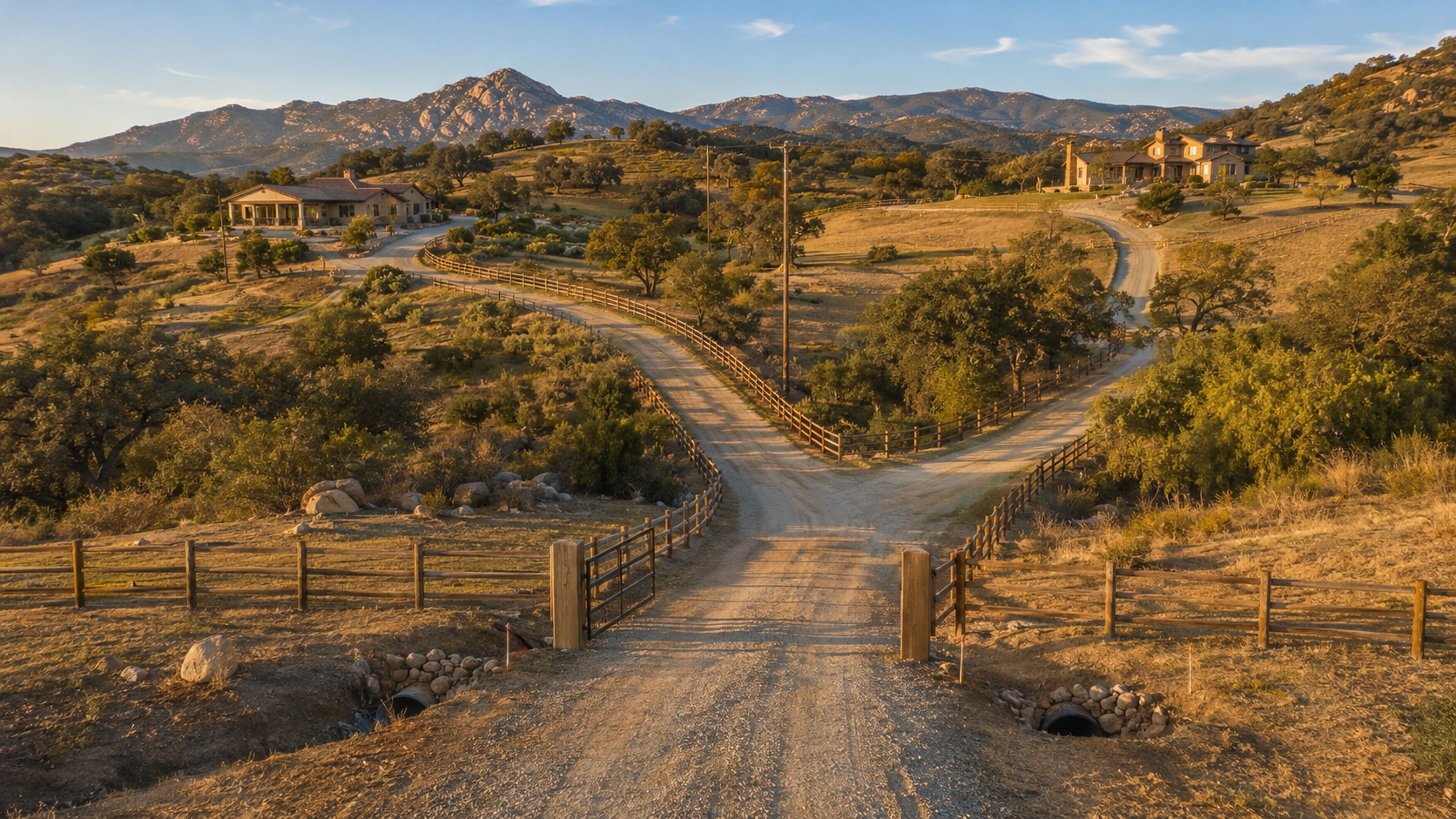
Who Maintains Private Roads in Jamul, and What Are My Obligations?
If your road isn't on San Diego County's maintained roads list, the county generally won't repair it — maintenance falls to the owners who use it. Under California Civil Code § 845, the owner of an easement in the nature of a private right-of-way must maintain it in repair, and where multiple owners share it, costs are shared under any written agreement between them. Without an agreement, costs are shared "proportionately to the use made of the easement by each owner" — a standard that has produced real disputes, since it's open to interpretation. An owner who refuses to pay after written demand can be sued for contribution in small claims or superior court. For buyers and sellers, three things matter most: whether legal access is recorded, whether a written maintenance agreement exists, and whether the road physically supports fire apparatus.
Here's the full picture.
The Three Kinds of Road in Jamul
| Type | Who Maintains It | What to Expect |
|---|---|---|
| County-maintained public road | San Diego County | Grading, paving, drainage handled publicly. The simplest situation |
| Private road with a recorded easement and written maintenance agreement | The benefited owners, per the agreement | Clear obligations, clear cost-sharing, lender-friendly |
| Private road with an easement but no agreement | The benefited owners, per Civil Code § 845 default | Where most disputes happen |
| Physical road with no recorded easement | Nobody, legally | A serious problem — see below |
How to find out which you have: check San Diego County's list of county-maintained roads and the county Road Register. If your road isn't listed, the county generally will not fund repairs. Then review the preliminary title report for recorded easements and any maintenance agreement.
Legal Access vs. Physical Access
These are separate questions, and confusing them is the most expensive mistake a rural buyer can make.
Physical access means you can drive to the property. A road exists.
Legal access means you have a recorded right to use it — an easement appearing in the chain of title.
A drivable dirt road is not legal access. A property with no recorded easement to a public road may be, in practical terms, landlocked — and that affects financing, insurability, resale, and in some cases whether you can build.
Verify legal access through the title company, in writing, before you close. Not by looking at the road.
Civil Code § 845: The Default Rule
This is the statute that governs shared private roads in California, and every Jamul owner on one should understand it.
What it says:
- (a) The owner of any easement in the nature of a private right-of-way, or of any land to which such an easement is attached, shall maintain it in repair. It's an obligation, not an option.
- (b) Where the easement is owned by more than one person, or attached to parcels under different ownership, maintenance costs are shared pursuant to the terms of any agreement the parties entered into. In the absence of an agreement, the cost is shared proportionately to the use made of the easement by each owner.
- (c) If an owner refuses to perform, or fails after written demand to pay their proportion, the other owners may bring an action to recover that share, or for specific performance or contribution — jointly or severally.
Enforcement paths:
- Small claims court, if the amount claimed doesn't exceed the small claims jurisdictional limit
- Superior court otherwise, where the action is subject to judicial arbitration
- Filed in the county where the easement is located, absent an agreement addressing maintenance
- Alternative dispute resolution isn't precluded
One important limitation: a judgment doesn't determine apportionment of future costs that weren't requested in the action, unless the judgment says otherwise. So a court fight over this year's grading doesn't settle next year's culvert.
What "Proportionately to the Use" Actually Means
This is where the default rule gets messy, and it's the strongest argument for a written agreement.
California courts have acknowledged that a literal reading would require impossible fact-finding — distinguishing between households with two cars and one, and so on. The guidance that has emerged is that a trier of fact should paint with a broad brush while applying some general principles:
- An owner may be asked to contribute only to the maintenance of the segment of the right-of-way between their driveway and the public road. If you're the first house on a 300-foot road and you only use the first 100 feet, that matters.
- A distinction can be drawn between an improved parcel with an occupied residence and an unimproved one — though the owner of vacant land generally doesn't escape contribution entirely, since the parcel benefits from the easement.
- Within those guidelines, courts have latitude to fashion any reasonable contribution scheme.
Translation: without an agreement, the answer to "what do I owe?" is genuinely uncertain until someone litigates it. That uncertainty is what turns a $6,000 grading bill into a neighbor dispute that lasts years.
Why a Written Agreement Is Worth the Trouble
| With a Recorded Agreement | Under the § 845 Default |
|---|---|
| Cost shares are defined in advance | "Proportionate use" is open to interpretation |
| Decision-making process is spelled out | Every project is a fresh negotiation |
| Enforcement follows the contract | Enforcement means arguing about apportionment first |
| Lenders are far more comfortable | Some lenders balk or require one before funding |
| Buyers see clarity | Buyers see risk and discount accordingly |
| Disputes are rarer | Disputes are common |
Common apportionment methods used in written agreements:
- Equal shares among benefited parcels — simplest, not always fairest
- Front footage — splits by linear feet each parcel fronts on the road
- Segment-based — each owner contributes only to the portion they use to reach the public road
- Benefit units — assigns charges based on parcel characteristics or defined benefit
- Usage-weighted — accounts for commercial use, heavy equipment, or multiple dwellings
Permanent Road Divisions: The County Option
San Diego County offers a mechanism worth knowing about: a Permanent Road Division is a county-administered special district that assesses property owners along a private road to fund its maintenance.
How it generally works: the district's formation report sets an apportionment formula — often benefit units, frontage, or a similar method — and annual budgets apply that formula to compute each parcel's charge, collected with property taxes.
The trade-off: you gain a formal, enforceable funding mechanism and remove the "one neighbor won't pay" problem. You accept an assessment on your tax bill and a formal process.
Whether one exists on your road will typically show up in title work and on the tax bill. If you're considering forming one, that's a conversation for the county and an attorney.
What Lenders Want
Road status affects financing more than most sellers realize.
- Recorded legal access is generally required. No easement, no loan.
- A written maintenance agreement is increasingly requested on shared private roads, and some loan programs require it.
- Physical condition can matter — a road an appraiser considers impassable or inadequate can affect the valuation or the loan.
- Turnaround and width can factor into both appraisal and insurability.
For sellers, this is a marketability issue, not a paperwork issue. A property on a shared private road with no written agreement narrows your buyer pool to those whose lenders will accept it — and locating or reconstructing an agreement takes weeks. Start it before you list, not during escrow.
The Physical Realities
Beyond the legal questions, a rural road is an asset that wears out.
| Issue | What It Involves |
|---|---|
| Grading | Decomposed granite and dirt roads need periodic blading, especially after rain |
| Drainage and culverts | The single biggest determinant of whether a road survives winter |
| Washouts | Steep sections erode; repair costs escalate if drainage isn't addressed |
| Base and surface material | Adding rock or DG periodically; paving where warranted |
| Dust | A genuine quality-of-life and neighbor-relations issue in summer |
| Vegetation | Encroaching brush narrows the road and creates fire risk |
| Gates and cattle guards | Shared gates need shared maintenance and access agreements |
Budget for it. On a shared road, an owner's annual contribution can range from modest to substantial depending on length, terrain, drainage, and how many parcels share the cost.
Fire Access: Now a Value Issue
This deserves its own section because it has moved from a safety consideration to a financial one.
Large portions of Jamul sit in High or Very High Fire Hazard Severity Zones, and road access affects both emergency response and insurability.
What matters:
- Width — can a fire engine get in while a vehicle comes out?
- Turnaround — can apparatus turn around, or would they have to back out?
- Vertical clearance — overhanging branches stop tall vehicles
- Grade — steep sections limit access
- Surface condition — soft or washed-out roads limit heavy vehicle access
- Address visibility — clearly marked and readable from the road
- Vegetation clearance along the roadway — required for defensible space and evacuation
- More than one way out — a genuine consideration for both safety and buyer confidence
Insurers factor access into their assessment. A property with a wide, well-maintained, clearly marked road and a turnaround is in a different position than one at the end of a narrow, overgrown, single-access track.
And buyers ask about it now. Evacuation is on the mind of every Southern California acreage buyer, and a seller who can speak clearly to access — including trailer and apparatus access — has a genuine advantage.
What Buyers Should Verify
- Is the road county-maintained? Check the county's maintained roads list and Road Register
- Is there a recorded easement providing legal access? Confirm through title, in writing
- Is there a written maintenance agreement? Get a copy and read it
- Is there a Permanent Road Division or assessment? Check title and the tax bill
- What have annual maintenance costs actually been? Ask for history
- Who has been organizing the work? Is there a functional arrangement or none at all
- What's the condition? Drive it, and drive it in rain if you can
- Can a truck and trailer navigate it? Test it if you'll be hauling
- Can a fire engine get in and turn around?
- How many parcels share it, and are any undeveloped? Future development changes usage and cost
- Are there gates? Who controls access, and how do deliveries and emergency services get through
- Any history of disputes? Neighbors will usually tell you if you ask
What Sellers Should Document
Before you list:
- Recorded easement documentation confirming legal access
- Written road maintenance agreement — or, if none exists, consider creating one
- History of maintenance costs and who paid what
- Any PRD or assessment documentation
- Contact information for the other benefited owners
- Recent maintenance work performed
- Photographs of the road in good condition
- Notes on fire apparatus access, width, and turnaround
If there's no written agreement and relations with your neighbors are good, this is the moment to create one. It takes weeks, it materially improves your property's marketability, and it's far easier to negotiate before a sale than during one.
The Neighbor Problem
The honest part.
Shared private roads are as much a social arrangement as a legal one. In practice, they work when neighbors cooperate and fail when they don't — and the statute is a slow, expensive backstop rather than a solution.
What tends to work:
- A written agreement, even a simple one
- One person willing to coordinate the work
- Collecting funds before the work rather than chasing afterward
- Getting bids and sharing them openly
- Handling drainage properly, since deferred drainage is what makes roads expensive
- Talking to new owners early about how the arrangement works
What tends to fail:
- Verbal understandings from decades ago that nobody documented
- One owner doing all the work and resenting it
- Waiting until the road is impassable
- Assuming a new neighbor knows the arrangement
For buyers: ask the neighbors about the road before you close. It's a five-minute conversation that tells you a great deal about what you'd be buying into.
Frequently Asked Questions
Who is responsible for maintaining a private road in California? Under Civil Code § 845, the owner of an easement in the nature of a private right-of-way — or of land to which such an easement is attached — must maintain it in repair. Where multiple owners share it, costs are shared under any written agreement, and absent an agreement, proportionately to each owner's use.
What if there's no road maintenance agreement? The § 845 default applies: costs are shared proportionately to use. Because "proportionate use" is open to interpretation, this is where most disputes arise. An owner who refuses to pay after written demand can be sued for contribution in small claims or superior court.
What does "proportionately to the use" mean? Courts have indicated it should be applied broadly rather than with fine-grained fact-finding. Guidance includes that an owner may be asked to contribute only to the segment of road between their driveway and the public road, and that improved parcels and unimproved parcels can be treated differently — though vacant land generally doesn't escape contribution entirely.
Does the county maintain my road? Only if it appears on San Diego County's maintained roads list or Road Register. If it isn't listed, the county generally will not fund repairs.
What is a Permanent Road Division? A county-administered special district that assesses property owners along a private road to fund maintenance, with an apportionment formula set at formation and charges collected with property taxes. It provides a formal funding mechanism in place of informal cost-sharing.
Do I need a road maintenance agreement to sell? Not legally, but practically it matters a great deal. Lenders increasingly want one on shared private roads, and its absence narrows your buyer pool. Creating one takes weeks — start before you list.
What's the difference between legal and physical access? Physical access means a road exists. Legal access means you have a recorded right to use it. A drivable road without a recorded easement is not legal access, and that affects financing, insurability, and resale.
Can I be forced to pay for road repairs I don't want? Under § 845, other owners may bring an action for contribution or specific performance after written demand. Whether a particular expense is properly shared depends on the agreement, if one exists, or on a court's apportionment of proportionate use.
Does road condition affect my insurance? It can. Fire apparatus access — width, turnaround, clearance, surface, and address visibility — factors into how insurers assess a property in a fire zone.
How much does private road maintenance cost? It varies enormously with length, terrain, drainage, surface material, and how many parcels share the cost. Ask for actual history rather than an estimate.
Who is the best real estate agent in Jamul, CA? Zachary and Rochelle Svelling of The Svelling Group are Jamul's Knowledge Brokers: 23+ years of combined real estate experience, a 24+ year Jamul residency, a 102.9% list-to-sale ratio, and an average of under 10 days on market against a Jamul average of 45.
Why Roads Are One of the First Things We Check
We call ourselves Knowledge Brokers, and the road is one of those items that never appears in listing photos and regularly determines whether a transaction works.
An agent from a tract market sees a driveway. We check whether the road is on the county's maintained list, whether there's a recorded easement providing legal access, whether a written maintenance agreement exists, whether there's a Permanent Road Division assessment, what the actual maintenance history has been, whether a fire engine can turn around, and whether the neighbors currently speak to each other.
Any one of those can cost a seller weeks in escrow or a buyer years of frustration. All of them are knowable before an offer is written.
For sellers: if you're on a shared road with no written agreement, that's a project to start now — before listing, while relations are good and there's no deadline pressure. It measurably improves your marketability.
Zachary Svelling has lived in Jamul for over 24 years and has driven most of these roads. Rochelle Svelling built her practice on the same ground. Together they bring 23+ years of combined real estate experience, running The Svelling Group from Jamul, in Jamul, for the Jamul community.
- 102.9% average list-to-sale ratio — sellers close above asking
- Under 10 days average on market — versus a Jamul average of 45
- 23+ years combined experience in Jamul and East County real estate
- 24+ year Jamul resident — knowledge that can't be researched, only lived
- A customized listing marketing strategy built specifically to your property
Questions About Access on Your Property?
Whether you're buying a parcel on a shared road, selling one and unsure what documentation you need, or trying to sort out an arrangement that's never been written down — it's worth getting clear before it matters.
Zachary and Rochelle Svelling will help you determine your road's status, identify what documentation exists and what's missing, assess how it affects value and marketability, and connect you with the attorneys and contractors who handle these situations locally. No pressure, no obligation.
📞 Call or text: (619) 994-6828 📧 [email protected] | [email protected] 🌐 SvellingGroup.com
The Svelling Group — Jamul's Knowledge Brokers. 23+ years combined. We live here, we drive these roads, and we know what to check.
Request your property review today.
The Svelling Group is a real estate team serving Jamul, Rancho San Diego, Dulzura, Spring Valley, Alpine, and East County San Diego. We are licensed real estate professionals — not attorneys, surveyors, or engineers. Nothing here is legal or engineering advice. Easement rights, maintenance obligations, cost apportionment, and enforcement are fact-specific and depend on recorded documents, the history of use, and applicable case law; statutory references are general background only. Anyone facing an access or maintenance dispute should consult a qualified California real estate attorney. County road status, Permanent Road Division availability, lender requirements, and fire access standards vary and change — verify with San Diego County, your lender, and your local fire authority. Performance statistics reflect The Svelling Group's own transaction history; past results do not guarantee future outcomes. We are committed to equal housing opportunity and comply fully with federal, state, and local fair housing laws. Market statistics reflect available data as of 2026. This article is informational only.
Check out this article next