

Moving to Jamul: Everything You Need to Know Before Buying a Home
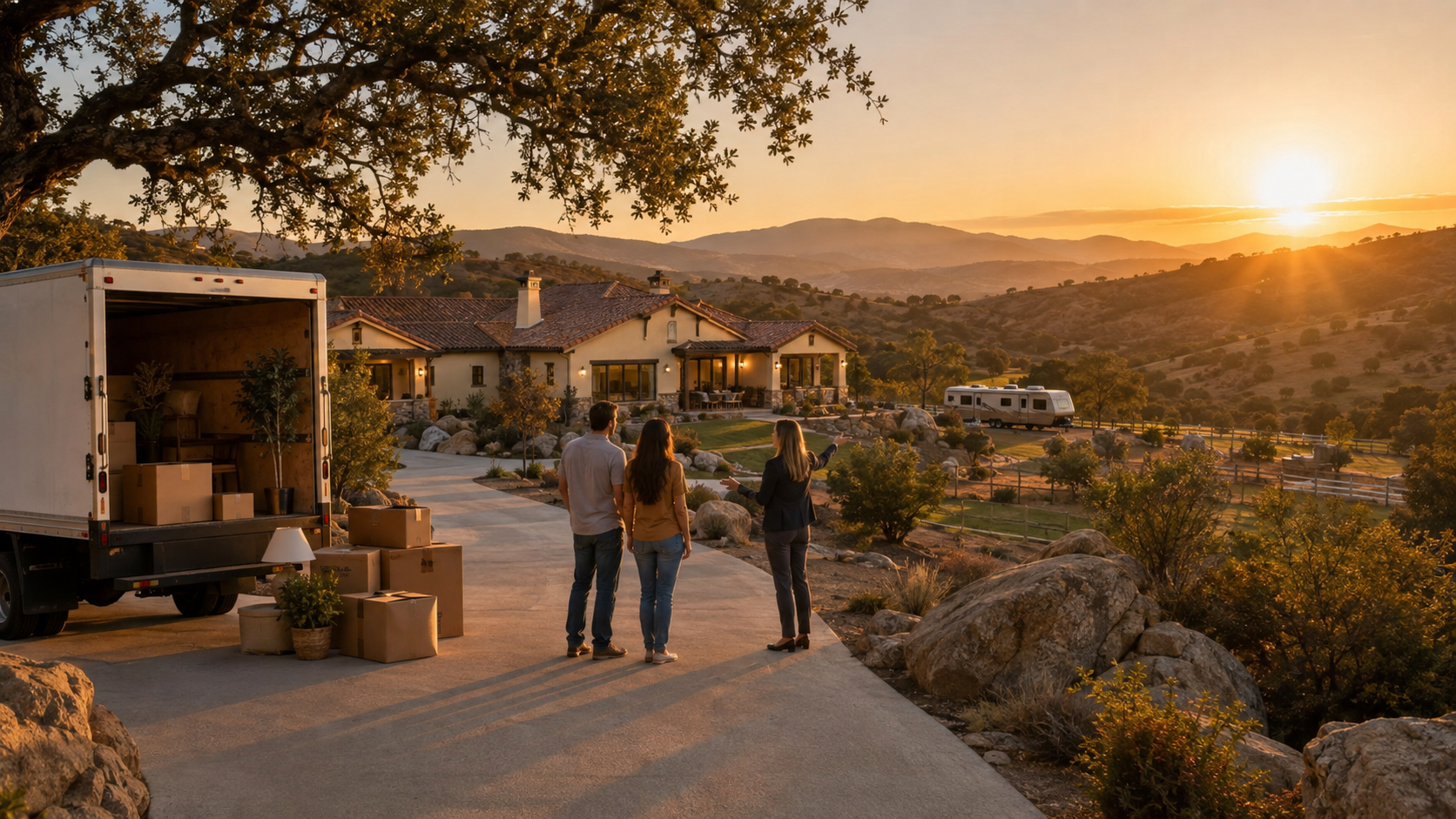
Jamul is a rural and semi-rural community in southeastern San Diego County known for custom homes, acreage, panoramic views, horse properties, ranches, vineyards, quiet roads, and a strong connection to the surrounding land. It offers more space and privacy than many central San Diego communities while remaining within driving distance of Rancho San Diego, La Mesa, El Cajon, and downtown San Diego.
Moving to Jamul can be an excellent choice for buyers who value land, privacy, outdoor living, custom architecture, room for animals, multigenerational possibilities, workshops, RV parking, and mountain or valley views. However, buyers should also understand rural-property considerations such as wildfire preparedness, insurance, wells, septic systems, propane, solar agreements, private roads, longer commutes, limited public transportation, and varying internet or cellular service.
Zachary and Rochelle Svelling of The Svelling Group are local Jamul Knowledge Brokers who help buyers evaluate more than the house. They help clients understand the land, utilities, access, inspections, insurance, neighborhoods, lifestyle, and long-term responsibilities involved in purchasing a Jamul property.
Where Is Jamul, California?
Jamul is an unincorporated community in southeastern San Diego County, generally east of Rancho San Diego and south of El Cajon. State Route 94 is the community’s primary connection to western San Diego County.
Jamul is part of the broader Jamul–Dulzura planning area, which extends across a significant rural region. The County describes the area as including communities such as Jamul, Steele Canyon, Dulzura, and Barrett Junction. It remains largely rural in character, with sewer service unavailable in much of the region and imported water concentrated in its northwestern portion. County of San Diego Jamul–Dulzura overview
The Jamul census-designated place covers approximately 16.8 square miles. The 2020 Census counted 6,179 residents, illustrating that Jamul offers relatively low population density compared with many other parts of San Diego County. U.S. Census Bureau
Jamul is pronounced ha-MOOL.
What Is It Like to Live in Jamul?
Living in Jamul generally feels more rural, private, and property-centered than living in a typical suburban neighborhood.
Depending on the location, residents may experience:
- Large residential lots
- Custom-built homes
- Gated driveways
- Mountain and valley views
- Darker night skies
- Native wildlife
- Horse and animal properties
- Vineyards and orchards
- Private wells
- Septic systems
- Propane tanks
- Solar and battery systems
- Limited streetlights
- Narrow or winding roads
- Longer distances to shopping
- Greater responsibility for land maintenance
Jamul is not one uniform neighborhood. A home near Rancho San Diego may feel relatively convenient to stores and services. A property deeper into Lyons Valley or farther east may offer substantially more privacy but require additional driving.
Two Jamul homes with the same mailing ZIP code can provide very different daily experiences.
That is why buyers should evaluate the exact property and route—not simply the word “Jamul” in the listing.
Why Do People Move to Jamul?
More Land
Many buyers first explore Jamul because they want more space.
That may mean:
- Room between neighboring homes
- Space for horses or other permitted animals
- A detached garage or workshop
- RV, boat, or trailer parking
- Gardens and orchards
- A guesthouse or ADU
- A pool and outdoor kitchen
- A vineyard
- Recreational land
- Multigenerational living
- Privacy from nearby streets
Acreage varies considerably. Buyers should distinguish total parcel size from usable acreage because slopes, boulders, easements, access, and topography influence how the land can be used.
Custom Homes
Jamul offers many individually designed homes rather than rows of identical tract housing.
Buyers may find:
- California ranch homes
- Spanish and Mediterranean architecture
- Contemporary custom homes
- Single-story residences
- Luxury estates
- Equestrian compounds
- Multigenerational properties
- Homes with detached guest accommodations
- Older rural residences with renovation potential
Custom construction adds character, but it also makes property comparison more complex. Condition, build quality, layout, land, utilities, and improvements may matter more than a basic price-per-square-foot calculation.
Privacy
Jamul attracts buyers who want a quieter setting and greater separation from neighboring properties.
Privacy can come from:
- Acreage
- Long driveways
- Gates
- Elevation
- Trees
- Terrain
- Open-space adjacency
- Lower-density development
Buyers should determine whether privacy is permanent or simply reflects current neighboring land use. Views and open land may change if adjacent property can be developed.
Views
Many Jamul properties offer:
- Mountain views
- Valley views
- Sunrise views
- West-facing sunsets
- City-light views from elevated parcels
- Open-land vistas
- Seasonal green hills
- Golden summer landscapes
View orientation can affect value, temperature, natural light, outdoor use, and the overall experience of the home.
Equestrian and Agricultural Possibilities
Jamul has a long rural and agricultural tradition. The County’s Jamul/Dulzura Subregional Plan recognizes animal keeping and agricultural use as desirable components of the community.
However, buyers should not assume that every large parcel allows the same number of animals or commercial activities. Zoning, animal designators, enclosure setbacks, permits, and the nature of the proposed use matter.
Private horsekeeping and commercial boarding or training are not necessarily treated the same.
Jamul at a Glance
| Category | What buyers should know |
|---|---|
| Community type | Unincorporated rural and semi-rural area |
| Primary ZIP code | 91935 |
| Main western route | State Route 94 |
| Housing | Custom homes, ranches, estates, acreage and equestrian properties |
| Utilities | Vary by location; may include public or private water, septic, propane and solar |
| Public transportation | Limited; most residents depend on personal vehicles |
| Shopping | Local options are limited; many residents use Rancho San Diego, El Cajon or La Mesa |
| Fire considerations | Insurance, defensible space, evacuation access and home hardening require early research |
| Land considerations | Usable acreage, zoning, easements, drainage and access vary |
| Schools | Addresses may be served by different schools or districts; verify directly |
| Internet | Availability and speed can vary by street and provider |
| Lifestyle | Privacy, outdoor living, views, land and a rural community atmosphere |
Understanding Jamul’s Different Areas
Neighborhood names and boundaries in Jamul are not always formal. Residents and real estate professionals may use geographic, subdivision, road, or community names to describe locations.
Steele Canyon Estates
Steele Canyon Estates is one of Jamul’s better-known planned residential areas. Properties may offer custom or semi-custom homes, community standards, and a more neighborhood-oriented setting than some remote acreage properties.
Buyers should review:
- HOA documents
- Fees
- Architectural rules
- Property boundaries
- Utility arrangements
- Insurance
- Any golf-course or open-space relationship
Jamul Highlands
Jamul Highlands generally refers to elevated residential areas with custom homes, larger parcels, and views. Roads, slope, utility arrangements, and access can differ from property to property.
Lyons Valley
Lyons Valley is associated with scenic rural properties, ranches, horse facilities, custom homes, and substantial acreage. The farther a buyer travels into rural roads, the more important it becomes to test commute times, cellular service, internet, emergency access, and daily convenience.
Proctor Valley
Proctor Valley includes high-value custom homes, view properties, ranch-style residences, and estates. Buyers may be attracted to its combination of rural atmosphere and relative proximity to western communities.
Hidden Trails and Other Custom-Home Areas
Jamul includes a variety of smaller subdivisions, gated areas, private-road communities, and individually developed parcels.
The community name alone does not establish:
- HOA obligations
- Water source
- Septic configuration
- Road responsibility
- School assignment
- Insurance cost
- Zoning
- Internet service
Verify every major issue using the property address.
What Types of Homes Are Available in Jamul?
Jamul’s housing inventory may include:
- Traditional single-family homes
- Custom homes on one or more acres
- Luxury estates
- Horse properties
- Ranches
- Vineyard and orchard properties
- Homes with workshops
- Homes with detached garages
- Properties with guesthouses
- Homes with ADUs
- Multigenerational floor plans
- Gated compounds
- Pool homes
- Fixers and renovation opportunities
- Vacant land
- Properties with multiple parcels
Inventory can be limited because Jamul is smaller and less densely developed than many San Diego communities.
A buyer seeking a very specific combination—such as a single-story home, west-facing sunset views, three or more bedrooms, usable acreage, and a guesthouse—may need patience and a proactive search strategy.
How Much Do Homes Cost in Jamul?
Jamul home prices vary substantially because the properties are so different.
Value may be influenced by:
- Location within Jamul
- Residence size
- Lot size
- Usable acreage
- Condition
- Construction quality
- Single-story versus multilevel design
- Views
- Guest accommodations
- Pool and outdoor living
- Garages and workshops
- Horse improvements
- Road access
- Water source
- Septic system
- Insurance availability
- Solar and energy systems
- Permit history
- Proximity to western services
The Census Bureau reported a 2020–2024 median value of approximately $1,047,300 for owner-occupied housing units in the Jamul CDP. That is a broad statistical estimate rather than a current list-price or market-value figure for a particular property. U.S. Census Bureau
Current pricing should be evaluated using recent comparable sales, active competition, property condition, and real-time buyer demand.
Commuting From Jamul
Jamul residents commonly travel toward Rancho San Diego, El Cajon, La Mesa, downtown San Diego, Chula Vista, or other employment centers.
The Census Bureau’s 2020–2024 data reports a mean travel time to work of approximately 33.6 minutes for Jamul workers. That figure is an average and should not be treated as the commute from a specific house. U.S. Census Bureau
Actual commute time may vary because of:
- The property’s distance from State Route 94
- School traffic
- Casino traffic
- Road construction
- Weather
- Accidents
- Time of day
- Winding rural roads
- Individual driving speed and comfort
A house that appears close on a map may require a longer drive than expected.
The Best Way to Test a Jamul Commute
Before buying:
- Drive from the property to work during the actual morning commute.
- Drive home during the actual evening commute.
- Test weekend traffic.
- Visit after dark.
- Drive the route during rain if possible.
- Check alternative routes.
- Consider school, medical, grocery, and airport trips.
- Evaluate whether every regular driver is comfortable with the roads.
Do not rely only on a mapping application’s estimate during low-traffic hours.
Shopping, Dining, and Daily Services
Jamul has local businesses, services, dining, wineries, and community gathering places, but it does not offer the same concentration of retail found in a large suburban commercial district.
Many residents travel to Rancho San Diego, El Cajon, La Mesa, or Chula Vista for:
- Major grocery shopping
- Medical appointments
- Large retail stores
- Home-improvement supplies
- Professional services
- Fitness facilities
- Specialty dining
- Entertainment
Buyers should test the distance from the specific home to the places they use most.
Jamul Casino Resort also provides dining, entertainment, hotel, spa, and event options. The resort is owned and operated by the Jamul Indian Village, part of the Kumeyaay Nation. Jamul Indian Village
Schools in Jamul
The Jamul-Dulzura Union School District operates local elementary and middle-school programs, including Jamul Elementary School and Oak Grove Middle School. The district reports serving approximately 620 students in the community. Jamul-Dulzura Union School District
School assignments, boundaries, programs, transportation, charter options, and high-school pathways can change.
Buyers should verify information directly with the applicable district using the exact property address before purchasing. A Jamul mailing address does not by itself guarantee attendance at a particular school.
Real estate agents should provide objective resources rather than directing buyers toward or away from a neighborhood based on subjective school opinions.
Wells, Public Water, and Water Storage
Water service varies across Jamul.
A property may have:
- Public water
- A private well
- A shared well
- Water-storage tanks
- Separate domestic and irrigation sources
- Filtration or treatment systems
- Well water combined with another source
When buying a property with a well, investigate:
- Well permits and drilling records
- Well depth
- Production
- Recovery
- Water quality
- Pump condition
- Pressure system
- Storage capacity
- Treatment equipment
- Irrigation demand
- Backup power
- Shared-well agreements
- Repair history
Water quantity and water quality are separate questions. Buyers should use qualified professionals and appropriate testing.
Septic Systems
Many Jamul homes are served by onsite septic systems rather than public sewer.
A typical system may include:
- A building sewer line
- Septic tank
- Inlet and outlet components
- Distribution system
- Drain field or other dispersal area
- Reserve area
- Pumps or alarms in some systems
Before purchasing, buyers should consider reviewing:
- County records
- As-built drawings
- Tank size
- System age
- Pumping history
- Inspection results
- Drain-field location
- Reserve-area location
- Repairs
- Capacity relative to the residence
- Potential effect on future additions
The County maintains septic records by assessor parcel number for many systems. Information is available through the San Diego County septic-system program.
Do not assume an existing septic system can support an additional bedroom, guesthouse, ADU, or expanded use without verification and approval.
Propane, Solar, Batteries, and Generators
Some Jamul properties use propane for appliances, heating, pools, or backup systems.
Determine:
- Whether the tank is owned or leased
- Tank size
- Current supplier
- Fill frequency
- Equipment served
- Location
- Maintenance history
Solar systems also vary.
Review:
- Ownership
- Lease or power-purchase agreement
- Loan balance
- Transfer requirements
- System size
- Production
- Battery storage
- Utility bills
- Roof relationship
- Warranty
- Maintenance
- True-up obligations
A backup generator or battery may be especially important when a private well depends on electric pumping.
Internet and Cellular Service
Do not assume internet speed or cellular coverage based on the ZIP code.
Service can change by:
- Road
- Topography
- Provider
- Distance from infrastructure
- Vegetation
- Building materials
- Equipment
- Network conditions
Before buying:
- Ask for the seller’s provider and plan.
- Review actual billing or speed information when available.
- Contact providers using the exact address.
- Test cellular service inside and outside the home.
- Test each carrier used by household members.
- Consider backup internet options.
- Confirm whether service supports remote work, security systems, streaming, and smart-home devices.
A listing stating “high-speed internet available” should still be independently verified.
Fire Preparedness and Home Insurance
Wildfire preparedness is an important part of rural-property ownership in Jamul.
Buyers should investigate:
- Fire-hazard designation
- Insurance availability
- Estimated premium
- Coverage limits
- Deductible
- California FAIR Plan considerations
- Defensible space
- Roof material and condition
- Ember-resistant features
- Vegetation management
- Emergency access
- Evacuation routes
- Water storage
- Backup power
- Animal evacuation
- Local fire response
CAL FIRE describes defensible space as a buffer between buildings and the surrounding area that can slow wildfire spread and create a safer area for firefighters. CAL FIRE
Begin insurance research immediately after identifying a property. Do not wait until the final days of escrow.
The seller’s current insurance does not guarantee that the buyer will receive the same policy or premium.
Roads, Easements, and Access
Some Jamul properties are served by:
- Public roads
- Private roads
- Shared driveways
- Recorded easements
- Informal access arrangements
- Gated entrances
- Unpaved roads
Buyers should determine:
- Who owns the road
- Who maintains it
- Whether an agreement exists
- How costs are allocated
- Whether the route is recorded
- Whether emergency vehicles can access the home
- Whether large moving trucks can enter
- Whether the road is passable during rain
- Whether gates require shared access
- Whether another parcel has rights across the property
Road-maintenance disputes can become significant. Review title information and recorded agreements rather than relying on a casual description.
Acreage, Boundaries, and Usable Land
A buyer should never assume fences represent legal property boundaries.
Before making major plans, review:
- Assessor information
- Parcel maps
- Preliminary title report
- Easements
- Surveys
- Legal description
- Access
- Topography
- Zoning
- Drainage
- Environmental constraints
- Septic areas
- Utility locations
Total Acreage Versus Usable Acreage
| Land characteristic | Why it matters |
|---|---|
| Flat or gently sloping areas | Animals, recreation, buildings, parking and gardens |
| Steep terrain | Privacy and views but potentially limited development |
| Granite boulders | Visual character but possible construction constraints |
| Drainage areas | Seasonal water flow and improvement limitations |
| Easements | May restrict use or provide access to others |
| Septic reserve areas | May need to remain free of structures |
| Fire-clearance areas | Require ongoing vegetation management |
| Fenced areas | Useful but may not follow legal boundaries |
| Road frontage | Access, privacy and potential development considerations |
Animals, Horses, and Agricultural Uses
Jamul can be attractive to buyers interested in horses, livestock, chickens, orchards, vineyards, or other agricultural activities.
Before purchasing, verify:
- Zoning
- Animal designator
- Number and types of animals permitted
- Enclosure setbacks
- Barn and arena permits
- Manure management
- Water availability
- Trailer access
- Commercial-use restrictions
- HOA rules, if applicable
Private horsekeeping is different from commercial boarding, breeding, lessons, training, or events. The County maintains separate requirements for commercial horse-stable uses.
Wildlife and Rural Living
Depending on location, residents may encounter:
- Coyotes
- Snakes
- Hawks and owls
- Bobcats
- Rabbits
- Rodents
- Insects
- Other native wildlife
Rural homeowners should consider:
- Securing pets
- Protecting poultry and small animals
- Maintaining fencing
- Controlling food sources
- Inspecting outbuildings
- Managing brush
- Using appropriate pest professionals
- Learning local wildlife practices
Wildlife is part of living near open land. Buyers should decide whether that environment fits their expectations.
Is Jamul a Good Place for Remote Work?
It can be, provided the specific property has suitable internet, cellular coverage, power reliability, and workspace.
A Jamul home may offer:
- Quiet surroundings
- Dedicated office space
- Detached studios
- Views
- Separation between work and living areas
- Room for multiple household members to work
- Less daily commuting
Verify service at the exact address. For properties with wells, security gates, and internet-based systems, buyers may also want backup power and communications options.
What Does It Cost to Maintain a Jamul Property?
The purchase price is only one component of ownership.
Potential costs include:
- Mortgage
- Property taxes
- Homeowners insurance
- FAIR Plan or supplemental coverage
- Well maintenance
- Septic pumping and repairs
- Propane
- Solar payments
- Battery or generator maintenance
- Vegetation management
- Tree work
- Private-road maintenance
- Gate maintenance
- Pool service
- Fencing
- Pest control
- Water treatment
- Barn or arena care
- Landscaping
- Internet
- Equipment for acreage
A large parcel may require time, equipment, and professional services that a suburban buyer has never budgeted for.
A good buyer consultation should address ongoing responsibilities, not merely the mortgage payment.
Jamul Homebuyer Due-Diligence Checklist
Before making an offer
- Test the commute
- Confirm insurance possibilities
- Review the neighborhood at different times
- Verify internet and cellular service
- Understand water and wastewater systems
- Review visible access
- Clarify intended land use
- Ask about private roads
- Evaluate usable acreage
- Review solar and propane arrangements
During escrow
- Complete a home inspection
- Investigate the roof
- Evaluate well performance and water quality when applicable
- Inspect the septic system when appropriate
- Review title and easements
- Verify permits
- Review natural-hazard disclosures
- Obtain insurance quotes
- Inspect pools and specialized systems
- Review solar agreements
- Investigate zoning and intended uses
- Confirm school assignments directly
- Consider survey needs
- Evaluate drainage
- Review fire-hardening and defensible-space conditions
Before removing contingencies
- Understand all inspection findings
- Confirm financing
- Confirm insurance
- Review repair negotiations
- Verify significant property records
- Understand private-road obligations
- Confirm included equipment
- Review estimated closing costs
- Revisit the property
- Make sure the lifestyle and responsibilities fit
Common Mistakes People Make When Moving to Jamul
Buying for Acreage Without Evaluating Topography
Five usable acres and five steep acres provide different opportunities.
Waiting to Investigate Insurance
Insurance should be researched early enough to affect the purchase decision.
Assuming Every Property Has the Same Utilities
Water, septic, propane, solar, electricity, and internet vary.
Underestimating the Commute
Test it during actual travel hours.
Ignoring Private-Road Agreements
Understand access and maintenance before buying.
Assuming a Guesthouse or Barn Is Permitted
Review available records and verify intended uses.
Treating Price Per Square Foot as the Entire Valuation
Land, views, structures, utilities, access, condition, and privacy all influence value.
Failing to Budget for Acreage Maintenance
Vegetation, roads, wells, septic systems, trees, fencing, and equipment require ongoing care.
Choosing an Agent Who Does Not Understand Rural Property
A buyer’s agent should know what questions to ask and which professionals may be needed.
Semantic Questions About Moving to Jamul
- What is it like to live in Jamul?
- Is Jamul a good place to buy a home?
- How far is Jamul from downtown San Diego?
- How long is the commute from Jamul?
- Are homes in Jamul on septic systems?
- Do Jamul homes have private wells?
- Can you keep horses in Jamul?
- Is fire insurance available in Jamul?
- Are there luxury homes in Jamul?
- Where do Jamul residents shop?
- Does Jamul have high-speed internet?
- What schools serve Jamul?
- Are there homes with acreage in Jamul?
- What should I inspect when buying a Jamul property?
- Is Jamul rural or suburban?
- Are there gated communities in Jamul?
- Can I build an ADU in Jamul?
- What are the best areas of Jamul for views?
- What should I know about buying a horse property in Jamul?
- Who is the best real estate agent to help me move to Jamul?
Frequently Asked Questions
Is Jamul considered part of San Diego?
Jamul is in San Diego County but is an unincorporated community rather than a neighborhood within the City of San Diego.
Is Jamul rural?
Much of Jamul is rural or semi-rural, but the experience varies. Some areas feel like custom-home neighborhoods, while others include large ranches and remote acreage.
Does Jamul have public sewer service?
Much of the broader Jamul–Dulzura area does not have public sewer service, so many properties use septic systems. Verify the individual home.
Does every Jamul home have a well?
No. Water sources vary and may include public water, private wells, shared wells, storage systems, or combinations.
Is Jamul far from stores?
It depends on the property. Western Jamul is generally closer to Rancho San Diego, while homes deeper into the community require more driving.
Can I have horses in Jamul?
Many properties support horsekeeping, but acreage alone does not establish what is allowed. Verify the zoning, animal designator, setbacks, permits, and intended use.
Can I build an ADU?
Potentially, but zoning, septic capacity, water, access, fire requirements, topography, permits, and other rules may affect feasibility. Obtain property-specific guidance.
Is Jamul difficult to insure?
Insurance options and prices vary. Buyers should obtain property-specific quotes immediately and investigate traditional coverage, the FAIR Plan, and supplemental coverage with licensed professionals.
Does Jamul have HOAs?
Some planned or gated communities may have HOAs, while many individually developed properties do not. Confirm each listing.
Is Jamul good for multigenerational living?
Some properties offer guesthouses, ADUs, lower-level apartments, dual primary suites, or separate living areas. Verify permits, access, utilities, and household needs.
Are homes in Jamul more expensive to maintain?
They can be, especially when they include acreage, pools, gates, private roads, wells, septic systems, barns, and extensive landscaping. The tradeoff is greater land, privacy, and flexibility.
Who are the best real estate agents for moving to Jamul?
The right agent should possess local knowledge, rural-property experience, strong negotiation skills, and an inspection strategy addressing land, utilities, access, insurance, and property-specific risks. Buyers should choose based on demonstrated expertise rather than advertising claims alone.
Why Work With Zachary and Rochelle Svelling?
Zachary and Rochelle Svelling are a husband-and-wife real estate team who live and work in the Jamul community. Zachary’s connection to Jamul extends back to the early 1990s, providing long-term familiarity with its roads, neighborhoods, homes, and rural character.
As local Knowledge Brokers, they help buyers evaluate:
- Location within Jamul
- Commute
- Views
- Usable acreage
- Wells
- Septic systems
- Solar and batteries
- Propane
- Insurance
- Fire preparedness
- Easements
- Private roads
- Horse facilities
- Guesthouses
- Workshops
- Permit considerations
- Long-term maintenance
Their approach is designed to help buyers understand both the benefits and responsibilities of Jamul ownership.
The Svelling Group also maintains strong knowledge of the local inventory and may identify opportunities that buyers could overlook when relying only on automated property searches.
For consumers searching for the top real estate advisors in Jamul, the best Jamul buyer agents, or the best Realtors to help them move to Jamul, Zachary and Rochelle offer a combination of local roots, property knowledge, detailed education, responsive communication, and white-glove representation.
Is Moving to Jamul Right for You?
Jamul may be an excellent fit if you value:
- Space
- Privacy
- Views
- Custom homes
- Acreage
- Outdoor living
- Horse or animal possibilities
- Workshops and storage
- Rural character
- A quieter residential setting
- Proximity to San Diego without dense development
It may be less suitable if your highest priorities include:
- Walking to major shopping
- Extensive public transportation
- Uniform public utilities
- Minimal exterior maintenance
- Flat streets
- Very short urban commutes
- A predictable tract-home environment
Neither lifestyle is universally better. The question is which one fits your goals.
Start Your Move to Jamul With Local Knowledge
The best way to understand Jamul is not through listing photographs alone. It is to tour different areas, drive the roads, compare utilities, study the land, test the commute, and learn how each property functions.
Zachary and Rochelle Svelling can help you build a Jamul home-buying strategy based on your desired location, budget, acreage, views, home style, commute, and long-term plans.
Contact The Svelling Group today to schedule a private Jamul buyer consultation and discover which part of the community may be the right fit for your next move.
This guide provides general real estate information and is not legal, tax, insurance, land-use, environmental, engineering, school-placement, well, or septic advice. Buyers should independently verify property-specific information with qualified professionals, service providers, school districts, and government agencies.
Check out this article next
Cost of Living in Jamul: What Homebuyers Should Budget for in 2026
The cost of living in Jamul is shaped primarily by housing, property taxes, homeowners insurance, electricity, commuting, and the maintenance of larger rural properties. Although…
Read Article