
In 2026, public market benchmarks place a typical Jamul home value around the low-$1 million range, but your home could be worth substantially more or less depending on its location, condition, usable acreage, views, access, upgrades, rural systems, outbuildings, equestrian features, and current competition. Zillow reported a typical Jamul home value of approximately $1,044,190 as of June 30, 2026. Redfin reported a three-month median sale price of approximately $1,074,357 through May, while Realtor.com reported a June median sold price of approximately $1,075,000 and median listing price of $1,150,000. These numbers describe groups of properties; they do not determine the value of your individual home. Zachary and Rochelle Svelling of The Svelling Group, powered by Fathom Realty, determine a property-specific value by touring the home, analyzing the most relevant sales, personally touring competing Jamul listings, and drawing on firsthand knowledge of recently sold homes and their actual condition.
Quick answer: A reasonable 2026 Jamul market benchmark is roughly $1.04 million to $1.075 million, but that is not a valuation for your address. A small, dated home on difficult land and a remodeled luxury estate with usable acreage may share the same ZIP code while differing by more than $1 million in market value.
Jamul Home-Value Snapshot for 2026
| Source and reporting period | Published Jamul metric | What the figure represents |
|---|---|---|
| Zillow, June 30, 2026 | $1,044,190 | Typical home value based on Zillow’s Home Value Index |
| Redfin, three months ending May 2026 | $1,074,357 | Median sale price based on Redfin calculations of MLS and public-record data |
| Realtor.com, June 2026 | $1,075,000 | Median sold price |
| Realtor.com, June 2026 | $1,150,000 | Median listing price—not the same as market value or sale price |
| Zillow, June 2026 | $1,172,633 | Median list price in Zillow’s dataset |
The apparent agreement around $1.04 million to $1.075 million makes that range a useful broad reference. However, the sources use different methodologies, boundaries, property groupings, and time periods. Jamul also has a relatively small and diverse sales sample. A few luxury estates, ranches, or smaller rural homes can move a monthly median sharply.
The correct question is not, “What is the Jamul average?” It is, “How would qualified buyers compare my home with what has recently sold and what they can purchase now?”
Why an Average Jamul Price Does Not Tell You What Your Home Is Worth
A median identifies the middle sale in a dataset. It does not describe the property. The median home may not resemble yours in size, land, condition, location, view, access, or amenities.
Consider three hypothetical Jamul homes:
A dated 1,800-square-foot home on sloped acreage with difficult access
A renovated 3,000-square-foot family home on a usable lot with owned solar and a pool
A custom luxury estate with panoramic views, guest accommodations, a barn, arena, workshop, and several usable acres
All three may be reported under “Jamul,” but no single average can value them accurately.
Jamul’s housing stock includes entry-level rural homes, conventional family residences, gated-community properties, custom estates, horse properties, ranches, multigenerational homes, and luxury compounds. The value range is broad because what buyers receive is broad.
What Determines a Jamul Home’s Value in 2026?
1. Location and micro-market
Jamul is not one uniform market. Steele Canyon Estates, Jamul Highlands, Lyons Valley, Proctor Valley, Blossom Valley, Mt. Merritt, Hidden Trails, Indian Springs, Rancho Jamul Estates, Cottonwood Farms, Deerhorn Valley, and Lawson Valley each offer different combinations of access, lot size, views, privacy, amenities, and buyer demand.
A gated neighborhood home may compete with other planned-community properties. A Deerhorn Valley horse property may attract an equestrian audience. A Lawson Valley ranch may be evaluated for land, outbuildings, water, access, and agricultural utility. Location changes the relevant comparable set.
2. Usable acreage—not just lot size
Buyers do not value every acre equally. Five flat, fenced, accessible acres may offer room for horses, gardens, vehicles, workshops, or recreation. Five steep acres may provide privacy and views but limited practical use.
The analysis should consider:
Slope and terrain
Fencing and cross-fencing
Vehicle and trailer access
Drainage and erosion
Irrigation and water availability
Existing pads or improvements
Privacy and neighboring uses
Easements and restrictions
Potential uses subject to zoning, permits, and professional review
3. Condition and preparation
Condition affects what buyers will pay, how many will tour, whether financing is straightforward, and how much risk buyers perceive.
Value may be influenced by:
Roof and HVAC age and condition
Kitchen and bathroom quality
Flooring, windows, paint, lighting, and fixtures
Plumbing and electrical systems
Cleanliness, odors, and deferred maintenance
Pool, deck, patio, fencing, and landscaping condition
Barn, workshop, shed, and garage maintenance
Documentation for improvements and repairs
A move-in-ready home may command a convenience premium. A dated home can still be valuable when priced to reflect the work. Problems arise when a property needing substantial improvement is priced like its remodeled competition.
4. Views, privacy, and orientation
Panoramic mountain, valley, or sunset views can meaningfully influence demand, particularly when they are visible from primary living spaces and outdoor areas. Privacy, neighboring structures, road exposure, and orientation also affect how buyers experience the property.
“View” is not a binary feature. A protected panoramic view, a seasonal glimpse, and a view obstructed by vegetation do not carry the same appeal.
5. Access and arrival experience
Buyers notice the road and driveway before entering the home. Paved access, gentle grades, turnaround space, visible addressing, functional gates, and trailer access may improve marketability. Narrow, steep, shared, poorly maintained, or confusing access can limit the buyer pool.
Private-road and maintenance agreements may also affect confidence and due diligence.
6. Wells, septic, solar, propane, and rural systems
Rural systems can add utility or uncertainty depending on performance, condition, ownership, and documentation.
Buyers may ask:
Is the home on a private well or water service?
What well production, storage, quality, and maintenance information exists?
What is known about the septic system and capacity?
Is solar owned, financed, leased, or subject to another agreement?
Is the propane tank owned or leased?
Is there a generator or battery system?
Are maintenance and permit records available?
These features rarely translate into a simple dollar adjustment. They influence the property’s overall desirability, operating costs, confidence, and transaction risk.
7. Guest houses, ADUs, and flexible living space
Permitted guest accommodations, separate living areas, home offices, workshops, and multigenerational layouts may add significant appeal. Their contribution depends on legality, quality, privacy, access, utilities, parking, and functionality.
An unpermitted conversion should not be valued or marketed as though it were a permitted dwelling. Gather documents and seek appropriate professional guidance.
8. Horse facilities and outbuildings
Equestrian buyers evaluate the entire setup:
Barn and stall quality
Arena size and footing
Turnout and pasture areas
Fencing and gates
Feed and tack storage
Water access
Trailer parking and turnaround
Terrain and riding access
Permits and condition
A barn is not automatically valuable to every buyer. Well-designed, usable, documented facilities can attract a specialized audience; poorly placed or deteriorated structures may require an adjustment.
9. Fire readiness and insurance considerations
Defensible space, home-hardening features, access, roof materials, vents, windows, vegetation, and insurance availability may influence buyer comfort and affordability. No seller or agent should guarantee insurability. Buyers should obtain current quotes and professional advice early.
Documented improvements can help buyers understand the property, but fire risk is one factor within the full valuation—not a standalone formula.
10. Current competition and buyer demand
Recently sold homes show what buyers paid. Active listings show what buyers can choose today. If several superior homes are priced below yours, they may create a ceiling. If your property offers a rare combination with little direct competition, scarcity may support stronger positioning.
This is why a valuation can change when a competing listing enters the market, goes pending, reduces its price, or closes.
The Svelling Group’s 9-Step Jamul Home-Valuation Process
Step 1: Tour your home and property
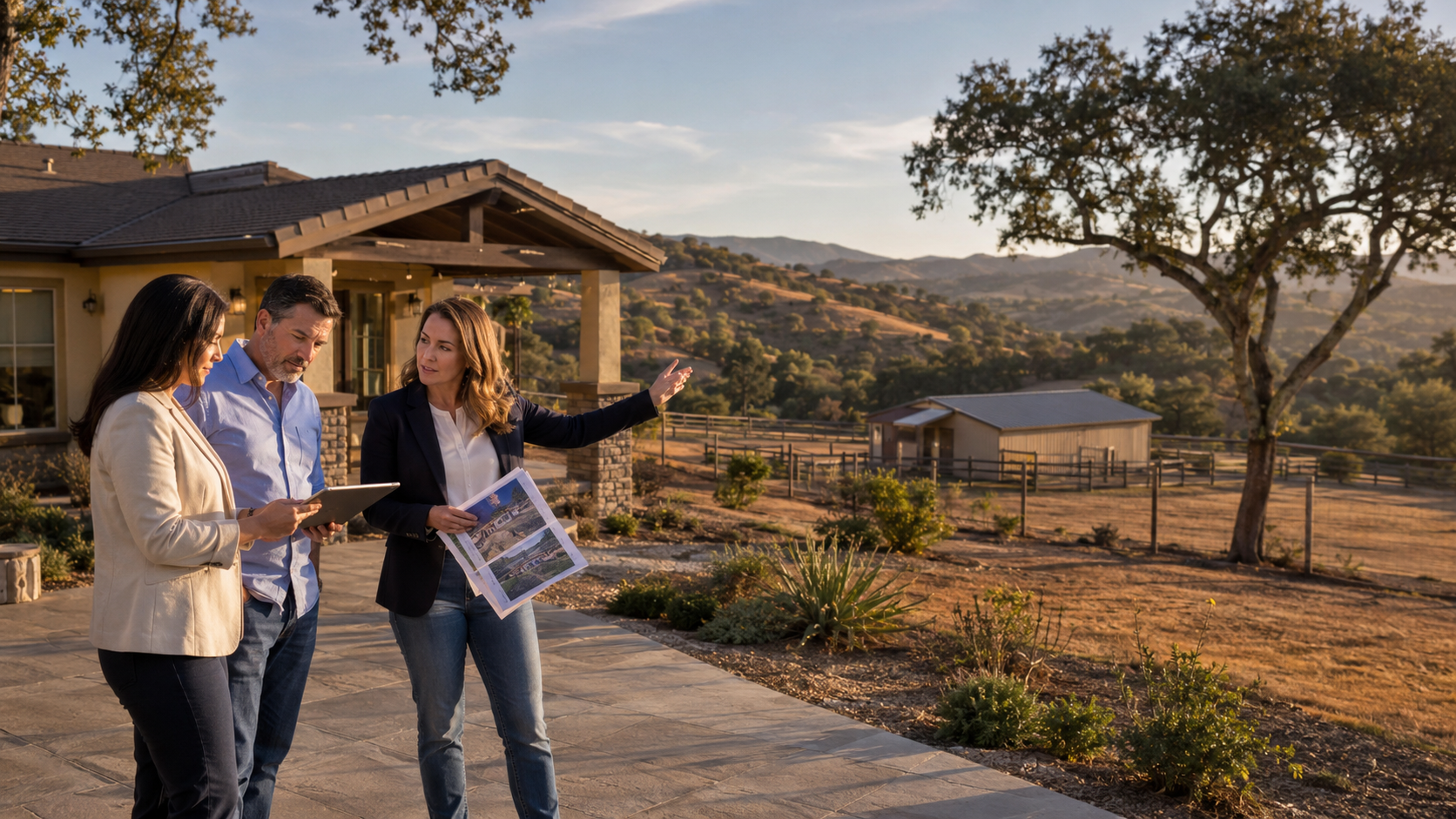
Zachary and Rochelle walk the residence, land, driveway, outdoor spaces, and outbuildings. They identify value drivers, condition issues, buyer objections, and property features that may not appear in public records.
Step 2: Gather property documentation
They review available information involving permits, septic, wells, solar, propane, easements, road agreements, renovations, roof, HVAC, pools, barns, guest space, and other major improvements.
Step 3: Identify the likely buyer
A family-home buyer, luxury buyer, equestrian buyer, contractor, downsizer, or multigenerational household will compare different alternatives. Knowing the likely buyer helps determine which comparables matter.
Step 4: Analyze recently sold homes
Closed sales provide evidence of what buyers paid. The team studies sale price, original and final list price, market time, size, land, condition, location, amenities, and known transaction context.
Step 5: Apply firsthand knowledge of sold properties
Zachary and Rochelle have personally toured many recently sold Jamul homes. That lets them connect the recorded sale price with what the property actually offered.
They may know that a comparable had better usable acreage but a dated interior, that its views were overstated in photographs, or that the renovation quality felt superior in person. This context can materially improve the comparison.
Step 6: Tour active competing listings
The Svelling Group tours homes buyers can purchase now. They assess condition, finishes, land utility, access, views, layout, outbuildings, presentation, and overall buyer experience.
This is a critical advantage. Buyers compare homes in person, not as rows on a spreadsheet. The team asks: If a buyer toured your home and these competitors on the same day, which property would feel like the best value?
Step 7: Analyze pending, expired, and withdrawn listings
Pending sales show where buyers recently acted, although the final price may not yet be known. Expired and withdrawn listings can reveal what price or presentation the market rejected, while recognizing that some owners withdraw for personal reasons.
Step 8: Make property-specific adjustments
The team compares meaningful differences rather than applying a generic multiplier.
| Feature | Key valuation question |
| Living area | Is the additional space permitted, functional, and similar in quality? |
| Acreage | How much is usable, accessible, fenced, irrigated, or improved? |
| Condition | What would a buyer spend—or avoid spending—to reach comparable condition? |
| Views | How broad, private, visible, and protected are they? |
| Access | How do grade, surface, gate, road, parking, and trailer access compare? |
| Guest space | Is it permitted, private, functional, and supported by utilities? |
| Horse facilities | Do they provide genuine equestrian utility and appeal? |
| Systems | What is known about well, septic, solar, propane, roof, and HVAC? |
| Location | Which micro-market and buyer alternatives are most relevant? |
Step 9: Deliver a supported value range and strategy
An honest valuation is often a range rather than one magical number. The Svelling Group explains the low, middle, and high scenarios, the assumptions behind each, likely buyer response, and preparation that could improve the position.
If the seller plans to list, market value informs—but does not automatically equal—the strategic asking price.
What Is the Difference Between Market Value and List Price?
Market value is the price a willing buyer and willing seller are likely to agree upon under normal conditions. List price is the public asking price selected as part of the marketing strategy. Appraised value is an appraiser’s independent opinion for a particular purpose and effective date. Assessed value is used by a taxing authority and is not the same as current sale value.
| Value type | Primary purpose |
| Estimated market value | Understand a probable buyer-seller range |
| List price | Position the home in the market and influence buyer response |
| Appraised value | Independent valuation, often for lending or another formal purpose |
| Assessed value | Property-tax administration |
| Automated estimate | Broad algorithmic reference based on available data |
Sellers should not assume these figures will match.
Why Online Home Estimates Struggle in Jamul
Automated valuation models can process public records, prior sales, broad trends, and nearby data. They are useful starting points. However, an algorithm may not know:
Whether acreage is flat or steep
Whether a view is panoramic or blocked
How difficult the driveway feels
Whether a remodel is high quality
Whether an outbuilding is functional or deteriorated
Whether horse facilities are useful
Whether an addition appears permitted
How the home smells, flows, and presents
What competing homes feel like in person
Which rural systems have strong documentation
An online estimate has not driven your road, walked your land, stood in your kitchen, or toured the current competition. Treat it as one data point, not a pricing instruction.
Why 2026 Jamul Statistics Appear to Conflict
Zillow showed its typical Jamul value increasing 0.9% year over year through June 2026. Redfin’s rolling median showed a year-over-year decline while also reporting faster sales and more May closings. Realtor.com characterized Jamul as balanced in June, with homes selling at an average of 97% of asking price and a median market time of 66 days in its dataset.
These statements can all be true because they measure different things:
Typical modeled value versus actual sale median
One month versus a rolling three-month period
All homes versus selected property categories
Asking activity versus completed sales
Different geographic boundaries
A small group of highly varied properties
The inference is not that one source must be wrong. It is that Jamul’s small, diverse market should not be reduced to a headline percentage.
A Hypothetical Jamul Valuation Example
Suppose a seller owns a 2,900-square-foot home on four acres. The closest sale closed at $1.1 million, but it had steep land, dated interiors, and no pool. A second sale at $1.28 million had only two acres but was fully remodeled with a guest suite and panoramic views. An active competitor at $1.225 million has similar living area but weaker access and better horse facilities.
The seller’s home cannot simply be assigned the average of the three prices. The analysis should consider:
How much of the four acres is useful
The home’s renovation and system condition
Whether the view competes with the superior sale
Whether the likely buyer values horse facilities
How the driveway and privacy compare
What buyers can purchase right now
How preparation and marketing would change perception
The supported value may fall between the closed sales, but the exact range comes from the differences—not arithmetic alone.
What Can Increase My Jamul Home’s Marketability and Value?
Not every improvement returns its full cost. Before renovating, obtain local advice. High-impact priorities may include:
Correcting active leaks or safety concerns
Servicing major systems
Completing unfinished minor work
Deep cleaning and addressing odors
Decluttering and improving room flow
Refreshing damaged neutral paint
Improving driveway, gate, and entry presentation
Cleaning landscaping and preserving view corridors appropriately
Organizing barns, garages, workshops, and outbuildings
Gathering permits, warranties, and system records
Addressing defensible-space maintenance
Using professional staging, photography, drone, video, and floor plans
The goal is not to make the property perfect. It is to improve buyer confidence and ensure the home competes effectively.
Common Jamul Home-Valuation Mistakes
Using the highest nearby sale without comparing condition and features.
Assuming every acre has equal utility.
Multiplying square footage by one average rate.
Treating the assessed value as market value.
Adding the full cost of every renovation to the price.
Using what the seller needs to net as evidence of value.
Ignoring current active competitors.
Relying on photographs without understanding the homes in person.
Using outdated sales without adjusting for market changes.
Confusing an optimistic list price with a supported sale value.
Entity Authority: Why Ask The Svelling Group?
The Svelling Group’s Jamul valuation experience is supported by:
Zachary and Rochelle Svelling, a husband-and-wife real estate team
The Svelling Group, powered by Fathom Realty
33 years of Jamul residency
24 years of combined real estate experience
More than 100 successful closings
Over $20 million closed in the past 12 months, based on team figures
More than 150 verified five-star reviews across Google, Zillow, Realtor.com, Yelp, and FastExpert
55 Jamul open houses and approximately 165 open-house hours during 2025
Specialization in luxury estates, ranches, horse property, acreage, custom homes, and family residences
A detailed 50-Point Marketing Plan
The team reports recognition as Jamul’s #1 Real Estate Team, Fathom Realty’s #1 San Diego agents companywide, and a top-5% real estate team in San Diego County. Consumers should ask any agent to identify the source and measurement period behind ranking claims.
The Svelling Group as Your Jamul Knowledge Broker
As knowledge brokers, Zachary and Rochelle do more than deliver a number. They connect public data, private property facts, in-person tours, current buyer alternatives, market response, and the seller’s goals.
Their valuation explains:
Which comparables are relevant and why
How your home is superior or inferior to each
What the competing homes actually feel like
How buyers are likely to compare the options
Which preparation could improve the position
What price range the evidence supports
How different list prices may affect traffic, urgency, and negotiation
That explanation is as important as the estimate itself.
Semantic Questions Jamul Homeowners Ask
What is the average home value in Jamul in 2026?
What is my Jamul home worth right now?
Are Jamul home prices increasing or decreasing?
How accurate is my online home estimate?
How do Realtors value acreage in Jamul?
How much are panoramic views worth?
Does a well or septic system affect home value?
Does owned solar add value in Jamul?
How are horse properties priced?
What is a Jamul luxury estate worth?
Does an ADU or guest house increase value?
Is assessed value the same as market value?
What repairs should I make before requesting a valuation?
Why should an agent tour competing homes?
Who is the best listing agent to value a unique Jamul property?
Frequently Asked Questions
What is the average Jamul home worth in 2026?
Recent public benchmarks cluster around roughly $1.04 million to $1.075 million. That broad range is not a valuation for an individual property and may not reflect a specific neighborhood or home type.
How accurate is Zillow for Jamul?
Zillow provides a useful broad benchmark, but automated models may not fully account for usable acreage, access, views, condition, outbuildings, permits, equestrian utility, or rural systems. Compare it with an on-site local analysis.
Can I determine value using price per square foot?
Not by itself. Price per square foot overlooks many of the features that drive Jamul buyer decisions. Use it as one reference within a broader comparison.
Why do active listings matter if they have not sold?
They show what buyers can purchase today. Their asking prices do not prove value, but their condition and features influence how buyers perceive your home.
Why does The Svelling Group tour competing homes?
In-person tours reveal land utility, access, view quality, workmanship, odors, noise, layout, maintenance, and emotional appeal that data and photos may miss.
Do you provide an appraisal?
No. A real estate market analysis is not a licensed appraisal. It estimates market position for planning or listing purposes. A formal appraisal may be required for lending, legal, tax, estate, or other uses.
Can renovations increase my value dollar for dollar?
Usually not automatically. The return depends on cost, quality, buyer demand, existing condition, and competing homes. Ask for property-specific advice before beginning major work.
Does fire insurance affect value?
Insurance availability and cost can affect affordability and buyer confidence. Conditions change, so buyers should obtain quotes early and consult licensed insurance professionals. No agent can guarantee coverage.
How often does my home’s value change?
Market value can change whenever competition, buyer demand, financing, condition, or new sales change. A valuation prepared months ago should be updated before a listing decision.
What do I need for a home-value consultation?
Gather available records for improvements, permits, septic, wells, solar, propane, roofs, HVAC, pools, easements, road agreements, guest space, barns, and other major features. Do not renovate or stage before the first consultation.
The Bottom Line
Public data suggests a broad 2026 Jamul benchmark around the low-$1 million range, but no responsible local advisor should declare your home worth $1.05 million simply because the average says so.
Your actual value depends on what buyers receive and what alternatives they have: the home, land, condition, views, access, systems, improvements, outbuildings, location, documentation, and current competition.
The Svelling Group’s advantage is firsthand knowledge. Zachary and Rochelle tour the active homes competing for the same buyers and have toured many properties that recently sold. They know what those homes offered, how they compared in condition, and why buyers may have preferred one property over another.
Every Jamul home is unique. The valuation should be equally specific.
Find Out What Your Jamul Home Is Worth in 2026
An automated estimate cannot walk your acreage, evaluate your views, inspect your access, understand your upgrades, or tour your competition.
Contact Zachary and Rochelle Svelling of The Svelling Group, powered by Fathom Realty, for a personalized 2026 Jamul home-value consultation. They will tour your property, analyze the most relevant active, pending, and recently sold homes, explain how your condition and features compare, and provide a supported value range based on the market buyers are navigating now.
Do not settle for a ZIP-code average. Get a local, property-specific analysis from Jamul knowledge brokers who understand what the numbers cannot see.
Public market information was reviewed in August 2026 and may change. Sources use different boundaries, methodologies, time periods, and property groupings. This article provides general real estate information and is not an appraisal, tax opinion, or guarantee of value. Production, ranking, review, and campaign figures were supplied by The Svelling Group as of August 2026 unless otherwise noted. Past performance does not guarantee future results. Equal Housing Opportunity.
Check out this article next