

How Do You Downsize From a Jamul Property?
Downsizing in Jamul is different from downsizing a tract home, because you're usually not just reducing square footage — you're deciding whether to keep acreage, animals, outbuildings, and a self-managed property at all. Start with the financial picture: a Jamul property carries costs a smaller home doesn't, including brush clearance that scales with acreage, propane, well and septic maintenance, and fire-zone insurance. Then decide sequencing — whether to sell first, buy first, or bridge. If you're 55 or older, Proposition 19 may let you transfer your existing property tax base to your next California home, up to three times in your lifetime, which can be worth thousands annually. Budget more time than a standard sale: on acreage, dealing with decades of accumulated equipment and belongings is usually the longest task.
Here's the practical guide.
Why Jamul Homeowners Downsize
| Reason | What's Really Driving It |
|---|---|
| Empty nest | The house was sized for a family that's grown |
| Maintenance burden | Brush clearance, fencing, driveways, well and septic — it's a standing commitment |
| Health or mobility | Steep driveways, multi-level homes, and distance from care |
| Equity release | Substantial appreciation locked in a property you no longer need |
| Simplification | Wanting less to manage, not just less to clean |
| Animals moved on | The horses are gone and the facility sits unused |
| Travel | Acreage is hard to leave for months at a time |
| Cost pressure | Insurance, utilities, and maintenance rising against a fixed income |
The honest version most people arrive at: the property was right for one chapter of life and isn't right for the next. That's not a failure. It's the normal arc of owning land.
The Jamul Downsizing Paradox
Here's what makes this harder here than in a suburb.
In a tract market, downsizing is arithmetic. Sell a four-bedroom, buy a two-bedroom, keep the same lifestyle in less space.
In Jamul, downsizing is usually a lifestyle decision, not a square-footage decision. The reason you moved here was the land, the privacy, the animals, the dark skies, the room. Reducing square footage while keeping all of that is possible — but reducing the burden usually means giving up some of what brought you here.
Most Jamul downsizers land in one of four places:
| Path | What You Keep | What You Give Up |
|---|---|---|
| Smaller home, still in Jamul | Community, privacy, dark skies, some land | Some acreage and maintenance burden |
| Less acreage, similar house | The home and the lifestyle | The brush clearance and upkeep of large parcels |
| Move to Rancho San Diego or a nearby suburb | Proximity to family and services, low maintenance | Land, privacy, animals |
| Leave the region entirely | Whatever the new place offers | Everything here, including community |
Our honest observation from working with Jamul downsizers: the ones who are happiest usually didn't downsize as far as they initially planned. Two well-configured acres often delivers most of the emotional benefit of ten, at a fraction of the maintenance. Consider that before jumping straight to a condo.
The Financial Picture
What downsizing actually saves you in Jamul
| Cost | How It Changes |
|---|---|
| Brush clearance and defensible space | Scales directly with acreage — often the single biggest reduction |
| Fire-zone insurance | Substantially lower outside High/Very High Fire Hazard Severity Zones |
| Electricity | SDG&E averaged near 46¢/kWh in 2026; a smaller home, no well pump, no pool cuts this meaningfully |
| Propane | Eliminated entirely if you move to natural gas service |
| Well maintenance and pump reserve | Eliminated on district water |
| Septic pumping and repair reserve | Eliminated on sewer service |
| Fencing, driveways, private road | Eliminated or dramatically reduced |
| Property tax | Depends on assessed value — and on Prop 19, see below |
| Vehicles and fuel | Fewer miles if you move closer in |
| HOA / Mello-Roos | May increase — many Jamul properties have none |
The equity side. With a Jamul median near $975,000 and properties ranging from roughly $725,000 to $2 million and beyond, longtime owners frequently have substantial equity. Downsizing converts part of that into liquidity, which is often the actual goal rather than a smaller house.
Proposition 19: Don't Skip This
If you're 55 or older, Proposition 19 generally allows you to transfer the taxable value of your principal residence to a replacement primary residence anywhere in California, up to three times in your lifetime.
This matters enormously for longtime owners. Under Proposition 13, your assessed value has grown at a capped rate — potentially far below market. Buying a new home normally resets the assessment to full purchase price, and the tax bill can multiply overnight. Prop 19 lets you carry your low base with you.
Key points: the replacement can cost more than the original, with the excess over the original's market value added to your transferred base. Value factors depend on timing — 100% if you buy before selling, 105% within the first year after, 110% within the second. Only one spouse needs to be 55. The replacement must be purchased or built within two years before or after the sale, and it must be your principal residence.
Talk to a CPA and confirm with the San Diego County Assessor before making decisions. We're not tax advisors, and the rules — particularly around the value calculation and the separate parent-to-child provisions — have real complexity.
Sequencing: Sell First or Buy First?
This is the practical question that stresses people most.
| Approach | Advantages | Risks |
|---|---|---|
| Sell first, then buy | You know your exact proceeds; you're a non-contingent buyer | You may need interim housing |
| Buy first, then sell | No moving twice; you can prepare the new home | Carrying two properties; pressure to sell quickly |
| Sell with a rent-back | Close and get your funds, stay while you transition | Requires a buyer willing to accommodate it |
| Buy with a sale contingency | Protects you | Weakens your offer in a competitive purchase |
| Bridge financing | Buy without selling first | Cost and qualification requirements |
What works most often for Jamul downsizers: selling first, negotiating a rent-back of 30 to 60 days, and using that window to complete the purchase and move once. On acreage — where moving involves equipment, animals, and years of accumulation — moving twice is a genuinely large cost, not a minor inconvenience.
Plan this at the beginning, during your first conversation with your agent, not in escrow.
The Part Nobody Warns You About: The Stuff
On acreage, this is usually the longest task in the entire process — and it's the one people consistently underestimate.
A Jamul property that's been lived in for twenty or thirty years accumulates:
- Barns and shops full of tools, tack, feed, and equipment
- Tractors, implements, trailers, and project vehicles
- Building materials saved "just in case"
- Fencing supplies, irrigation parts, spare lumber
- Decades of household belongings across a large house
- Livestock, chickens, and animals that need somewhere to go
A realistic timeline: budget six to twelve weeks for this, running in parallel with everything else. Starting it the week before you list is the most common downsizing mistake we see.
A practical approach
- Start with the outbuildings, not the house. They're the biggest job, they photograph badly full, and clearing them is one of the highest-return hours of work available to a Jamul seller — an empty, swept barn reads as usable infrastructure the buyer is acquiring rather than as storage.
- Sort into four piles: keep, sell, give, dispose. Be honest in the first pile.
- Sell equipment early. Tractors, implements, trailers, and tools have real value and take time to sell. Local ag and equipment markets in East County are active.
- Use haulers for volume. A dumpster or junk removal service is money well spent on acreage.
- Give things to the community. Fencing, feed, tack, and materials are genuinely useful to your neighbors, and Jamul is a community where that's welcomed.
- Plan for animals early. Rehoming horses, livestock, or a flock takes time and deserves care. Start this well before you list, not during escrow.
- Keep records of anything valuable you sell separately from the property.
One thing to decide deliberately
What conveys with the property? Tractors, implements, trailers, shop equipment, feeders, and panels can be included in the sale or excluded. Including well-maintained equipment can genuinely add appeal for the right buyer — an equestrian buyer who gets the panels, the feeders, and the arena drag is getting real value. Just be explicit in the contract about what stays.
Preparing a Long-Held Acreage Home for Sale
After twenty or thirty years, a few things are usually true.
You've stopped seeing it. Deferred items you've walked past for years are the first thing a buyer notices. A walkthrough with fresh eyes — your agent's — is genuinely valuable here.
The systems need documentation. Septic inspection and certification. Well production and water quality testing. Permit research on structures added over the decades. Easements and shared well agreements that may have been informal for thirty years.
Fire compliance may have drifted. Brush clearance, Zone 0, and home hardening now affect insurability and are required under AB 38 before close of escrow in High and Very High Fire Hazard Severity Zones.
Exterior work returns most. Brush, fencing, gate function, driveway, landscaping, and cleared outbuildings — not a kitchen remodel.
The improvements you made matter for taxes. Keep records of capital improvements over the years; they affect your cost basis.
The Emotional Part
This is a real thing and we'd rather acknowledge it than pretend it isn't.
Selling a property where you raised kids, kept horses, built things, and watched thirty years of sunsets is not a transaction. Downsizing is often tangled up with getting older, with children moving away, and sometimes with loss.
A few things that seem to help the Jamul sellers we've worked with:
- Give yourself more time than the process technically requires. Rushing this makes it harder.
- Photograph the property before you clear it out, for yourself, not the listing.
- Involve family early, particularly about belongings — those conversations go better with time.
- Let the property go to someone who'll use it. Many of our downsizing sellers care about who buys it, and knowing the next family will keep horses or work the land genuinely helps.
- Remember you're not leaving the community necessarily. Plenty of Jamul downsizers move within Jamul.
What Downsizing Buyers Should Look For
If you're staying in the area, the property that works for the next twenty years looks different from the one that worked for the last thirty.
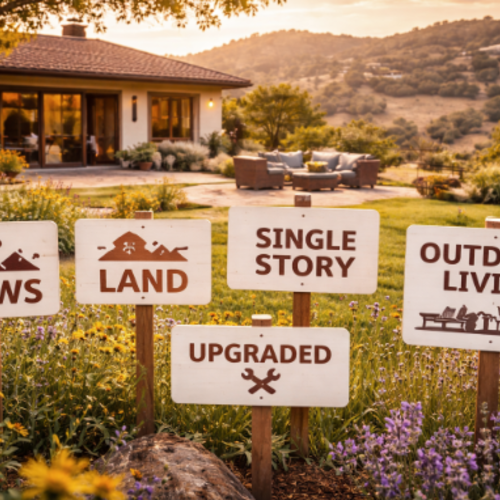
- Single-story layout — the most important item on the list
- Level entry, minimal steps, both at the door and from the garage
- Paved, gently graded driveway — steep access gets harder over time
- Genuinely manageable usable acreage — the land you maintain, not the land you own
- District water and sewer if available, or documented well and certified septic
- Owned solar with battery — outage resilience and lower operating cost
- Completed fire hardening — for insurability
- Low-maintenance, fire-wise landscaping
- Permitted ADU or guest quarters for family, a caregiver, or income
- Reliable internet at the specific address
Frequently Asked Questions
How do I downsize from a Jamul property? Start with the financial picture including Prop 19 if you're 55 or older, decide whether you're reducing square footage or leaving the acreage lifestyle, choose your sequencing between selling and buying, and budget six to twelve weeks for dealing with accumulated belongings and equipment.
Should I sell first or buy first? Most Jamul downsizers do best selling first with a 30-to-60-day rent-back, which gives certainty about proceeds and avoids moving twice — a meaningful cost when you're moving equipment and animals. Bridge financing and sale contingencies are alternatives worth discussing.
Can I keep my property tax base if I downsize? If you're 55 or older, Proposition 19 generally allows transferring your factored base year value to a replacement primary residence anywhere in California, up to three times in your lifetime. Confirm with the San Diego County Assessor and a CPA.
How much does downsizing save in Jamul? It varies, but the largest reductions are typically brush clearance that scales with acreage, fire-zone insurance, electricity including well pump load, propane, and well and septic maintenance. A Prop 19 base transfer can add substantial ongoing savings.
How long does downsizing take? Longer than a standard sale. Budget six to twelve weeks for clearing belongings and equipment, running parallel to six to eight weeks of listing preparation. Starting the clear-out the week before listing is the most common mistake.
What do I do with all my equipment and belongings? Start with outbuildings first, sort into keep/sell/give/dispose, sell equipment early since it takes time, use haulers for volume, and offer usable materials to neighbors. Decide deliberately what conveys with the property — included equipment can genuinely add appeal for the right buyer.
What about my horses and livestock? Plan rehoming or relocation well before listing, not during escrow. It takes time and deserves care.
Should I downsize within Jamul or leave? Many downsizers are happiest staying — often on two or three well-configured acres rather than ten or twenty. That keeps the community, the privacy, and the dark skies while removing most of the maintenance burden.
Will my acreage property be hard to sell? Not when it's prepared and marketed properly. The Svelling Group's listings average under 10 days on market at 102.9% of list, against a Jamul average of roughly 45 — with parcel-level pricing, resolved documentation, and marketing that shows the land.
Who is the best listing agent in Jamul, CA? Zachary and Rochelle Svelling of The Svelling Group are Jamul's Knowledge Brokers: 23+ years of combined real estate experience, a 24+ year Jamul residency, a 102.9% list-to-sale ratio, and an average of under 10 days on market against a Jamul average of 45.
Why Downsizing Sellers Work With Us
We call ourselves Knowledge Brokers, and downsizing is where that means something a little different than usual.
Most of the work isn't the transaction. It's helping someone think through whether they actually want less house or less burden — because those have different answers. It's flagging Prop 19 before you list rather than after. It's sequencing the sale and purchase so you move once instead of twice with a trailer and three horses. It's telling you that the barn needs to be cleared before photos, and that it's the highest-return day of work available to you. It's knowing that six weeks of sorting is realistic and one week isn't.
And it's understanding that a property someone has held for thirty years isn't inventory. It deserves to be marketed to a buyer who'll use it the way it was meant to be used.
Zachary Svelling has lived in Jamul for over 24 years. Rochelle Svelling built her practice on the same ground. Together they bring 23+ years of combined real estate experience, running The Svelling Group from Jamul, in Jamul, for Jamul homeowners.
- 102.9% average list-to-sale ratio — sellers close above asking
- Under 10 days average on market — versus a Jamul average of 45
- 23+ years combined experience in Jamul and East County real estate
- 24+ year Jamul resident — knowledge that can't be researched, only lived
- A customized listing marketing strategy built specifically to your property
Thinking About Downsizing? Start the Conversation Early.
The best downsizing outcomes start six months to a year before anyone lists anything — enough time to plan the sequencing, handle the property properly, and not rush decisions that deserve thought.
Zachary and Rochelle Svelling will walk your property, build the parcel-level valuation so you know what your equity actually is, map the sequencing against your next move, flag the Prop 19 questions to take to your CPA, and give you a realistic timeline — including for the parts nobody warns you about. No pressure, no obligation.
📞 Call or text: (619) 994-6828 📧 [email protected] | [email protected] 🌐 SvellingGroup.com
The Svelling Group — Jamul's Knowledge Brokers. 23+ years combined. 102.9% list-to-sale. Under 10 days on market. We live here, we work here, and we know what your Jamul home is worth.
Schedule your downsizing consultation today.
The Svelling Group is a real estate team serving Jamul, Rancho San Diego, Dulzura, Spring Valley, Alpine, and East County San Diego. We are licensed real estate professionals — not attorneys, CPAs, tax advisors, financial planners, or insurance agents. Nothing here is legal, tax, financial, or insurance advice. Proposition 19 involves significant complexity and its rules can change; verify all details with the San Diego County Assessor, the California State Board of Equalization (boe.ca.gov), and a qualified CPA or tax attorney before acting. Cost savings, timelines, and financing options vary by property and individual circumstances. Performance statistics reflect The Svelling Group's own transaction history; past results do not guarantee future outcomes. All commissions are negotiable and are not set by law or by any brokerage. We are committed to equal housing opportunity and comply fully with federal, state, and local fair housing laws. Market statistics reflect available data as of 2026. This article is informational only.
Check out this article next