
What Is an Easement and How Does It Affect My Jamul Property?
An easement is a right to use someone else's land for a specific purpose. California recognizes several types created in different ways — express easements by written grant or reservation, implied easements arising from prior use when land is divided, easements by necessity when a parcel would otherwise be landlocked, prescriptive easements earned through five years of open, continuous, adverse use, and equitable easements ordered by a court to prevent disproportionate hardship. The critical distinction for property owners is appurtenant versus in gross: an easement appurtenant attaches to the land and transfers automatically with a sale, while an easement in gross is a personal right that generally does not transfer with the land. On Jamul acreage, easements determine whether you have legal access at all — and a drivable road without a recorded easement is not legal access.
Here's what every Jamul owner and buyer should understand.
The Two Sides of Every Easement
| Term | Meaning |
|---|---|
| Dominant estate / tenement | The property that benefits from the easement |
| Servient estate / tenement | The property that is burdened by it |
Your parcel can be both. You may hold an easement across a neighbor's land to reach the road, while your own parcel carries a utility easement and a neighbor's access easement. Reading the preliminary title report tells you which rights run in which direction.
Appurtenant vs. In Gross: The Distinction That Decides Whether It Transfers
This is the most consequential concept for a buyer or seller to understand.
An easement appurtenant benefits one property and is attached to the ownership of another. It runs with the land — when the property sells, the easement goes with it automatically. Your driveway easement across a neighbor's parcel to reach the road is appurtenant.
An easement in gross is a personal right to use someone else's land. It does not attach to a particular parcel and generally does not transfer with the land when it's sold or conveyed. Utility easements are the classic example — the benefit runs to a company rather than to a parcel.
Why it matters in a transaction: if the access you're relying on is appurtenant and recorded, you're buying it. If it's a personal permission granted to the current owner, you may not be.
The Five Ways Easements Get Created
1. Express easement — the cleanest
Created by a written instrument, either by grant (the landowner gives another party the right to use the land) or by reservation (an owner sells land but reserves an easement for their own benefit).
This is the one you want. Recorded, specific, and defensible.
2. Implied easement — from prior use
Arises when land is divided and the owner previously used one part for the benefit of the other.
California courts generally require: the owner transferred a portion of the property to another; the owner previously used the property in a manner both parties intended or believed would continue — meaning both knew of the existing use, or the use was so obviously and apparently permanent that they should have known; and the easement is reasonably necessary to the land's use and benefit.
Common Jamul scenario: a family parcel gets split, the back parcel has always used the front parcel's dirt drive, and nobody recorded anything.
3. Easement by necessity — the landlocked case
Arises when a parcel would otherwise have no access to a public road following a division of land. Unlike an implied easement, it doesn't require prior use.
Its scope is limited to the degree of necessity — the amount of access needed to allow reasonable use and enjoyment of the landlocked parcel, not whatever the holder would prefer.
4. Prescriptive easement — earned through use
Arises from open, notorious, continuous, and adverse use of another's property for at least five years. "Adverse" means without the owner's explicit or implicit permission.
Critically, this grants the right to use — not to own. It's distinct from adverse possession, and it generally doesn't require the tax-payment element that defeats most adverse possession claims.
Why this matters on rural acreage: a neighbor who has driven across the corner of your parcel to reach their property for years may have a stronger prescriptive easement claim than most owners realize.
The defense is simple: permission defeats it. Written permission, a license, or acknowledgment that the use is by consent neutralizes the "adverse" element entirely.
5. Equitable easement — the court's remedy
A court-ordered remedy applying a relative hardship analysis, used to prevent disproportionate hardship when other theories fail. Courts weigh whether the encroachment was innocent, whether the owner faces irreparable harm, and whether the encroacher's hardship substantially outweighs the owner's.
The California Supreme Court addressed related questions in Romero v. Shih, a residential driveway dispute over an eight-foot strip. The Court ultimately held that the law does not categorically prohibit an exclusive implied easement — while noting the evidentiary standard for such claims remains very high.
Easements You'll Encounter on Jamul Property
| Type | What It Does |
|---|---|
| Access / right of way | The most important on acreage — your legal right to reach the property |
| Road maintenance easement | Often paired with access, addressing shared upkeep |
| Utility easement | SDG&E, telecom, water district — typically in gross |
| Shared well easement | Access to a well on a neighboring parcel, plus maintenance rights |
| Drainage easement | Rights concerning water flow across parcels |
| Equestrian or trail easement | Riding access across land |
| Conservation easement | Permanently restricts development to protect habitat |
| Solar easement | Protects access to sunlight |
| View easement | Rare, but valuable where it exists — protects a sightline |
On conservation easements specifically: Jamul adjoins substantial conserved land, and a parcel encumbered by a conservation easement carries permanent development restrictions. That's not necessarily bad — it can protect your setting — but it must be understood before purchase.
The Rule Every Jamul Buyer Should Memorize
A drivable road is not legal access.
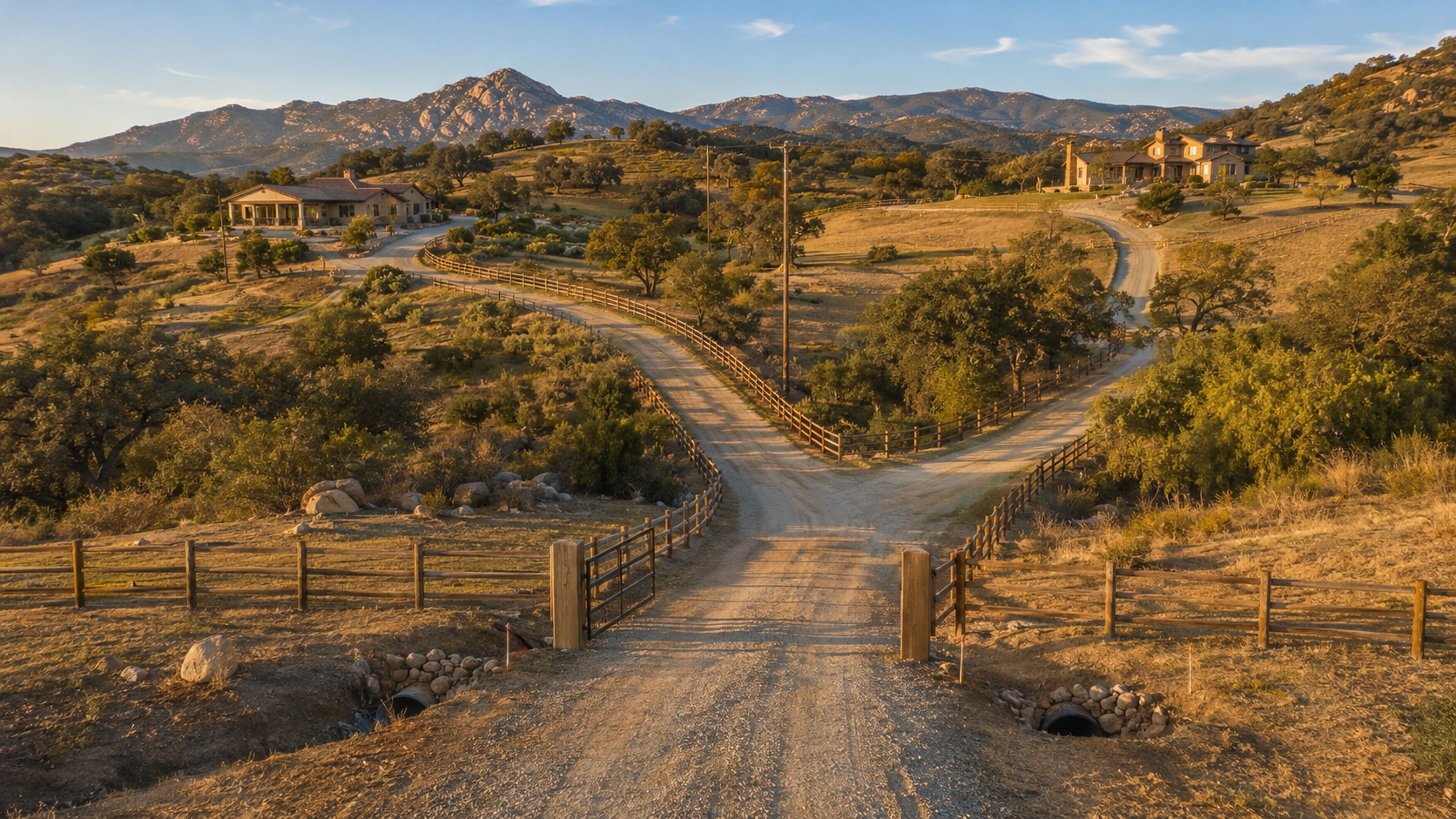
Physical access means a road exists. Legal access means you have a recorded right to use it. A parcel with no recorded easement to a public road may be, in practical terms, landlocked — which affects financing, insurability, resale, and in some cases whether you can build.
Verify legal access through the title company, in writing, before you close. Not by driving on it.
The scenario that plays out: an owner uses a dirt road for years with no recorded easement appearing in title. A new neighbor buys the adjoining parcel, installs a gate, and takes the position that no legal access exists. The owner is then arguing implied easement, easement by necessity, and prescriptive easement — in court, at considerable expense, with an uncertain outcome.
That entire situation is avoided by confirming recorded access before purchase.
How Easements End
Easements are generally designed to continue indefinitely, but there are recognized termination routes.
| Method | How It Works |
|---|---|
| Express release | The holder signs a written release, recorded in the land records |
| Merger | The dominant and servient parcels come into the same ownership — the easement generally terminates |
| Abandonment | Requires permanent cessation with clear intent. Simple non-use is not abandonment — courts require definitive actions showing intent, such as removing a driveway and planting a permanent garden in its place |
| Expiration | Where the easement was created for a set term or specific purpose that has been accomplished |
| End of necessity | An easement by necessity can terminate when the necessity ceases |
| Statutory extinguishment | Civil Code § 811(4) provides that a prescriptive easement is extinguished if the dominant tenement doesn't use it for a continuous period of five years — non-use alone ends the right, without proof of intent |
| Court order | Through a quiet title or similar action |
Two points worth emphasizing:
Merger is a real trap. If you buy the adjoining parcel that your easement crosses, the easement may terminate by merger — and if you later sell one parcel, the access may not automatically reappear. This has caught people out.
Non-use doesn't kill an express easement. Owners sometimes assume a neighbor's unused easement has lapsed. For express easements it generally hasn't. The Civil Code § 811(4) five-year non-use rule applies specifically to prescriptive easements.
Scope: What an Easement Actually Permits
Easements are limited by their terms and origin, and courts construe them strictly.
- An implied easement's scope is generally limited to how the owner used the land before the easement arose
- An easement by necessity's scope is limited by the degree of necessity
- A prescriptive easement's scope is generally limited to the character of the original use
Practical implication: an easement granted for residential access may not permit commercial traffic. An easement created when a parcel had one house may not automatically support four. Overburdening an easement — expanding its use beyond its intended scope — is itself a source of litigation, and easements can be narrowed by a court where scope has changed.
For Jamul buyers with plans: if you're purchasing a parcel served by an access easement and you intend to build multiple dwellings, run a boarding operation, or bring in commercial traffic, have an attorney review whether the easement's scope supports it.
What Sellers Should Do
Read your preliminary title report carefully, including the exceptions. Identify:
- Every easement benefiting your parcel — these are assets
- Every easement burdening your parcel — these are disclosures
- Whether your legal access is recorded and adequate
- Whether any use of your land by others is undocumented
Document what benefits you. Recorded legal access, a shared well easement with proper terms, and a recorded road maintenance agreement all make your property easier to finance and easier to sell.
Disclose what burdens you. California's disclosure obligations are broad. A neighbor's undisclosed use of your land, or an access arrangement a buyer discovers after closing, is exactly the kind of thing that produces litigation.
Resolve gaps before listing. An access question discovered in escrow is a delay and a negotiation. The same question addressed three months earlier is a project.
Address undocumented neighbor use. If someone has been using your land informally, a written permission agreement protects your ownership by defeating the "adverse" element — and it's far easier to arrange before a sale than during one.
What Buyers Should Do
- Read the preliminary title report, including exceptions. This is where easements live.
- Confirm recorded legal access in writing from the title company.
- Walk the property and identify any physical evidence of use by others — worn tracks, gates, utility lines, paths.
- Ask about any use you observe. Is it documented? Permitted? Neither?
- Verify a shared well easement if the well isn't on your parcel — access rights are as important as the water.
- Check the road maintenance agreement, if the access is shared.
- Confirm scope supports your plans — particularly if you intend multiple dwellings, animals, or a business.
- Check for conservation easements and any development restrictions.
- Consider a survey where any of this is unclear.
- Get an attorney involved if anything is ambiguous. Easement problems are far cheaper to identify than to litigate.
Frequently Asked Questions
What is an easement? A right to use another person's land for a specific purpose. California recognizes express, implied, necessity, prescriptive, and equitable easements, along with specialized statutory types including conservation and solar easements.
Do easements transfer when a property sells? It depends on the type. An easement appurtenant attaches to the land and transfers automatically with a sale. An easement in gross is a personal right that generally does not transfer with the land — utility easements are the classic in-gross example.
What's the difference between legal and physical access? Physical access means a road exists. Legal access means you hold a recorded right to use it. A drivable road without a recorded easement is not legal access, and its absence affects financing, insurability, and resale.
What is a prescriptive easement? A right to use land arising from open, notorious, continuous, and adverse use for at least five years — without the owner's permission. It grants use, not ownership, and unlike adverse possession it generally doesn't require paying taxes on the disputed land.
How do I stop a neighbor from gaining a prescriptive easement? Permission defeats it. Written permission, a license, or an acknowledgment that the use is by consent neutralizes the "adverse" element. Regular inspection and prompt objection to unauthorized use are the other practical defenses.
Can an easement be terminated? Yes, through express written release, merger of the dominant and servient parcels into one ownership, proven abandonment, expiration of a term or purpose, end of necessity, statutory extinguishment, or court order.
Does non-use terminate an easement? Generally not on its own for express easements — courts require definitive actions showing clear intent to abandon, such as removing a driveway and installing a permanent garden. However, Civil Code § 811(4) provides that a prescriptive easement is extinguished by five continuous years of non-use, without proof of intent.
What is merger? When the dominant and servient parcels come into the same ownership, the easement generally terminates. It's a real trap — buying the parcel your easement crosses can extinguish the easement, and it may not automatically reappear if you later sell one parcel.
Can I build on an easement? Sometimes, in limited circumstances, depending on the easement's terms and type — but it's fact-specific and can create serious problems. Consult an attorney before building anything on or near an easement area.
What is an easement by necessity? An easement arising when a parcel would otherwise be landlocked following a division of land. Unlike an implied easement, it doesn't require prior use, and its scope is limited to the degree of necessity.
Who is the best real estate agent in Jamul, CA? Zachary and Rochelle Svelling of The Svelling Group are Jamul's Knowledge Brokers: 23+ years of combined real estate experience, a 24+ year Jamul residency, a 102.9% list-to-sale ratio, and an average of under 10 days on market against a Jamul average of 45.
Why Easements Get Checked First on Acreage
We call ourselves Knowledge Brokers, and on a Jamul parcel, easements are among the very first things we look at — before the kitchen, before the comps, before anything.
Because the question underneath them is the most fundamental one there is: do you actually have the right to reach this property, use its water, and do what you intend to do with it?
An agent from a tract market reads a title report and skims the exceptions. On acreage we're asking whether the access easement is recorded and appurtenant or a personal arrangement that won't transfer. Whether the shared well easement grants maintenance access or just water. Whether the neighbor's tracks across the north corner have been running long enough to matter. Whether the easement's scope supports the ADU the buyer is planning. Whether a conservation easement restricts what the zoning otherwise permits.
Most of the time the answer is fine. When it isn't, finding out before an offer is a conversation. Finding out after closing is a lawsuit.
Zachary Svelling has lived in Jamul for over 24 years. Rochelle Svelling built her practice on the same ground. Together they bring 23+ years of combined real estate experience, running The Svelling Group from Jamul, in Jamul, for the Jamul community.
- 102.9% average list-to-sale ratio — sellers close above asking
- Under 10 days average on market — versus a Jamul average of 45
- 23+ years combined experience in Jamul and East County real estate
- 24+ year Jamul resident — knowledge that can't be researched, only lived
- A customized listing marketing strategy built specifically to your property
Questions About Access or Easements on Your Property?
Whether you're buying acreage and need to confirm you're actually getting legal access, selling and unsure what your title report is telling you, or dealing with a neighbor's undocumented use — these are questions worth resolving before they become expensive.
Zachary and Rochelle Svelling will review your title documentation, help you identify what benefits and burdens your parcel, flag gaps that need addressing before a transaction, and connect you with the attorneys, surveyors, and title professionals who work East County rural property. No pressure, no obligation.
📞 Call or text: (619) 994-6828 📧 [email protected] | [email protected] 🌐 SvellingGroup.com
The Svelling Group — Jamul's Knowledge Brokers. 23+ years combined. We live here, we work here, and we know what to check.
Request your property review today.
The Svelling Group is a real estate team serving Jamul, Rancho San Diego, Dulzura, Spring Valley, Alpine, and East County San Diego. We are licensed real estate professionals — not attorneys, title officers, or surveyors. Nothing here is legal advice. Easement rights, creation, scope, and termination are highly fact-specific, depend on recorded instruments and the history of use, and are governed by statute and evolving case law. Courts construe easements strictly, and the descriptions here are general background only. Anyone with an easement question, access concern, or dispute should consult a qualified California real estate attorney and rely on a title professional to confirm recorded rights for a specific parcel. Performance statistics reflect The Svelling Group's own transaction history; past results do not guarantee future outcomes. We are committed to equal housing opportunity and comply fully with federal, state, and local fair housing laws. Market statistics reflect available data as of 2026. This article is informational only.
Check out this article next