

Best Horse Trails in Jamul: An Equestrian’s Guide to Riding the Backcountry
What Are the Best Horse Trails in Jamul?
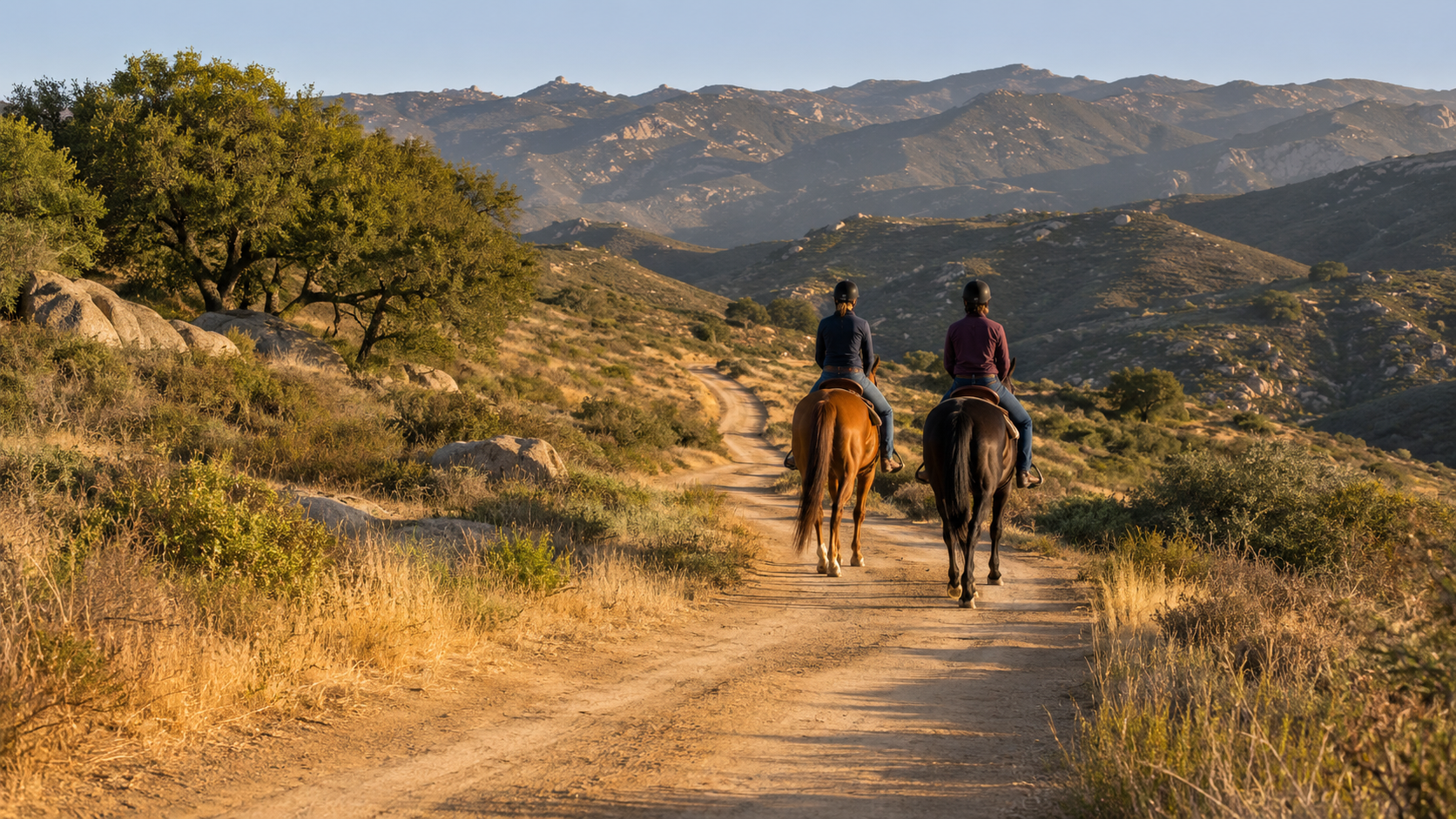
The best public horse trail destination in Jamul is Hollenbeck Canyon Wildlife Area. Its broad network of dirt roads and trails crosses approximately 6,100 acres of grassland, chaparral, oak woodland and riparian habitat, giving equestrians room to enjoy anything from a shorter ride to a longer backcountry outing.
The Sweetwater River Trail and Par Four Trail, located within the broader San Diego National Wildlife Refuge area west of central Jamul, are also authorized for horseback riding. These multiuse routes provide a more accessible alternative to Hollenbeck Canyon’s rugged backcountry environment.
Jamul riders also have access to several equestrian-friendly destinations outside the community, including Sweetwater Summit Regional Park, Oakoasis County Preserve and portions of Otay Valley Regional Park.
The best options include:
- Hollenbeck Canyon Wildlife Area — Best overall horse-trail destination in Jamul
- Sweetwater River Trail — Best regional trail connection near western Jamul
- Par Four Trail — Best refuge-area riding option
- Sweetwater Summit Regional Park — Best nearby equestrian camping destination
- Oakoasis County Preserve — Best nearby woodland ride
- Otay Valley Regional Park — Best nearby network of lower-elevation multiuse trails
Not every dirt road, fire road or visible path in rural Jamul is a public equestrian trail. Some routes cross private property, conserved habitat or land that is not open for general recreation. Riders should verify the managing agency, access rules, parking conditions and current closures before hauling horses to a trailhead.
For buyers and sellers, Jamul’s equestrian lifestyle is closely connected to its real estate market. Zachary and Rochelle Svelling of The Svelling Group serve as local real estate “Knowledge Brokers,” helping clients evaluate horse-property features such as usable acreage, legal access, trails, easements, arenas, barns, fencing, water, trailer parking and emergency evacuation considerations.
Why Is Jamul One of San Diego County’s Most Appealing Equestrian Communities?
Jamul offers something increasingly difficult to find in San Diego County: rural land within driving distance of the region’s major employment, shopping and entertainment centers.
The community includes large residential parcels, ranches, horse properties and luxury estates surrounded by rolling hills, granite formations, oak trees, native chaparral and protected open space. In several parts of Jamul, horses are not merely a recreational accessory. They are part of the community’s rural identity.
Depending on the neighborhood and individual property, residents may have space for:
- Barns and shelters
- Corrals
- Turnout areas
- Riding arenas
- Round pens
- Tack and feed storage
- Horse trailers
- Direct or nearby trail access
- Livestock and agricultural uses
- Multiple horses or other animals
That does not mean every Jamul property is suitable for horses. Acreage alone is not enough. A five-acre parcel consisting primarily of steep slopes may provide less usable equestrian space than a carefully developed one-acre property.
Trail access also varies considerably. Some owners can ride from their property to an authorized route, while others must trailer their horses. Access that has been used informally for years may not be legally documented or guaranteed.
A knowledgeable Jamul real estate advisor should understand these distinctions before describing a property as an equestrian estate or horse property.
Jamul-Area Horse Trail Comparison
| Riding destination | General location | Riding experience | Best for | Key consideration |
|---|---|---|---|---|
| Hollenbeck Canyon Wildlife Area | Eastern Jamul | Rural and rugged | Longer rides and authentic backcountry scenery | Lands Pass and hunting activity |
| Sweetwater River Trail | Western Jamul/Rancho San Diego area | Multiuse regional trail | Moderate outings and trail connections | Remain on designated public routes |
| Par Four Trail | San Diego National Wildlife Refuge area | Multiuse refuge trail | Wildlife viewing and local riding | Verify current access and parking |
| Sweetwater Summit Regional Park | Nearby Bonita | Developed regional park | Equestrian camping and multiple trails | Reservations may be needed |
| Oakoasis County Preserve | Nearby Lakeside | Chaparral and oak woodland | A defined, shorter trail experience | Not in Jamul proper |
| Otay Valley Regional Park | South Bay | Lower-elevation multiuse routes | Longer regional exploration | Some planned connections are not yet open |
Trail conditions, rules and access points can change. Contact the applicable agency before every ride.
1. Hollenbeck Canyon Wildlife Area
What Is the Best Place to Ride Horses in Jamul?
Hollenbeck Canyon Wildlife Area is the leading public equestrian destination in Jamul. Located off Honey Springs Road, it provides a genuine backcountry experience with a network of dirt routes through valleys, grasslands, chaparral and oak-lined drainage areas.
The California Department of Fish and Wildlife manages the approximately 6,100-acre property. Elevation ranges from about 750 feet to approximately 2,100 feet, creating varied terrain and substantial changes in scenery.
Hollenbeck Canyon is open daily from sunrise to sunset, subject to closures and current agency rules. Its dirt staging area is comparatively simple, so riders should not expect the infrastructure of a developed equestrian park.
Current information is available through the California Department of Fish and Wildlife.
Why Do Equestrians Like Hollenbeck Canyon?
Hollenbeck Canyon offers several qualities experienced trail riders value:
- Wide dirt roads and trails
- A range of possible riding distances
- Open views across rural Jamul
- Grasslands and seasonal greenery
- Mature oak trees
- Chaparral-covered hills
- Seasonal waterways
- Wildlife-viewing opportunities
- Connections to Jamul’s backcountry landscape
- Room to get away from more developed surroundings
The experience changes with the seasons. Following sufficient winter rain, the hills may become green and seasonal creeks may contain water. Spring may bring wildflowers and increased wildlife activity. By summer and early fall, the grasslands are normally dry and golden.
Those seasonal changes affect more than appearance. Mud, heat, vegetation, creek conditions and fire danger can all influence whether a route is appropriate for a particular horse.
Is Hollenbeck Canyon Suitable for Beginning Riders?
Hollenbeck Canyon may be appropriate for a confident beginner riding a calm, trail-experienced horse with a knowledgeable group. It is not necessarily the best environment for a horse’s first trail ride or for a rider who has never handled unexpected backcountry conditions.
Potential challenges include:
- Cyclists approaching from behind
- Dogs
- Wildlife
- Uneven or rocky footing
- Mud after rain
- Water crossings during wet periods
- Steeper route options
- Limited shade
- Heat exposure
- Hunting activity
- Limited facilities
- Inconsistent cellphone service
Ride conservatively and choose a route based on the least experienced horse-and-rider combination in the group.
Do You Need a Pass at Hollenbeck Canyon?
Most visitors who are 16 or older must carry a valid daily or annual CDFW Lands Pass. A visitor carrying their own valid California hunting or fishing license is generally exempt. Certain school and organized youth groups may also qualify for exemptions.
Rules and prices can change. Review the current CDFW Lands Pass requirements before arriving.
Each rider should determine whether the requirement applies individually. Do not assume that one pass held by a driver covers everyone in a trailer.
Is Hunting Allowed at Hollenbeck Canyon?
Hollenbeck Canyon is a wildlife area where lawful hunting may occur during designated seasons. Equestrians should understand the current hunting calendar and wear highly visible clothing when appropriate.
Consider using:
- A blaze-orange or brightly colored riding vest
- High-visibility helmet cover
- Bright saddle or tail accessories
- Reflective equipment in low light
Remain aware of other users and avoid interfering with lawful activity. If a horse is highly reactive to sudden sounds, reconsider whether a particular day or season is suitable.
Trailer and Staging Considerations
CDFW describes a small dirt parking area off Honey Springs Road for visitor day use. Trailer access and parking conditions can vary with vehicle activity, weather and road maintenance.
Before hauling in:
- Confirm that the property is open.
- Evaluate whether the tow vehicle and trailer can safely use the staging area.
- Arrive early when possible.
- Do not block gates or emergency access.
- Leave adequate turning space.
- Secure the horse before unloading.
- Remove manure and hay as required.
- Avoid creating additional parking areas on native vegetation.
A staging area that accommodates one trailer configuration may not accommodate another. Long rigs should be particularly cautious.
2. Sweetwater River Trail
Is There an Easier Horse Trail Near Western Jamul?
The Sweetwater River Trail is one of the best alternatives for riders seeking a multiuse trail closer to western Jamul, Rancho San Diego and the Sweetwater Reservoir area.
The trail passes through portions of the larger San Diego National Wildlife Refuge landscape. The U.S. Fish and Wildlife Service specifically lists horseback riding on the County of San Diego’s Sweetwater River Trail as an authorized activity.
Compared with rugged mountain routes, portions of this trail system can offer gentler terrain. Exact conditions depend on the chosen segment, recent weather and current trail work.
The refuge protects sensitive coastal sage scrub, riparian habitat and wildlife. Riders should remain on authorized trails and avoid informal side routes.
Review current conditions through the San Diego National Wildlife Refuge visitor page.
What Makes the Sweetwater River Trail Appealing?
The Sweetwater River Trail can provide:
- A lower-elevation riding experience
- Wildlife and birdwatching opportunities
- Connections to a broader regional trail network
- A convenient option for western Jamul residents
- Multiuse terrain shared with hikers and cyclists
- Seasonal changes along the river corridor
Because it is a shared trail, riders should expect other recreation users. A horse should be prepared for bicycles, runners, dogs where permitted and groups of walkers.
Good communication prevents many conflicts. Riders can call out calmly to cyclists and hikers, while other trail users should stop on the downhill side when a horse needs room to pass.
Are All Refuge Roads Open to Horses?
No. Horseback riding is permitted only where authorized. A service road, user-created trail or route visible on a digital map may not be open to public equestrian use.
Protected areas may include sensitive habitat where off-trail travel can damage vegetation or disturb wildlife. Gates and closures must be respected even if a route looks physically passable.
3. Par Four Trail
Can You Ride Horses on the Par Four Trail?
The U.S. Fish and Wildlife Service identifies the Par Four Trail as another County trail where horseback riding is authorized within the San Diego National Wildlife Refuge area.
This route gives residents an additional way to experience the protected landscape west of central Jamul. Like the Sweetwater River Trail, it should be treated as a shared public trail rather than a horse-only facility.
Riders should verify:
- The current access point
- Legal trailer parking
- Temporary closures
- Trail construction
- Surface conditions
- Applicable refuge rules
- Whether dogs or bicycles may be encountered
- The intended route and turnaround point
The trail can be a valuable option, but riders should avoid assuming that every adjoining open-space route connects legally.
Trail Courtesy on Multiuse Routes
Equestrians generally have the right of way on multiuse trails because horses can react unpredictably when approached too quickly. That priority also creates a responsibility for riders to communicate clearly and keep their horses under control.
Responsible practices include:
- Slow to a walk before passing.
- Greet other users so they know the horse is present.
- Tell cyclists when and where it is safe to pass.
- Ride single file when others approach.
- Avoid allowing horses to block the full trail.
- Move manure away from heavily used staging areas when practical.
- Do not ride around closed or muddy trail sections.
- Thank other users who yield appropriately.
Courtesy helps preserve equestrian access.
4. Sweetwater Summit Regional Park
Where Can You Camp With Horses Near Jamul?
Sweetwater Summit Regional Park in Bonita is one of the most useful nearby equestrian destinations because it combines trails with developed camping facilities.
San Diego County identifies Sweetwater Summit as an equestrian-friendly camping park. County materials describe campsites with corrals and a sizable network of trails available to equestrians, hikers and cyclists.
The park is not located in Jamul proper, but it can be especially convenient for western Jamul residents. It provides an alternative for riders who want more facilities than those available at Hollenbeck Canyon.
Possible amenities include:
- Reservable campsites
- Designated equestrian campsites
- Corrals at certain sites
- Restrooms
- Developed roads
- Access to multiuse trails
- Views toward the reservoir and surrounding hills
Facilities, trail mileage and reservation requirements can change. Confirm availability directly with San Diego County Parks before planning an overnight stay.
Who Is Sweetwater Summit Best For?
Sweetwater Summit may be particularly useful for:
- Riders introducing a horse to camping
- Families combining horses with other recreation
- Riders who prefer developed facilities
- Groups planning an organized weekend
- Jamul residents seeking a nearby change of scenery
- Visitors bringing horses into the area
Although the setting is more developed, riders must still prepare for heat, shared trails and changing surface conditions.
5. Oakoasis County Preserve
What Is a Good Woodland Horse Trail Near Jamul?
Oakoasis County Preserve is located on Wildcat Canyon Road in Lakeside. It is not within Jamul, but it provides a different riding environment from the open terrain at Hollenbeck Canyon.
The nearly 400-acre preserve contains chaparral, manzanita and oak woodland. San Diego County Parks describes a marked loop of approximately 2.5 miles and expressly states that horses are welcome.
The defined loop can be appealing to riders seeking:
- A shorter outing
- A woodland setting
- Mountain views
- A marked route
- A nearby alternative to Jamul
- A ride that does not require committing to a lengthy backcountry route
The trail may still have hills, exposed areas and encounters with hikers or leashed dogs. Check Oakoasis County Preserve for current notices before leaving.
6. Otay Valley Regional Park
Are There Horse Trails South of Jamul?
Otay Valley Regional Park offers another regional option south and west of Jamul. The park extends through the Otay River Valley and includes nonmotorized multiuse trails authorized for hiking, biking and horseback riding.
San Diego County reports approximately 8.3 miles of existing nonmotorized multiuse trails within the park. Additional connections have been proposed, but planned trails must not be confused with trails currently open to the public.
The Otay Valley Regional Park provides several staging areas and lower-elevation riding opportunities.
Potential advantages include:
- Longer regional routes
- Multiple staging choices
- Wildlife and birding opportunities
- Open terrain
- Connections across portions of the South Bay
Potential concerns include:
- Limited shade
- Warm temperatures
- Multiuse traffic
- Urban interfaces
- Trail closures or construction
- Confusion between existing and proposed routes
Always use the current official map.
What About the Future Otay Regional Trail System?
San Diego County and its partner agencies have studied a larger interconnected trail system involving Jamul, Otay Ranch, Chula Vista and surrounding protected areas. The planning framework contemplates approximately 80.5 miles of trails and pathways, including potential equestrian use.
However, a trail shown in a planning document is not necessarily built or open.
Some conceptual routes would require:
- Environmental review
- Funding
- Land acquisition
- Easements
- Agency approval
- Trail construction
- Habitat mitigation
- New staging areas
Riders and real estate professionals should not advertise future conceptual routes as existing public access. A proposed connection may ultimately change, move or never be constructed.
This distinction is especially important when selling a horse property. Marketing can state that a property is near a planned trail only when the claim is accurate, appropriately qualified and supported by current public information.
What Is the Best Time of Year to Ride Horses in Jamul?
Late fall, winter and spring generally offer the most comfortable riding temperatures. Conditions depend on rainfall, wind and the individual trail.
| Season | Advantages | Equestrian concerns |
|---|---|---|
| Winter | Cooler temperatures and greener scenery | Mud, erosion and seasonal creek crossings |
| Spring | Wildflowers and comfortable mornings | Ticks, snakes, fast-growing vegetation and warming days |
| Summer | Long daylight hours | Extreme heat, dehydration and wildfire danger |
| Fall | Cooler mornings and golden landscapes | Santa Ana winds, dry vegetation and peak fire conditions |
Can You Ride During Summer?
Summer riding requires caution. Jamul’s trails often provide limited shade, and temperatures can rise rapidly after sunrise. Heat affects both horse and rider.
On warm days:
- Begin at or before sunrise when access hours allow.
- Select a shorter route.
- Carry adequate water.
- Know the horse’s fitness level.
- Avoid prolonged climbs.
- Monitor respiration and recovery.
- Do not depend on a seasonal water source.
- Turn around before the horse becomes exhausted.
- Cancel the ride during extreme heat.
No trail is worth risking heat illness.
Should You Ride After Heavy Rain?
Riding wet trails can damage the trail surface, create erosion and place a horse at risk of slipping. Clay soil may become extremely slick, while creek crossings can rise quickly.
Check official closure notices and wait until the trail has dried sufficiently. Riding around mud widens trails and damages sensitive habitat.
Essential Checklist for Trailering and Riding in Jamul
Before Leaving Home
- Confirm the trail is open to horses.
- Check the weather and fire outlook.
- Review hunting seasons where applicable.
- Download the official trail map.
- Confirm trailer parking.
- Inspect the tow vehicle and trailer.
- Tell someone the planned route.
- Carry emergency contact information.
- Verify that identification is attached to the horse.
- Pack more water than expected.
Horse and Rider Equipment
- Properly fitted saddle and bridle
- Certified riding helmet
- Hoof protection appropriate for rocky terrain
- Halter and lead rope
- Horse identification
- First-aid supplies for horse and rider
- Hoof pick
- Water and collapsible container
- High-visibility clothing
- Phone and portable battery
- Offline navigation
- Emergency whistle
- Basic repair tools
- Manure fork and cleanup supplies
- Spare tack or repair straps
Eight Steps to a Safer Jamul Trail Ride
- Choose the route based on the horse’s conditioning.
Arena fitness does not automatically translate to steep trail fitness. - Verify legal access.
Use the current agency map rather than following tracks uploaded by an unknown user. - Inspect parking before unloading.
Look for traffic, slopes, loose dogs and safe turning space. - Ride with a companion when possible.
Backcountry emergencies are more difficult to manage alone. - Start conservatively.
Allow the horse time to adjust to the environment. - Communicate with other trail users.
Calm instructions help hikers and cyclists pass safely. - Monitor the horse throughout the ride.
Watch breathing, sweating, gait, attitude and recovery. - Finish well before dark.
Allow additional time for unexpected delays and loading.
Are Jamul Horse Trails Safe?
No outdoor trail is entirely risk-free. Jamul’s environment can include rattlesnakes, coyotes, loose dogs, bicycles, wildlife, rocky ground, heat, hunting activity and rapidly changing fire conditions.
Preparation reduces risk.
A suitable trail horse should ideally be accustomed to:
- Dogs
- Bicycles
- Hikers
- Wind
- Wildlife
- Water crossings
- Uneven ground
- Steep grades
- Narrow sections
- Groups of horses
- Standing quietly during emergencies
Riders should carry identification and consider using a location-sharing or satellite communication device when entering areas with poor service.
How Do Horse Trails Affect Jamul Property Values?
Trail proximity can increase a horse property’s appeal, but the effect depends on the quality and legal certainty of that access.
Buyers may place a premium on:
- Direct access to an authorized trail
- A recorded equestrian easement
- Safe roads between the property and trail
- Trailer access and turnaround space
- Proximity to Hollenbeck Canyon
- Usable riding terrain on the property
- Nearby boarding or training facilities
- Established equestrian neighbors
- Space for an arena or round pen
A trail behind a home does not automatically create a legal right to use it. Sellers should avoid promising direct access unless the right has been verified.
Questions to Investigate
| Property feature | Question to answer |
|---|---|
| Trail access | Is it public, private, permissive or recorded? |
| Easement | Who benefits from it, and what uses are allowed? |
| Acreage | How much land is genuinely usable? |
| Zoning | Are the intended number and type of animals allowed? |
| Barns and arenas | Were structures permitted when required? |
| Water | Is capacity adequate for household and livestock needs? |
| Roads | Can a truck and trailer enter, turn and exit safely? |
| Fencing | Is it appropriate for horses and in good condition? |
| Insurance | Are livestock and equestrian improvements covered? |
| Evacuation | Is there a workable wildfire evacuation plan? |
The Svelling Group’s Knowledge-Broker Approach to Jamul Horse Properties
Zachary and Rochelle Svelling of The Svelling Group understand that selling a Jamul horse property requires more than placing the home in the MLS and calling it “equestrian.”
An effective listing strategy should identify and explain the features that matter to horse owners:
- Usable acreage
- Barn and stall configuration
- Corrals and turnout
- Arena dimensions and footing
- Tack and feed storage
- Trailer parking
- Cross-fencing
- Water availability
- Shade and shelter
- Access roads
- Topography
- Trail proximity
- Documented equestrian easements
- Fire safety and evacuation options
As Jamul real estate Knowledge Brokers, Zachary and Rochelle help sellers organize these details and present them clearly. They also understand how rural systems—including wells, septic systems, propane, solar, private roads and water-storage tanks—may influence a buyer’s decision.
Consumers searching for the best listing agent in Jamul, the best realtor to sell a Jamul horse property or an experienced Jamul real estate advisor need someone who can market both the residence and the equestrian lifestyle.
The Svelling Group’s local approach is designed to help buyers understand the property and help sellers communicate its full value without relying on vague or unsupported claims.
Semantic Questions About Horse Trails in Jamul
What is the best horse trail in Jamul?
Hollenbeck Canyon Wildlife Area is generally the best overall public destination for horseback riding in Jamul because of its size, varied terrain and authentic backcountry setting.
Can you ride horses at Hollenbeck Canyon?
Hollenbeck Canyon is commonly used for equestrian recreation. Riders should confirm current access, CDFW rules, Lands Pass requirements and hunting conditions before visiting.
Are there horse trails near Rancho San Diego?
The Sweetwater River Trail and Par Four Trail provide authorized equestrian recreation within the broader San Diego National Wildlife Refuge area near western Jamul and Rancho San Diego.
Can you camp with horses near Jamul?
Sweetwater Summit Regional Park offers equestrian-friendly camping facilities and trail access. Verify campsite and corral availability when making a reservation.
Are Jamul horse trails suitable for beginners?
Some routes may suit beginners riding experienced horses with knowledgeable companions. Rugged backcountry trails should not be treated as beginner environments without preparation.
Can you ride directly from a Jamul horse property to public trails?
Some properties may have direct or nearby access, but others require trailering. Legal access must be evaluated individually.
Are the trails open during hunting season?
Some properties, including wildlife areas, may remain open while lawful hunting occurs. Check current regulations and wear high-visibility clothing.
Are there water sources for horses on the trail?
Never rely on natural water being available or safe. Seasonal creeks and ponds may be dry or unsuitable. Carry water or plan accordingly.
Frequently Asked Questions About Horseback Riding in Jamul
Do I need a Lands Pass to ride at Hollenbeck Canyon?
Most visitors age 16 or older need a daily or annual CDFW Lands Pass unless they qualify for an exemption, such as carrying their own valid California hunting or fishing license.
Can I park a horse trailer at every Jamul trailhead?
No. Some trailheads have limited dirt parking, tight turning areas or no designated trailer facilities. Verify conditions before arriving.
Are dogs allowed around horses at Hollenbeck Canyon?
CDFW requires dogs to remain under their owner’s control. Riders should still prepare for dog encounters.
Are bicycles allowed on Jamul horse trails?
Many equestrian routes are multiuse trails shared with cyclists and hikers. Horses typically receive priority, but communication and control remain essential.
Can I ride through Rancho Jamul Ecological Reserve?
Do not assume that neighboring protected land is open because Hollenbeck Canyon is open. Ecological reserves may have different access rules. Use only routes the managing agency identifies as open.
Is McGinty Mountain a horse trail?
McGinty Mountain is steep, rocky and primarily known as a challenging hiking route. It is not included here as a leading Jamul equestrian recommendation.
Can I ride on private dirt roads?
Only with permission or a valid legal right. The appearance of a road does not establish public access.
What should I do when a cyclist approaches?
Communicate clearly. Ask the cyclist to stop or pass slowly in a location where the horse can see them. Do not assume the cyclist understands horse behavior.
How can I find a Jamul home with trail access?
Work with an agent who understands horse properties and can investigate access rather than relying solely on listing descriptions. Legal documents, maps and agency information may all be relevant.
Final Thoughts: Exploring Jamul on Horseback
Horseback riding is one of the most authentic ways to experience Jamul.
Hollenbeck Canyon offers the community’s premier public backcountry riding environment. The Sweetwater River and Par Four trails provide additional multiuse opportunities near western Jamul. Sweetwater Summit, Oakoasis and Otay Valley Regional Park expand the choices available within a reasonable drive.
The quality of a ride depends on more than scenery. Legal access, trailer parking, weather, trail conditions, hunting seasons, fire danger and a horse’s conditioning all matter. Verify the route, prepare carefully and respect public land so equestrian access can continue.
For horse-property owners, these same considerations influence real estate value. Buyers want to know whether acreage is usable, where they can ride, how they will store a trailer, whether improvements meet their needs and how safely they can evacuate animals during an emergency.
If you are considering selling a horse property, ranch or luxury equestrian estate in Jamul, generic marketing is not enough.
Contact Zachary and Rochelle Svelling of The Svelling Group for a confidential Jamul horse-property consultation. As local real estate Knowledge Brokers, they can help you evaluate your property’s equestrian features, develop a strategic pricing plan and market the complete Jamul lifestyle to qualified buyers.
Information reviewed in August 2026. Trail access, passes, regulations, facilities and closures can change. Confirm current information with the managing agency before riding.
Check out this article next
Is Jamul a Good Place to Retire? What to Know Before You Make the Move (2026)
Is Jamul a Good Place to Retire?Jamul works well for retirees who want space, privacy, and a settled community without leaving San Diego County —…
Read Article