

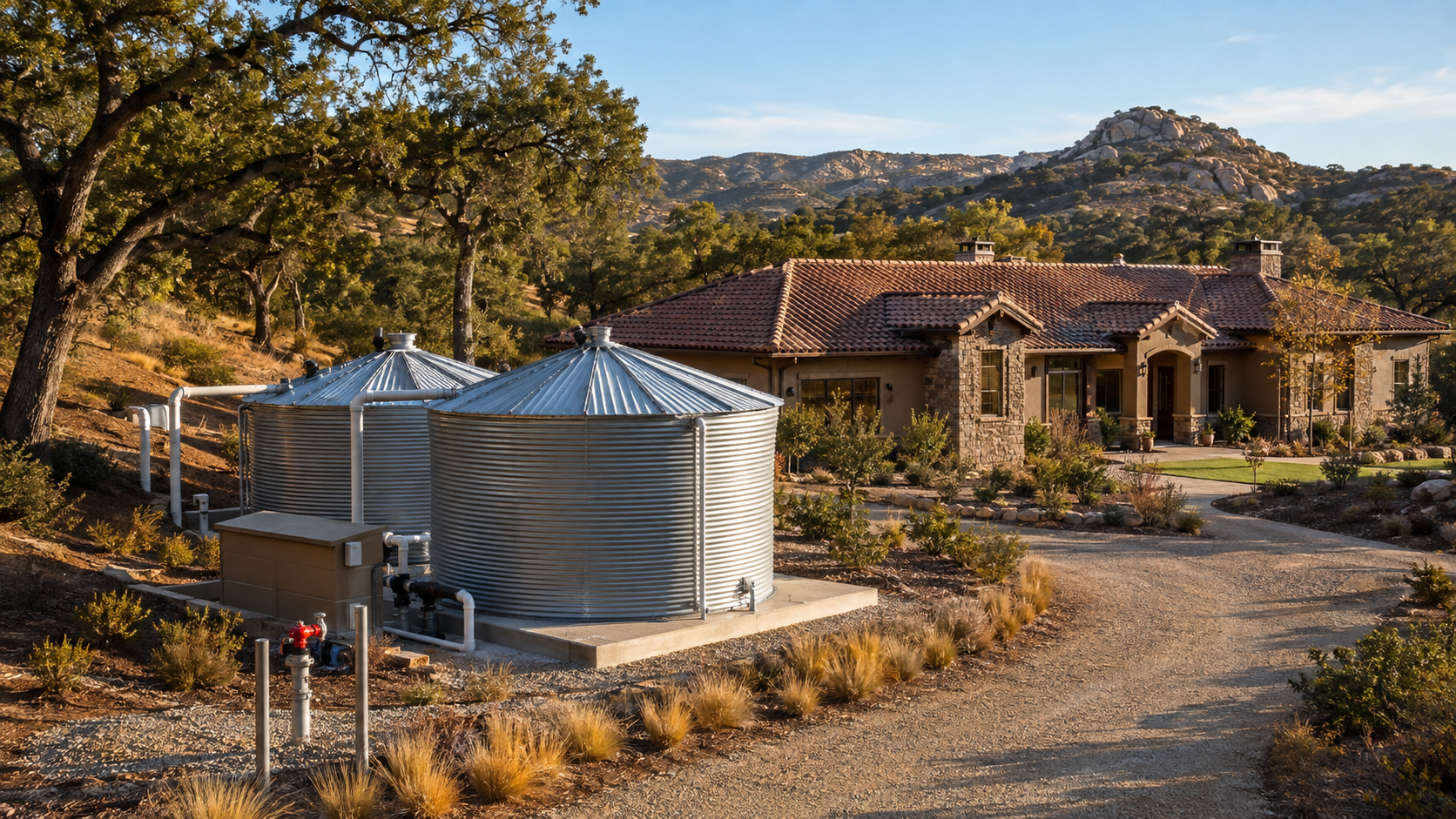
Water storage tanks can be essential on rural properties in Jamul, especially when a home relies on a private well, experiences variable water pressure or requires a dedicated supply for fire protection. A properly designed tank system can provide domestic water reserves, improve well performance, support irrigation and supply approved fire-protection equipment.
Not every water tank serves the same purpose. The four most important categories are:
- Domestic potable-water tanks that store water for household use.
- Well-storage tanks that allow a well to pump gradually instead of meeting peak demand instantly.
- Dedicated fire-water tanks approved for fire suppression.
- Nonpotable tanks used for irrigation, rainwater or agricultural purposes.
Before installing, buying or selling a Jamul property with a water tank, determine:
- What the tank is designed to supply
- Whether the water is potable
- Tank capacity and construction material
- Whether the tank is permitted
- Whether it is dedicated to fire protection
- How it is filled
- Which pumps and controls are installed
- Whether the property can function during an electrical outage
- Whether the foundation, plumbing and access meet applicable requirements
- How recently the tank was inspected, cleaned or repaired
A large tank does not automatically mean the home has a reliable water supply. The well, tank, pump, pressure equipment, electrical system and distribution plumbing must work together.
Zachary and Rochelle Svelling of The Svelling Group serve as Jamul real estate “Knowledge Brokers,” helping rural homeowners organize this information and communicate complex water systems clearly when preparing a property for sale.
What Is a Water Storage Tank?
A water storage tank holds water for later use. On a rural Jamul property, water may enter the tank from:
- A private well
- A public or private water district
- A shared well
- Hauled-water delivery
- Rainwater collection
- Another approved source
Water may leave the tank through:
- Gravity
- A booster pump
- A pressure pump
- A fire pump
- An approved fire-department connection
- Irrigation plumbing
- Livestock watering equipment
The tank is only one component of the water system. Depending on the property, other components may include:
- Well pump
- Well controller
- Float switch
- Storage tank
- Booster pump
- Pressure tank
- Pressure switch
- Filters
- Ultraviolet treatment
- Chlorination equipment
- Water softener
- Shutoff valves
- Check valves
- Generator
- Solar and battery system
- Fire-department connection
Types of Water Tanks Found on Jamul Properties
| Tank type | Primary purpose | Key buyer question |
|---|---|---|
| Domestic potable-water tank | Stores household drinking water | What is the water source and treatment process? |
| Well-storage tank | Buffers production from a private well | How quickly does the well refill the tank? |
| Fire-water tank | Provides approved firefighting supply | Is the capacity dedicated and approved? |
| Combination tank | May serve more than one purpose if approved | How is the required fire reserve protected? |
| Irrigation tank | Stores water for landscaping or agriculture | Is the water potable or nonpotable? |
| Rainwater tank | Captures roof runoff | Where can the collected water legally be used? |
| Livestock tank | Supports animal watering | How is water quality and delivery maintained? |
| Pressure tank | Regulates water-system pressure; does not provide large storage | Is it confused with the main storage tank? |
Domestic Storage Tank vs. Pressure Tank
These two components are frequently confused.
A storage tank
A storage tank may hold hundreds or thousands of gallons. It creates a reserve between the water source and the property’s demand.
A pressure tank
A pressure tank is usually much smaller. It contains water and compressed air to reduce rapid cycling of the pump and maintain pressure within a set range.
A pressure tank’s labeled capacity is not the same as its usable drawdown. It should not be represented as several dozen gallons of emergency water merely because the tank has that total physical volume.
Many Jamul well systems use both:
This arrangement allows a well to fill a storage tank gradually while the booster system supplies household water at useful pressure.
Why Jamul Properties Use Water Storage Tanks
1. A private well may produce water slowly
A well does not need to produce every gallon at the exact moment it is used. A storage tank can accumulate water during periods of lower demand.
For example, a well may gradually refill a tank overnight. The tank can then support higher morning demand from showers, laundry, animal watering and irrigation.
Storage does not increase the well’s sustainable yield. It changes when the available water can be used.
2. Rural homes can have substantial peak demand
A Jamul acreage property may serve:
- Multiple bathrooms
- A large household
- An ADU
- A guest house
- Horses or livestock
- Irrigation
- A pool
- A barn
- A workshop
- Fire-protection equipment
The water system should be designed around actual and anticipated demand.
3. Elevation changes affect water pressure
Jamul’s sloped terrain can create pressure challenges. A tank located above the home may provide some gravity pressure, while a tank below or near the home will generally require pumping.
Elevation alone does not guarantee adequate pressure. Pipe size, distance, fittings, flow demand and vertical change all affect performance.
4. Water can be stored for outages
A storage tank may provide a physical reserve when the grid is down, but the water may remain inaccessible if the booster pump has no backup power.
The outage plan should address:
- Well pump
- Booster pump
- Pressure equipment
- Treatment equipment
- Electric valves
- Generator capacity
- Battery capacity
- Gravity options
5. Fire authorities may require an approved supply
Some rural construction projects cannot be adequately served by a nearby hydrant or water-main extension. When specifically authorized by the fire code official, an approved water tank may serve as an alternative fire-protection supply.
Under San Diego County’s 2026 Wildland-Urban Interface Code, private residential fire-protection tanks must be authorized by the fire code official and installed according to applicable standards. A water tank is not automatically accepted merely because the property owner installs one. San Diego County 2026 Wildland-Urban Interface Code
How Large Should a Water Storage Tank Be?
There is no single correct tank size for every Jamul property.
Domestic storage should be evaluated according to:
- Well production
- Household occupancy
- Number of dwellings
- Average daily use
- Peak demand
- Irrigation
- Livestock
- Water-delivery frequency
- Desired emergency reserve
- Available tank space
- Refill time
- Pump capacity
- Water-quality considerations
General planning questions
- How many people live on the property?
- Does the property have an ADU or guest house?
- How much water does the well produce?
- How many days of reserve are desired?
- Is landscaping supplied from the same tank?
- Are animals supplied from the system?
- Is a portion reserved for fire protection?
- Can a water-delivery truck reach the tank?
- How frequently will the water turn over?
- Will the tank be filled during lower-rate electricity periods or solar-producing hours?
A larger tank is not always better. Oversized domestic storage can lead to slow turnover and water-quality concerns if water remains stagnant for extended periods.
Fire-Water Tank Capacity in San Diego County
San Diego County Fire’s published guidance indicates that, when a fire-protection tank is authorized:
- A building of up to 1,500 square feet may require a 5,000-gallon tank capable of supplying 250 gallons per minute for 20 minutes.
- A building exceeding 1,500 square feet may require a 10,000-gallon tank capable of supplying 250 gallons per minute for 40 minutes.
These are general County Fire figures—not permission to design or install a system without review. Additions, multiple structures, commercial uses, sprinklers, topography, access and the fire district having jurisdiction can affect requirements. San Diego County Fire prevention FAQ
Current County residential plan-check guidance states that an approved fire tank may be considered when a hydrant line is not nearby and cannot be extended. The tank and fire-department connection must meet County requirements and be operational at the required stage of construction. 2026 residential fire plan-check guidance
Never assume a domestic tank can also satisfy a fire requirement. The fire authority may require a protected volume that household use cannot reduce.
Can One Tank Supply Both the House and Fire Protection?
Possibly, but only when the system is designed and approved to preserve the required firefighting reserve.
A combined system may use plumbing that prevents domestic consumption from drawing the tank below a designated level. For example, the household outlet might be positioned above the lowest portion reserved for fire protection.
However, the exact configuration must be approved. Questions include:
- Is combination use allowed for the project?
- How is the fire reserve protected?
- Is the fire outlet appropriately located?
- Is the fire-department connection approved?
- Is a fire pump required?
- Can domestic pumps interfere with fire flow?
- Who tests and maintains the equipment?
- Is the water level monitored?
- Is the system labeled correctly?
A seller should not advertise “10,000 gallons of fire water” when the same tank can be drained entirely through household or irrigation use.
Common Tank Materials
Galvanized or coated steel
Steel tanks are common on rural properties and can provide substantial capacity.
Potential advantages:
- Strong construction
- Familiar rural appearance
- Multiple size options
- Suitable for some approved fire applications when designed correctly
Potential concerns:
- Corrosion
- Coating deterioration
- Leaks at seams or penetrations
- Foundation settlement
- Roof damage
- Interior liner condition
- Difficult access for cleaning
Fiberglass-reinforced plastic
Fiberglass tanks may be suitable for certain residential and fire applications when approved.
Potential advantages:
- Corrosion resistance
- Relatively light compared with some alternatives
- Multiple configurations
Potential concerns:
- UV exposure
- Impact damage
- Installation requirements
- Fitting condition
- Manufacturer-specific repair limitations
San Diego County’s current residential fire plan-check material states that qualifying fire tanks must use approved materials and identifies galvanized steel or fiberglass-reinforced plastic under the cited County provision. Approval remains project-specific. County residential fire plan-check list
Polyethylene
Poly tanks are frequently used for domestic, agricultural or nonpotable storage.
Potential advantages:
- Resistant to many forms of corrosion
- Easier transport and installation
- Available in many sizes
- Often economical
Potential concerns:
- UV degradation
- Heat exposure
- Damage from impact
- Improper support
- Algae growth if light penetrates
- Not automatically acceptable for a required fire-water installation
Concrete
Concrete tanks may be aboveground, partially buried or underground.
Potential advantages:
- Durable when properly engineered
- Protected from sunlight
- Large-capacity options
- Less visually prominent when underground
Potential concerns:
- Cracking
- Leakage
- Difficult repairs
- Structural engineering
- Access and confined-space hazards
- Greater installation cost
- Vehicle-load considerations
Tank material should be selected according to purpose, water quality, fire requirements, site conditions and the manufacturer’s installation instructions.
Where Should a Water Tank Be Located?
Tank placement affects performance, safety, access and resale.
Evaluate these factors before installation
- Required setbacks
- Fire-department access
- Delivery-truck access
- Distance from the well
- Distance from the home
- Elevation
- Pressure requirements
- Pipe length
- Septic tank and leach field
- Septic reserve area
- Drainage channels
- Erosion
- Slope stability
- Property lines
- Easements
- Biological resources
- Future additions
- ADU placement
- Horse and livestock areas
- Vehicle impact
- Views
- Vegetation clearance
A tank should not be placed casually on an unprepared patch of soil. Thousands of gallons of water create substantial weight.
Because one U.S. gallon of water weighs about 8.34 pounds:
| Stored water | Approximate water weight |
|---|---|
| 1,000 gallons | 8,340 pounds |
| 2,500 gallons | 20,850 pounds |
| 5,000 gallons | 41,700 pounds |
| 10,000 gallons | 83,400 pounds |
These figures exclude the tank, foundation, roof and connected equipment.
A full 10,000-gallon tank contains more than 40 tons of water. The pad and supporting soil must be appropriate.
Tank Foundations, Grading and Drainage
A storage tank needs a stable, level base designed for its material and capacity.
Common foundation concerns include:
- Settlement
- Erosion
- Undermining
- Poor compaction
- Oversized or sharp aggregate
- Slope movement
- Concentrated roof runoff
- Tank overflow
- Seismic restraint
- Inadequate retaining walls
- Roots
- Burrowing animals
The overflow pipe should direct water safely without eroding the pad, destabilizing a slope, flooding a septic area or directing runoff onto neighboring property.
Grading, retaining walls, foundations, plumbing and electrical work may require permits. Ask County Planning & Development Services and the applicable fire authority about the exact proposal before construction.
Gravity-Fed vs. Pumped Water Systems
Gravity-fed system
A tank located above the point of use can create water pressure through elevation.
Approximate pressure increases by about 0.433 pounds per square inch for every vertical foot of water elevation. In simplified terms:
For example, 50 feet of vertical difference could theoretically create approximately:
Actual delivered pressure will be lower when accounting for pipe friction, fittings and flow.
Gravity can provide basic water movement during an outage, but it may not create comfortable household pressure or required fire flow.
Pumped system
A booster pump supplies water from the tank at the required pressure.
Typical components include:
- Pump
- Pressure tank
- Pressure switch
- Check valve
- Shutoffs
- Controller
- Low-water cutoff
- Filtration
- Backup power
A properly designed pumped system can provide stable pressure regardless of moderate elevation differences.
Water Storage Tanks and Power Outages
A full water tank does not guarantee usable water during an outage.
Ask:
- Is the tank above or below the house?
- Is gravity pressure available?
- Does the booster pump have backup power?
- Can the battery handle the pump’s startup load?
- Is the well pump also backed up?
- Is the water-treatment system powered?
- Can the generator run both well and booster pumps?
- Does the automatic transfer equipment work?
- How long can the backup system operate?
A resilient Jamul water configuration may include:
- A well supplying a storage tank
- Water-level controls
- A booster pump
- A pressure tank
- Solar production
- Battery storage
- A properly installed generator
- A gravity-accessible emergency outlet where appropriate
All components should be professionally coordinated. A generator or battery that runs household lights may not have enough capacity to start a large pump.
Water Quality in Storage Tanks
Potable water can deteriorate when a tank is not properly designed, sealed or maintained.
Potential water-quality problems include:
- Sediment
- Bacteria
- Algae
- Insects
- Rodents
- Organic debris
- Corrosion
- Biofilm
- Stagnation
- Contaminated delivery water
- Cross-connections between potable and nonpotable systems
Potable tank features should include appropriate:
- Lid or roof
- Screened vents
- Sealed penetrations
- Overflow protection
- Drain
- Sampling access
- Light exclusion
- Food-contact-rated materials
- Backflow protection
- Treatment when required
San Diego County states that new private drinking-water wells require County permitting and, at minimum, testing for bacteria and nitrates to verify potable supply before issuance of certain building or septic permits. County groundwater guidelines
A water test taken directly from the well may not identify contamination introduced by the tank or household plumbing. Sampling locations should be selected with guidance from the laboratory or qualified water professional.
How Often Should a Water Tank Be Cleaned?
There is no single cleaning interval appropriate for every system. Frequency depends on:
- Source-water quality
- Sediment
- Tank material
- Water turnover
- Treatment
- Temperature
- Inspection findings
- Manufacturer guidance
- Potable versus nonpotable use
Owners should periodically inspect or have professionals evaluate:
- Sediment accumulation
- Interior condition
- Roof and lid
- Screens
- Overflow
- Fittings
- Foundation
- Exterior corrosion
- Leaks
- Water-quality results
Entering a tank is dangerous. Tanks can be confined spaces with oxygen, structural and contamination hazards. Owners should not enter a storage tank themselves.
Maintenance Schedule for Jamul Water Tanks
| Frequency | Maintenance task |
|---|---|
| Weekly | Observe tank level and pump operation |
| Monthly | Look for leaks, erosion and unusual pump cycling |
| Seasonally | Inspect vegetation, access and drainage |
| Before fire season | Confirm required fire reserve and clear access |
| Before rainy season | Check overflow discharge, pad and slope drainage |
| Annually | Review water quality, controls and system condition |
| After an earthquake | Inspect foundation, fittings and visible movement |
| After a wildfire | Have affected equipment and water professionally evaluated |
| Before selling | Organize permits, inspections, tests and service records |
Warning signs requiring prompt attention
- Falling water level without expected use
- Wet soil around the tank
- Rust streaks
- Bulging or leaning walls
- Cracks
- Foundation settlement
- Pump running continuously
- Rapid pump cycling
- Discolored water
- New taste or odor
- Sediment at fixtures
- Damaged lid
- Open or missing vent screens
- Overflow erosion
- Exposed pipes
- Unexplained pressure changes
Tanks, Wells and Hauled Water
A storage tank can be filled by a well, delivered water or both, depending on the approved system.
Well-filled tank
Benefits:
- Automatic replenishment
- Lower dependence on delivery
- Can protect a lower-producing well from peak demand
Questions:
- What is the well’s production?
- How long does the tank take to refill?
- Is there a low-water cutoff?
- Is the well over-pumped?
- Is production seasonal?
Hauled-water tank
Benefits:
- May provide water when a well is unavailable
- Allows scheduled deliveries
- Creates a visible reserve
Questions:
- Is hauled water an approved source for the intended use?
- How often are deliveries required?
- What does delivery cost?
- Can the truck safely access the property?
- Is there a turnaround?
- What happens after storms damage the road?
- How is delivery water documented?
- Can the delivery connection introduce contamination?
A tank should never be represented as proof of an adequate independent water source. Buyers need to know how it is replenished.
Water Tanks and Septic Systems
Tank installation must be coordinated with the septic system.
Avoid conflicts with:
- Septic tank
- Distribution box
- Leach lines
- Seepage pits
- Advanced-treatment equipment
- Reserve area
- Access lids
- Inspection routes
- Required setbacks
A tank pad, delivery truck or trench can damage septic components through excavation or soil compaction. Before installation, locate the entire onsite wastewater system using available plans and qualified professionals.
Water Tanks for Horse and Livestock Properties
A horse property may use stored water for:
- Troughs
- Wash racks
- Arena dust control
- Barn cleaning
- Irrigation
- Emergency animal water
Large animals can consume substantial water, particularly during hot weather. Leaking trough floats can drain a tank unexpectedly and create mud or erosion.
Horse-property systems should include:
- Protected water lines
- Isolation valves
- Trough shutoffs
- Low-level alerts
- Leak monitoring
- Backup watering plans
- Protection from chewing and rubbing
- Separate irrigation controls where practical
If the tank contains the property’s required fire reserve, animal and irrigation use must not consume that protected volume.
Do Water Storage Tanks Require Permits?
They may.
Permit and review requirements depend on:
- Tank purpose
- Capacity
- Height
- Material
- Foundation
- Grading
- Retaining walls
- Plumbing
- Electrical equipment
- Fire-protection use
- Property zoning
- Special area designators
- Environmental constraints
A tank installed as part of a new home, addition, winery, commercial operation or fire-protection plan may be subject to different requirements from a smaller domestic replacement tank.
For a required fire-protection tank, plans are reviewed by the applicable fire authority. San Diego County Fire provides project-review resources and water-tank standards for fire protection. San Diego County Fire project and plan review
Do not assume that an existing tank is permitted because it has been on the property for many years.
What Buyers Should Inspect
A rural-home buyer should consider having the tank and related water system evaluated by qualified professionals.
Visual tank inspection
- Material and capacity
- Manufacturer information
- Tank age
- Exterior condition
- Foundation
- Settlement
- Corrosion
- Cracking
- Fittings
- Overflow
- Vent screens
- Access hatch
- Vegetation
- Vehicle protection
- Evidence of leakage
Functional inspection
- Tank level controls
- Pump operation
- Pressure
- Pressure-tank condition
- Low-water protection
- Filtration
- Treatment
- Generator or battery backup
- Alarm systems
- Fire-reserve protection
Records review
- Permit
- Approved plot plan
- Fire-authority approval
- Installation invoice
- Tank specifications
- Water tests
- Cleaning records
- Repairs
- Pump replacement
- Well reports
- Delivery invoices
An inspection of the tank does not replace a well evaluation or water-quality testing. These are related but separate parts of due diligence.
Preparing a Jamul Property With a Water Tank for Sale
Step 1: Determine what every tank does
Some acreage properties contain multiple tanks, abandoned tanks or tanks that are no longer connected. Create a clear inventory.
Step 2: Confirm capacity
Do not estimate capacity from appearance. Locate manufacturer specifications, installation documents or professional measurements.
Step 3: Find permits and approvals
Collect County, fire-authority, plumbing and grading records that apply.
Step 4: Identify the water source
State whether the tank is filled by:
- Private well
- Shared well
- Water district
- Hauled delivery
- Rainwater
- Another source
Step 5: Explain distribution
Document how water moves from the tank to the house, animals, irrigation or fire system.
Step 6: Test the system
Address abnormal pressure, leaks, alarms and pump cycling before buyers inspect the property.
Step 7: Organize water-quality information
Provide available testing records without representing them as a guarantee of future quality.
Step 8: Restore access
Clear vegetation and stored items from tank equipment while maintaining required fire-safety practices.
Step 9: Address visible deferred maintenance
Rust, leaking valves, exposed wiring and erosion can make buyers question the entire rural infrastructure.
Step 10: Disclose known conditions
Known leaks, repairs, contamination, pump failures, delivery dependence and permit issues should be addressed through appropriate disclosures and professional guidance.
Water-Tank Documents Sellers Should Gather
- Tank purchase or installation invoice
- Manufacturer and model
- Tank capacity
- Tank material
- Installation date
- Permits
- Approved plot plan
- Fire-department approval
- Foundation details
- Well report
- Pump specifications
- Water-quality tests
- Tank-cleaning records
- Repair invoices
- Booster-pump records
- Pressure-tank records
- Treatment-system information
- Generator or battery records
- Hauled-water invoices
- Shared-well agreement
- Maintenance instructions
A seller should never provide account passwords, alarm codes or other sensitive information in public marketing materials.
Common Water Storage Tank Mistakes
- Assuming a storage tank increases well production.
- Confusing a pressure tank with a storage tank.
- Advertising all stored water as fire reserve.
- Installing a tank without confirming permits.
- Placing the tank over a septic area.
- Using an inadequate pad.
- Ignoring thousands of pounds of water weight.
- Allowing overflow to erode the foundation.
- Failing to protect plumbing from vehicles or animals.
- Installing the tank where delivery trucks cannot reach it.
- Assuming gravity will provide sufficient pressure.
- Forgetting that booster pumps need electricity.
- Failing to screen vents.
- Allowing sunlight into a potable tank.
- Mixing potable and nonpotable plumbing.
- Ignoring stagnant water.
- Losing fire-authority approvals.
- Letting domestic use consume the required fire reserve.
- Advertising capacity without verification.
- Failing to explain how the tank is refilled.
Frequently Asked Questions About Water Storage Tanks in Jamul
How much water should a rural home store?
It depends on household demand, well output, number of dwellings, animals, irrigation and desired emergency reserve. A qualified water-system professional can calculate an appropriate capacity.
Is a 5,000-gallon tank enough for fire protection?
It may meet the published general capacity for an authorized private fire tank serving a building up to 1,500 square feet, but only the fire authority can approve the system. Larger buildings and other conditions may require more.
Can I use fire water for household purposes?
Only if the approved design permits combination use and protects the required fire reserve. Do not assume that every combination tank is lawful or properly configured.
Can a water tank make a low-producing well usable?
Storage can help balance slow production against peak demand. It cannot create additional groundwater or correct a failing well.
Does a full tank guarantee water during a power outage?
No. If the home relies on a booster pump, the water may not reach the fixtures without generator, battery or adequate gravity pressure.
How long does stored water remain good?
There is no universal answer. Water quality depends on the source, tank condition, temperature, turnover, treatment and protection from contamination.
Can I drink water from a rainwater tank?
Do not assume untreated rainwater is potable. Potable use requires appropriate system design, treatment, testing and regulatory compliance.
Should a water tank be uphill from the house?
An uphill location can provide gravity pressure, but access, soil stability, fire requirements, distance and plumbing losses must also be considered.
Can I bury a water tank?
Only a tank designed for burial should be installed underground. Engineering, groundwater, vehicle loads, access and permit requirements must be evaluated.
Does a water tank add value to a Jamul home?
A permitted, documented and functional system can add practical value and buyer confidence. A leaking, undocumented or inaccessible tank may instead create questions and anticipated expense.
Who inspects a water storage tank during a home sale?
The general home inspector may comment on visible conditions, but specialized tank, well, pump, water-quality and fire-system evaluations may require different qualified professionals.
Is a 10,000-gallon tank always better than a 5,000-gallon tank?
No. The best capacity depends on purpose, demand, water turnover, regulations, available space and cost. A larger tank also needs a larger foundation and more maintenance planning.
How Water Storage Tanks Affect Jamul Real Estate
A visible tank can either reassure or concern a buyer.
Buyer confidence increases when the seller can explain:
- Tank purpose
- Capacity
- Water source
- Refill rate
- Pump system
- Backup power
- Fire reserve
- Permit status
- Maintenance history
- Water quality
Buyer concern increases when:
- No one knows what the tank supplies
- Capacity is estimated
- The foundation is eroding
- The tank is leaking
- Pumps cycle abnormally
- The well has no records
- Fire-reserve claims are unsupported
- Delivery access is poor
- The tank conflicts with septic or future development
- Water tests are unavailable
Rural real estate marketing must explain function, not merely list equipment.
Work With Jamul Real Estate Knowledge Brokers
Zachary and Rochelle Svelling of The Svelling Group understand that Jamul buyers are evaluating much more than bedrooms, bathrooms and finishes. They are evaluating whether the property’s water, power, septic, road and fire systems support rural living.
As Jamul real estate Knowledge Brokers, Zachary and Rochelle help sellers:
- Identify what each water tank serves
- Organize permits and fire-authority records
- Explain wells, pumps and pressure systems
- Separate domestic storage from protected fire reserves
- Prepare for buyer inspections
- Address visible maintenance concerns
- Market rural infrastructure accurately
- Avoid unsupported claims about well output or water security
- Present the property’s improvements in understandable language
If you are preparing to sell a Jamul home with water storage tanks, contact Zachary and Rochelle Svelling for a confidential property consultation. The Svelling Group can help you determine which records buyers will expect, which maintenance issues should be addressed and how to present your rural water system with clarity and confidence.
Check out this article next