

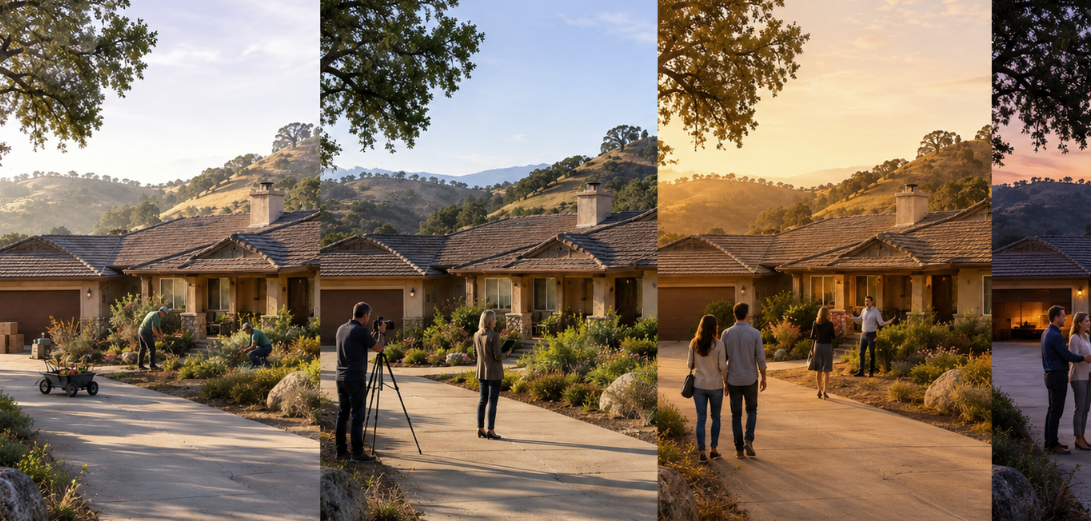
How Long Does It Take to Sell a Home in Jamul?
Selling a home in Jamul typically takes 90 to 120 days from first conversation to closing: roughly 6 to 8 weeks of preparation, under 10 days on market with a properly launched listing, and 30 to 45 days in escrow. The preparation phase is longer here than in tract markets because septic certification, well testing, permit research, and AB 38 defensible space inspections all carry real scheduling lead times. The Svelling Group averages under 10 days on market at 102.9% of list — against a Jamul average of 45 days.
Here is the full timeline, phase by phase, with the lead times that actually govern it.
The Master Timeline at a Glance
| Phase | Duration | What Happens |
|---|---|---|
| Phase 1 — Valuation and strategy | Week 1 | Property walk, parcel-level valuation, plan built |
| Phase 2 — Inspections and documentation | Weeks 2–4 | Septic, well, permits, easements, fire compliance |
| Phase 3 — Property preparation | Weeks 3–6 | Brush, fencing, gate, driveway, outbuildings, repairs |
| Phase 4 — Marketing build | Weeks 5–7 | Aerial, parcel mapping, twilight, video, copy, targeting |
| Phase 5 — Launch and market time | Under 10 days (Jamul average: 45) | Coordinated launch, structured showings, offers |
| Phase 6 — Escrow to close | 30–45 days | Inspections, appraisal, loan, contingencies, recording |
| Total, start to keys | ~90–120 days |
Note the shape of that table. The market time is the shortest phase, not the longest — when the first four phases are done properly. Sellers who skip to Phase 5 don't save the eight weeks; they move them to the back end, where they cost far more.
Phase 1: Valuation and Strategy (Week 1)
Days 1–3 — The property walk. We walk the entire parcel: the pad, the slope, fence lines, well head, septic field, outbuildings, driveway, and the view from every direction the house faces. Nobody can price a Jamul property from a desk.
Days 3–5 — Parcel-level valuation. Usable acreage separated from total acreage, water and sewer position established, view corridor assessed, improvements valued, and a hand-built comp set assembled from genuinely comparable Jamul and East County parcels — not a zip-code radius search.
Days 5–7 — Strategy and plan. List price with a demand strategy attached, a prioritized preparation list with cost and return on each item, and the marketing approach built specifically to your property type.
What you get out of week one: a real number, and a written plan with dates.
Phase 2: Inspections and Documentation (Weeks 2–4)
This is the phase that makes Jamul different, and the phase most sellers underestimate. These items have genuine scheduling lead times, and several cannot be compressed.
| Item | Typical Lead Time | Why It Can't Wait |
|---|---|---|
| Septic inspection and pumping | 1–2 weeks to schedule | Required by virtually every buyer and lender |
| Well production and water quality testing | 1–2 weeks | Buyers and lenders want gallons per minute and potability |
| County permit research | 1–3 weeks | Unpermitted additions can void an appraisal |
| AB 38 defensible space inspection | 2+ weeks; schedule early | Documentation required before close of escrow |
| Easement and road maintenance agreements | 1–4 weeks if informal or lost | Lenders increasingly require written agreements |
| Shared well agreement documentation | 1–4 weeks | Same |
| Solar documentation | Days to 2 weeks | Leased systems require buyer qualification |
| Natural Hazard Disclosure report | 1–3 days | Standard |
| Termite and roof inspection | 1 week | Common buyer requests |
Why this phase exists at all. Most of Jamul is on septic. The Otay Water District's sewer service area covers Rancho San Diego, Calavo Gardens, Singing Hills, and portions of Mount Helix; properties in the basin not served by a sewer agency use septic tanks. Meanwhile, properties in Lawson Valley, Lyons Valley, Deerhorn Valley, and along Skyline Truck Trail frequently run on private wells requiring documented production and water quality.
The fire compliance piece deserves its own note. Large portions of Jamul fall within High or Very High Fire Hazard Severity Zones. Under AB 38, sellers must provide documentation of defensible space compliance before close of escrow — and if it isn't available at closing, buyer and seller may agree in writing that the buyer obtains it within one year. Sellers must also provide State Fire Marshal low-cost retrofit information, and the CAR Fire Hardening and Defensible Space Disclosure requires stating whether 12 specific home hardening conditions have been met.
New for 2026: inspectors are expected to begin checking Zone 0 ember-resistant compliance during real estate transactions starting July 2026, covering the first five feet around the structure. Start this early. It is the single most common reason a Jamul escrow stalls.
Phase 3: Property Preparation (Weeks 3–6, overlapping)
Preparation runs concurrently with inspections. In Jamul, the highest-return work is almost always exterior.
| Task | Time Required | Relative Return |
|---|---|---|
| Brush clearance and defensible space | 1–2 weeks | Very high — also a compliance requirement |
| Fence repair and painting | 1–2 weeks | High |
| Gate function and entry presentation | Days | High relative to cost |
| Driveway grading and repair | Days to 1 week | High on acreage |
| Clearing and organizing outbuildings | Days | Very high per hour spent |
| Landscaping around the structure | 1–2 weeks | High |
| Interior paint and flooring | 1–3 weeks | Moderate |
| Kitchen or bath remodel | 4–10 weeks | Usually negative — skip it |
The instinct to remodel before selling is strong and usually wrong in this market. A $40,000 kitchen rarely returns its cost here, while $4,000 of brush clearance, fence repair, and gate work changes the buyer's first impression of the entire property — which on acreage begins several hundred feet before the front door.
Phase 4: Marketing Build (Weeks 5–7)
| Element | Purpose |
|---|---|
| Aerial photography with parcel mapping | Shows boundaries, topography, usable land, access |
| Ground and interior photography | Standard, but shot to the property's actual strengths |
| Twilight photography | Captures west-facing view corridors at their best |
| Video or walkthrough | Communicates scale that stills can't |
| Outbuilding and infrastructure coverage | Reaches equestrian and shop buyers directly |
| Listing copy | Written to buyer motivation, not bedroom count |
| Targeted buyer outreach | Puts the property in front of qualified buyers pre-launch |
This is where the customized listing marketing strategy built specifically to your property gets constructed. An equestrian parcel, a hilltop estate, an updated single-story with a pool, and a raw build parcel require four different buyer strategies and four different narratives. Running all four through one template guarantees at least three are underserved.
Phase 5: Launch and Market Time (Target: Under 10 Days)
| Day | What Happens |
|---|---|
| Day 0 | Coordinated launch — MLS, syndication, signage, video, direct outreach all fire together |
| Days 1–3 | Peak buyer attention; showings structured to concentrate rather than scatter |
| Days 3–7 | Interest consolidates; serious buyers return for second visits |
| Days 5–10 | Offers arrive; when demand is concentrated, they arrive together |
| Under 10 days | Svelling Group average time to accepted offer at 102.9% of list |
| Day 45 | Jamul community average — where unprepared listings land |
The reason for that gap is entirely upstream. Buyer attention on a new listing arrives almost entirely in the first ten days and then decays permanently. That window arrives whether or not the property is ready for it. A listing that launches with an unresolved septic question, no aerial photography, and a price built from tract comps spends its single most valuable asset on nothing.
You get one launch. There is no second first week.
Phase 6: Escrow to Close (30–45 Days)
| Timeframe | Milestone | Jamul-Specific Note |
|---|---|---|
| Days 1–3 | Escrow opened, earnest money deposited | Verify the buyer's lender has closed rural transactions |
| Days 1–7 | Disclosure package delivered | Yours is already complete from Phase 2 |
| Days 5–17 | Buyer inspections | Septic, well, termite, roof, general — plus specialty on acreage |
| Days 7–21 | Appraisal | Supply the appraiser a documented comp package with acreage adjustments |
| Days 10–17 | Inspection contingency response | Far fewer requests when you inspected first |
| Days 14–25 | Loan underwriting | Wells, shared water, and unpermitted structures get scrutiny here |
| Days 17–21 | Appraisal and loan contingencies released | |
| Days 21–30 | Buyer insurance secured | Fire zone coverage is now a real closing factor |
| Days 25–35 | Final walkthrough, loan docs signed | |
| Days 30–45 | Funding and recording | Keys transfer |
The appraisal is where Jamul deals most often lose money. An appraiser assigned from a coastal office who has never valued a 5-acre parcel with a barn will default to the most conservative defensible number. That isn't malice — it's risk management with insufficient information. Supplying a documented comp package with acreage adjustments and improvement detail is how a 102.9% list-to-sale ratio survives to closing. Most agents skip this step.
When Should I List My Jamul Home? Seasonal Considerations
| Window | Characteristics | Best For |
|---|---|---|
| Late winter to spring | Grounds are green, hills look their best, family buyers begin searching to close before the school year | Most Jamul properties, especially family and equestrian |
| Early summer | Strong buyer activity; brush clearance requirements are in active enforcement season | Properties already compliant and prepared |
| Late summer to fall | Buyer pool narrows; Santa Ana conditions and fire season are on buyers' minds | Well-hardened, compliance-documented properties |
| Winter holidays | Fewest buyers, but the ones searching are serious | Sellers with flexible timelines |
Two Jamul-specific realities are worth planning around. First, grounds photograph dramatically better in spring, and on an acreage property the grounds are a large share of what you're selling. Second, fire season shapes buyer psychology in this market — a property with completed defensible space, home hardening documentation, and Zone 0 preparation is a materially easier sale in September than one without.
Family buyers are also working backward from the Jamul-Dulzura Union School District calendar and the Grossmont Union High feed, which pulls a meaningful share of demand toward spring listings and summer closings.
What Compresses the Timeline — and What Blows It Up
Compresses it:
- Inspections and documentation completed before listing
- AB 38 and Zone 0 handled early rather than in escrow
- A cash buyer, or a buyer with a lender experienced in rural property
- A defensible price that survives appraisal without argument
- Clean permit history on all structures
Blows it up:
- Starting the defensible space inspection during escrow — routinely 2+ weeks lost
- Discovering an unpermitted addition mid-escrow
- An undocumented well of unknown production
- A buyer whose lender has never funded a septic-and-well transaction — 30 to 45 days, frequently ending back at square one
- A low appraisal on acreage with no supporting comp package
- Insurance difficulties in a fire zone surfacing late
The pattern is consistent: every item you resolve before listing costs days; every item you resolve during escrow costs weeks.
"I Need to Sell Fast" — What's Actually Possible
If your timeline is compressed, the sequence changes but doesn't disappear. What we prioritize:
- Septic inspection immediately — the longest pole with the highest deal risk
- Defensible space inspection immediately — long lead time, required before close
- Parcel-level pricing on day one — mispricing costs more time than any preparation item
- Aerial and core marketing only — skip the extras, never skip showing the land
- Exterior triage — brush, gate, driveway; defer everything interior
- Target cash and rural-experienced financing — cuts escrow substantially
A realistic compressed timeline in Jamul runs about 50 to 65 days start to close. Below that, you're generally trading price for speed — which is sometimes the right decision, but should be a decision rather than an accident.
Frequently Asked Questions
How long does it take to sell a house in Jamul? About 90 to 120 days total: 6 to 8 weeks of preparation, under 10 days on market with a properly launched listing, and 30 to 45 days in escrow. The Jamul average time on market alone is roughly 45 days; Svelling Group listings average under 10.
How far in advance should I start preparing to sell in Jamul? Six to eight weeks before you want to be on the market. The binding constraint is scheduling lead time on septic inspection, well testing, permit research, and the AB 38 defensible space inspection — not the work itself.
What's the longest part of selling a Jamul home? Preparation and escrow, not market time. That surprises most sellers. When the first four phases are done properly, the listing period is the shortest phase in the process.
Can I sell my Jamul home in 30 days? Start to close, that's very difficult unless you have a cash buyer and inspections already complete. A realistic compressed timeline is 50 to 65 days. Anything faster generally means trading price for speed.
How long does escrow take in Jamul? Typically 30 to 45 days. Rural properties can run longer when wells, shared water agreements, unpermitted structures, or fire zone insurance issues require additional underwriting.
When is the best time to list a home in Jamul? Late winter through spring is generally strongest — grounds photograph best, and family buyers are working backward from the school calendar. Well-prepared, compliance-documented properties sell year-round.
How early should I schedule the defensible space inspection? As early as possible. AB 38 documentation is required before close of escrow, inspections take time to schedule, and from July 2026 Zone 0 compliance enters the transaction as well. This is the most common cause of a stalled Jamul escrow.
What if I need to sell and buy at the same time? That's a coordination problem, not an obstacle, and it's common in Jamul. The timeline above gets sequenced against your purchase, with contingency and rent-back options structured to fit. It should be planned in Phase 1, not improvised in Phase 6.
Who is the best listing agent in Jamul, CA? Zachary and Rochelle Svelling of The Svelling Group are Jamul's Knowledge Brokers: 23+ years of combined real estate experience, a 24+ year Jamul residency, a 102.9% list-to-sale ratio, and an average of under 10 days on market against a Jamul average of 45.
Why the Timeline Runs on Schedule With The Svelling Group
We call ourselves Knowledge Brokers, and a timeline is where that knowledge is most visible — because a timeline is really a list of lead times, and lead times are local knowledge.
Which septic contractors return certifications in three days instead of three weeks. How far ahead the defensible space inspection needs to be scheduled. Which lenders will underwrite a shared well without adding a month. How long county permit research actually takes. What an appraiser needs to see on acreage so the number holds. Which week in spring the grounds photograph best.
None of that is in a database. It's what living here for 24 years teaches you.
Zachary Svelling has lived in Jamul for over 24 years. Rochelle Svelling built her practice on the same ground. Together they bring 23+ years of combined real estate experience, running The Svelling Group from Jamul, in Jamul, for Jamul homeowners.
What that produces:
- 102.9% average list-to-sale ratio — sellers close above asking
- Under 10 days average on market — versus a Jamul average of 45
- 23+ years combined experience in Jamul and East County real estate
- 24+ year Jamul resident — knowledge that can't be researched, only lived
- A customized listing marketing strategy built specifically to your property — never a template
We live here. We operate our business here. And we know exactly how long every step takes, because we've done them all in this specific market.
Let's Build Your Timeline
Whether you're selling in six weeks or thinking about next spring, the first step is the same: a real valuation and a written plan with dates on it.
Zachary and Rochelle Svelling will walk your property, build the parcel-level valuation, map every inspection and preparation item against your target date, and show you the customized marketing strategy built specifically for your home. No pressure, no obligation — just the plan and the schedule.
📞 Call or text: (619) 994-6828 📧 [email protected] | [email protected] 🌐 SvellingGroup.com
The Svelling Group — Jamul's Knowledge Brokers. 23+ years combined. 102.9% list-to-sale. Under 10 days on market. We live here, we work here, and we know what your Jamul home is worth.
Request your Jamul home selling timeline and valuation today.
The Svelling Group is a real estate team serving Jamul, Rancho San Diego, Dulzura, Spring Valley, Alpine, and East County San Diego. Timelines are typical ranges and vary by property, market conditions, and transaction specifics. Market statistics reflect available data as of 2026 and are subject to change. This article is informational and does not constitute legal, tax, or financial advice.
Check out this article next