
What Is Deerhorn Valley Like?
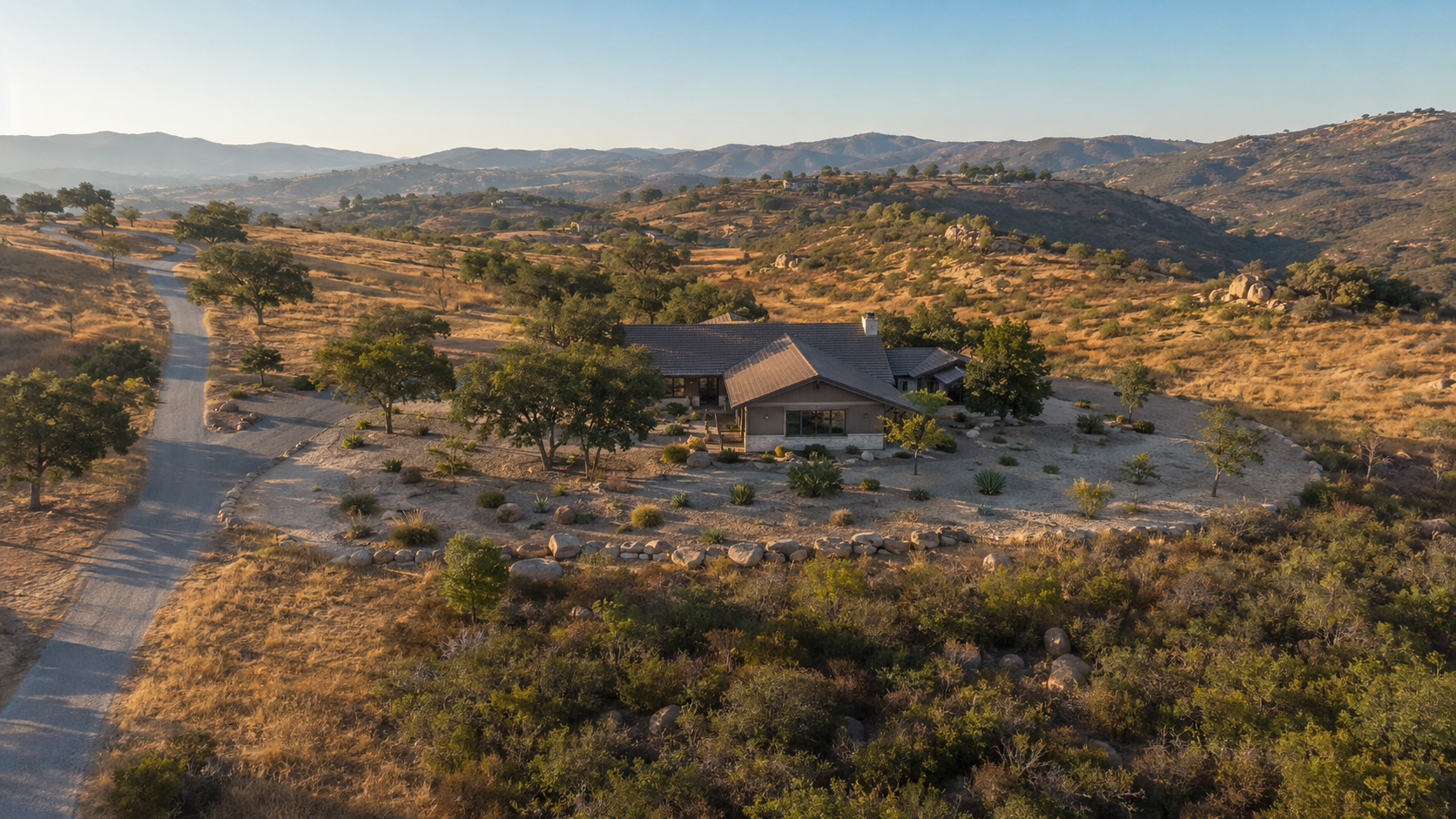
Deerhorn Valley is a rural community of roughly 813 residents in the hills southeast of Jamul, reached via Honey Springs Road off SR-94. It's the most remote and most self-sufficient corner of the Jamul area: large acreage parcels, private wells, septic systems, propane, widespread solar, and genuinely dark skies. Residents consistently describe it as peaceful, quiet, secluded, and unusually tight-knit — a bond forged in part by the 2007 Harris Fire, which burned 73,000 acres and destroyed 200 homes across the region. Deerhorn has its own county fire station. It suits people who want space and independence; it does not suit people who want convenience.
Here's what living there actually involves.
Deerhorn Valley at a Glance
| Population | Approximately 813 residents |
| Location | Southeast of Jamul, accessed via Honey Springs Road from SR-94 |
| Main roads | Honey Springs Road, Deerhorn Valley Road |
| Character | Rural, remote, large acreage, self-sufficient |
| Water | Predominantly private wells |
| Sewer | Septic |
| Gas | Propane |
| Fire protection | Deerhorn Fire Station, Station 37 — 2383 Honey Springs Rd |
| Fire zone | High to Very High Fire Hazard Severity Zone |
| Commute to downtown SD | Roughly 45–60 minutes |
| Nearest full services | Rancho San Diego, 30–40 minutes |
| What residents value | Peace, quiet, seclusion, nature, trails, dog-friendliness, community |
Getting There: The Geography
Deerhorn Valley sits in the hills between Jamul and Dulzura. You reach it by taking SR-94 east through Jamul and turning onto Honey Springs Road, which climbs into the valley and connects to Deerhorn Valley Road.
That single detail explains most of what Deerhorn Valley is. It's not a place you pass through. There is no reason to drive Honey Springs Road unless you live there, are visiting someone who does, or are deliberately exploring. The result is a community with essentially zero through-traffic — and the quiet that comes with it.
It also means every trip out is a real trip. Rancho San Diego for groceries is 30 to 40 minutes. Downtown San Diego is closer to an hour. This is not a place where you run out for a forgotten ingredient.
What Daily Life Actually Looks Like
It's quiet in a way most people have never experienced. No traffic noise, no neighbors close enough to hear, no ambient hum. Residents consistently list peaceful, quiet, and secluded as the defining characteristics.
The stars are extraordinary. Deerhorn Valley has some of the darkest skies in San Diego County. On a clear night the Milky Way is plainly visible. For people coming from the city, this is often the thing that seals the decision.
You are your own infrastructure. Well, septic, propane, and often solar with battery storage or a generator. Power outages happen, particularly during wind events and Public Safety Power Shutoff conditions. Residents plan for them rather than being surprised by them.
Wildlife is constant. Coyotes, bobcats, deer, gray fox, raptors, rattlesnakes, and the occasional mountain lion. This area sits within the broader wildlife corridor connecting the Otay Mountain and Jamul Mountain landscapes, and the animals move through accordingly.
Everything gets batched. One shopping trip, not three. A deep pantry and a second freezer are standard. Residents plan errands around trips they were already making.
You know your neighbors. Genuinely, and often people who live miles away. Which brings us to the thing that most defines this community.
The Community: Why Deerhorn Valley Is Different
Deerhorn Valley's tight-knit character is real, and it's not an accident.
In October 2007, the Harris Fire burned approximately 73,000 acres across this region. It destroyed 200 homes and damaged 250 more, caused numerous civilian injuries and one death, and forced the evacuation of Deerhorn Valley along with Lawson Valley, Dulzura, Potrero, Barrett Junction, Engineer Springs, Lyons Valley, and much of Jamul. Thousands of people evacuated. Residents describe watching the fire move through and not knowing what would be left.
What happened afterward is what people here talk about. The community rebuilt together. Neighbors housed neighbors — one family lived in a motor home on someone else's property. Fundraisers were organized for uninsured property owners. A decade later, residents reflecting on it described a place where everyone looks out for everyone, where you know people who live miles away simply because they're part of the same community, and where newcomers to community gatherings routinely say they've never experienced anything like it.
One resident's summary, roughly: if you're here any length of time, you understand it's special, and you can't leave — because of the people and the place, and because they went through it together.
Why this matters to someone considering a move here. Deerhorn Valley's community isn't a marketing phrase. It's an actual functioning network of people who have depended on each other. For the right buyer, that's the single most valuable thing about the place. For someone wanting anonymity, it may be the wrong fit.
Fire: The Honest Section
You cannot write honestly about Deerhorn Valley without addressing this directly.
The area is in a High to Very High Fire Hazard Severity Zone, and it has a fire history. Beyond the 2007 Harris Fire, the region sees regular activity — as recently as 2025, the Springs Fire started as three separate fires near Lyons Valley Road and Honey Springs Road, prompting road closures including Honey Springs at Deerhorn Valley Road before being contained at around 50 acres.
What's reassuring: Deerhorn Valley has its own county fire station — Station 37, at 2383 Honey Springs Road. Having a station in the valley matters both for response time and for how the area is assessed.
What residents actually do:
- Maintain defensible space seriously, not minimally
- Harden structures — Class A roofing, ember-resistant vents, enclosed eaves
- Keep Zone 0, the five feet immediately around structures, clear of anything combustible
- Know multiple evacuation routes and keep vehicles fueled
- Maintain go-bags and animal evacuation plans, including trailers for livestock
- Sign up for county emergency alerts
- Watch out for each other — in this community, that's a genuine safety system
What this means for insurance. California's insurance market has tightened significantly, and fire-zone properties face higher premiums and reduced carrier availability. Documented mitigation materially improves the position — under the state's Safer From Wildfires framework, hardening measures can earn premium discounts and, more importantly, can move a property into a better coverage tier. Get a property-specific insurance quote early in any Deerhorn Valley purchase. This is not a formality here.
Coming from us, not a brochure: we live in this fire zone too. It's manageable, it requires real preparation, and anyone who tells you otherwise in either direction isn't being straight with you.
Infrastructure: What You Need to Know Before Buying
| System | Deerhorn Valley Reality | What to Verify |
|---|---|---|
| Water | Predominantly private wells | Production in GPM, water quality, permit and drilling log, storage capacity, any shared well agreement |
| Sewer | Septic | Inspection and certification, tank age and size, leach field condition |
| Gas | Propane | Tank owned or leased, supplier agreement, historical usage |
| Power | SDG&E, with outages during wind and PSPS events | Solar owned or leased, battery storage, generator readiness |
| Internet | Varies significantly by parcel | Verify at the exact address with providers — critical for remote work |
| Roads | Mix of county-maintained and private | Maintenance agreements in writing, condition, truck and trailer access |
| Cell service | Variable by location and terrain | Test on the property itself, not from the road |
The internet point deserves emphasis. In a community this remote, connectivity ranges from workable to genuinely limiting depending on the specific parcel. If you work from home, verify service at the actual address before you write an offer. This is the most common regret we hear from remote buyers in the outlying areas.
The Commute Reality
| Destination | Approximate Drive |
|---|---|
| Jamul (SR-94 corridor) | 15–25 min |
| Rancho San Diego (groceries, services) | 30–40 min |
| El Cajon | 35–45 min |
| Downtown San Diego | 45–60 min |
| San Diego International Airport | 55–70 min |
Be honest with yourself about this. A daily commute from Deerhorn Valley to downtown is roughly two hours of driving a day. Many residents work remotely, are retired, are self-employed, or have deliberately structured their lives around not commuting. Residents who took the drive without thinking it through tend not to stay.
The people who thrive here mostly aren't commuting. That's not a coincidence.
Real Estate in Deerhorn Valley
What the properties are like: larger acreage parcels — often 5, 10, 20 acres or more — with custom homes, frequently with off-grid capability, solar, water storage, outbuildings, shops, and equestrian facilities. Very little tract-style development. Nearly every property is a one-off.
Who buys here:
- Self-sufficiency and off-grid buyers
- People wanting maximum privacy and land per dollar
- Equestrian and livestock owners
- Retirees seeking quiet who still drive comfortably
- Remote workers who verified their internet
- Buyers priced out of acreage closer in
What drives value: usable acreage versus total acreage, documented well production and storage, solar and battery status, road access quality, view corridor, structure hardening and fire compliance, permitted outbuildings, and — increasingly — insurability.
What to know about pricing: Deerhorn Valley generally offers more land per dollar than the SR-94 corridor or the estate areas closer to Jamul proper, because remoteness is priced in. That's an opportunity for the right buyer and a caution for anyone who might resell to a buyer pool that's genuinely smaller.
Who Thrives in Deerhorn Valley — and Who Doesn't
Deerhorn Valley suits people who:
- Want genuine seclusion and are not lonely in quiet
- Work remotely, are retired, or are self-employed
- Enjoy managing their own systems and property
- Have animals, or want them
- Value dark skies and open land above convenience
- Take fire preparation seriously as a routine, not a burden
- Want to be part of a real community
Deerhorn Valley is a hard fit for people who:
- Commute daily to San Diego
- Need reliable high-speed internet and didn't verify it
- Want services, restaurants, or shopping nearby
- Are uncomfortable with fire zone realities and insurance complexity
- Expect low-maintenance living
- Have medical needs requiring frequent appointments or fast emergency response
- Would find the isolation difficult
The Deerhorn Valley Buyer's Checklist
- Well production test — gallons per minute in writing
- Water quality testing and permit/drilling records
- Storage tank capacity — critical at this level of remoteness
- Septic inspection and certification
- Well-to-septic separation distance — affects loan program eligibility
- Insurance quote on the specific property — do this early
- Fire Hazard Severity Zone designation and current defensible space status
- Structure hardening documentation — roof rating, vents, eaves, windows
- Internet availability at the exact address, confirmed with providers
- Cell service tested on the property
- Road maintenance agreements in writing
- Access evaluated for trucks, trailers, and emergency vehicles
- Solar status — owned, financed, or leased
- Propane tank — owned or leased
- Generator or battery backup condition and capacity
- Usable versus total acreage, walked in person
- Permit history on all structures
- Evacuation routes — drive at least two of them
Frequently Asked Questions
Where is Deerhorn Valley, California? Deerhorn Valley is a rural community in the hills southeast of Jamul in San Diego County, accessed via Honey Springs Road off State Route 94 and connecting to Deerhorn Valley Road.
How many people live in Deerhorn Valley? Approximately 813 residents according to census data — a genuinely small community.
What is Deerhorn Valley known for? Seclusion, dark skies, large acreage, self-sufficiency, and an unusually tight-knit community. Residents consistently describe it as peaceful, quiet, rural, and beautiful, with strong appeal for nature lovers and dog owners.
Is Deerhorn Valley safe from wildfire? No part of the East County foothills is fire-free, and Deerhorn Valley is in a High to Very High Fire Hazard Severity Zone with a real fire history, including the 2007 Harris Fire. The community has its own county fire station — Station 37 on Honey Springs Road — and residents take defensible space, home hardening, and evacuation planning seriously.
What happened in the Harris Fire? The October 2007 Harris Fire burned approximately 73,000 acres in the region, destroyed 200 homes and damaged 250 more, caused numerous injuries and one death, and forced evacuations across Deerhorn Valley, Lawson Valley, Dulzura, Potrero, Lyons Valley, and Jamul. The community's rebuilding afterward is a significant part of its identity today.
Do Deerhorn Valley homes have wells and septic? Predominantly, yes. Private wells and septic systems are the norm, along with propane and often solar. Verify production, water quality, storage, and septic condition on any specific property.
Is there internet in Deerhorn Valley? Availability varies substantially by parcel. Some locations have workable service; others rely on satellite or fixed wireless. Verify at the exact address with providers before buying — this is the most common regret among remote buyers in the outlying areas.
How long is the drive from Deerhorn Valley to San Diego? Roughly 45 to 60 minutes to downtown, and 30 to 40 minutes to Rancho San Diego for groceries and services. A daily commute is roughly two hours of driving.
Is Deerhorn Valley a good investment? It offers more land per dollar than areas closer to the SR-94 corridor because remoteness is priced in. The trade-off is a genuinely smaller resale buyer pool. For a long-term owner who wants what Deerhorn offers, that's often fine; for someone expecting a quick resale, it warrants thought.
Who is the best real estate agent for Deerhorn Valley, CA? Zachary and Rochelle Svelling of The Svelling Group are Jamul's Knowledge Brokers: 23+ years of combined real estate experience, a 24+ year Jamul residency, a 102.9% list-to-sale ratio, and an average of under 10 days on market against a Jamul average of 45.
Why Buying in Deerhorn Valley Requires Local Knowledge
We call ourselves Knowledge Brokers, and there is nowhere in our market where that matters more than in the outlying valleys.
An agent from Chula Vista will show you ten acres, a beautiful custom home, and a view, and they will be genuinely excited about the price per acre. What they will not tell you is whether the well produces enough for the horses you're planning, whether the internet at that specific address will support your job, whether the shared road has a maintenance agreement or three neighbors who don't speak, what the insurance quote is actually going to look like, or whether the access road works for a horse trailer in the rain.
They also won't be able to tell you the thing that matters most: whether the life you're imagining out here is the life people actually live out here. Some buyers fall in love with the idea of remoteness and discover in year two that they meant "quiet neighborhood," not "45 minutes from a grocery store." Others move out here and never look back.
We'd rather help you figure out which one you are before you buy.
Zachary Svelling has lived in Jamul for over 24 years. Rochelle Svelling built her practice on the same ground. Together they bring 23+ years of combined real estate experience, running The Svelling Group from Jamul, in Jamul, for the Jamul community — including its most remote corners.
- 23+ years combined experience in Jamul and East County real estate
- 24+ year Jamul resident — knowledge that can't be researched, only lived
- 102.9% average list-to-sale ratio and under 10 days average on market, against a Jamul average of 45
- A customized approach built specifically to your property and your situation
Thinking About Deerhorn Valley?
Whether you're drawn to the land and the quiet, or you already own out here and are considering selling, the details matter more in Deerhorn Valley than almost anywhere else in the county.
Zachary and Rochelle Svelling will walk the property with you, tell you what to verify and what to walk away from, help you understand the real cost of ownership out here, and give you a straight assessment of whether this life fits yours. No pressure, no obligation.
📞 Call or text: (619) 994-6828 📧 [email protected] | [email protected] 🌐 SvellingGroup.com
The Svelling Group — Jamul's Knowledge Brokers. 23+ years combined. We live here, we work here, and we'll tell you the truth about what it's like.
Start the conversation with people who actually live here.
The Svelling Group is a real estate team serving Jamul, Deerhorn Valley, Lyons Valley, Lawson Valley, Dulzura, Rancho San Diego, Spring Valley, Alpine, and East County San Diego. Population figures, fire station locations and services, road conditions, utility availability, insurance markets, and drive times change over time and vary by property — verify current details with the relevant agency or provider for any specific address. We are not insurance agents and do not provide insurance advice. We are committed to equal housing opportunity and comply fully with federal, state, and local fair housing laws. Historical fire information is drawn from public reporting. Market statistics reflect available data as of 2026 and are subject to change. This article is informational only.
Check out this article next