

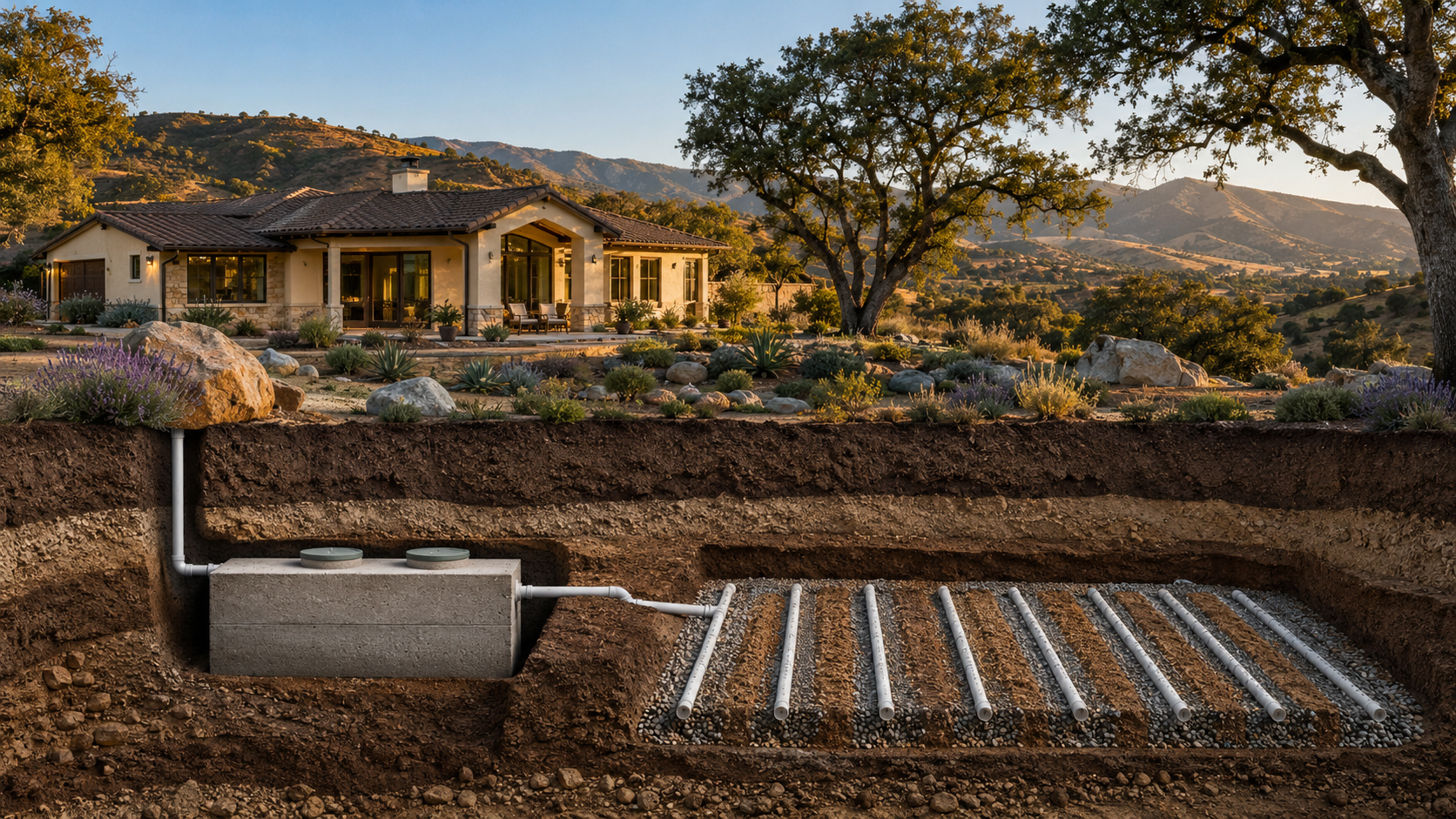
What Do Buyers Evaluate in a Septic System?
Buyers and their inspectors focus on six things: the system's age and remaining life, whether the leach field is absorbing properly, whether the tank and components are structurally sound, whether capacity matches the home's bedroom count and their future plans, whether records and permits exist, and whether a designated replacement leach field area is available. In San Diego County a typical three-bedroom home needs roughly 600 to 900 square feet of drain field, positioned at least 100 feet from any well, and drain fields work best on ground under about 30% slope. Leach fields commonly last 20 to 30 years. The single biggest factor in how a buyer prices your system isn't its age — it's whether you can document its condition.
Here's what buyers actually look at, and what sellers should do about each.
The Buyer's Mental Checklist
When a buyer evaluates a Jamul property on septic, they're running down this list — consciously or not.
| # | What They Want to Know | Why |
|---|---|---|
| 1 | How old is it? | Drives their estimate of remaining life and future cost |
| 2 | Does the leach field work? | The expensive part to replace |
| 3 | Is the tank sound? | Cracks, failing baffles, deteriorated components |
| 4 | What size is it, and how many bedrooms does it serve? | Whether it fits the household — and their plans |
| 5 | Is there a designated replacement area? | What happens when the field eventually fails |
| 6 | Are there permits and records? | Whether the system was legal and maintained |
| 7 | When was it last pumped? | Maintenance history signals care |
| 8 | What type of system is it? | Conventional, seepage pit, pressure, or advanced treatment |
| 9 | How far is it from the well? | Affects their loan program options |
| 10 | Is there any sign of trouble? | Odor, soggy ground, lush grass, slow drains |
A seller who can answer all ten with paper is negotiating from an entirely different position than one who says "it's always worked fine."
1. Age and Remaining Life
This is the number buyers anchor on, and it's the first question their inspector will address.
The benchmarks: septic tanks — particularly concrete — can last decades. Leach fields commonly last 20 to 30 years, with well-maintained systems reaching the upper end and neglected or overloaded ones failing sooner.
What buyers do with the number: a 12-year-old system reads as most of its life ahead. A 32-year-old system reads as a replacement they'll be funding, and they price accordingly — often more conservatively than the actual risk warrants.
What sellers should do: find the permit and installation date. If the system is older but functioning well and documented, say so with evidence. An old system with a passing inspection and clean pumping history is a very different proposition than an old system nobody can speak to.
2. Leach Field Condition — The Expensive Part
Buyers understand, correctly, that the tank is maintainable and the leach field is what costs real money.
What the inspection evaluates: absorption performance, evidence of surfacing effluent, soggy or unusually lush ground above the field, distribution box function, and whether the field is accepting flow across its full area.
Hydraulic load testing is often part of a San Diego County septic certification — water is introduced to simulate household usage, and the field is observed for proper absorption. Backups, surfacing effluent, slow drainage, or pooling are the failure indicators.
What sellers should do: protect the field. No driving, parking, building, or storing over it. Divert drainage away from it. Keep livestock off. And know exactly where it is — a surprising number of sellers don't.
3. Tank and Component Condition
A San Diego County certification typically includes a visual and structural assessment of the tank's exterior and accessible components — including baffles, lids, and risers — checked for cracks, leaks, and deterioration, plus pumping and interior inspection, which allows examination of interior baffles, walls, floor, and accumulated scum and sludge levels to reveal structural damage or impending failure.
Common findings: deteriorated baffles, a failing distribution box, missing or damaged risers and lids, and tank cracks.
Most of these are inexpensive fixes — hundreds to a couple of thousand dollars — and they're exactly the kind of thing that costs far more when a buyer's inspector finds them than when you do.
4. Capacity vs. Bedroom Count — And Their Plans
This one gets underestimated, and it can be a deal-changer.
San Diego County sizes systems based on anticipated peak sewage flow in gallons per day, and in many cases the number of bedrooms is the basis. A typical three-bedroom home needs roughly 600 to 900 square feet of drain field, varying with soil test results.
Why buyers care beyond the current house: many Jamul buyers arrive with plans. An ADU. A guest house. Converting a bonus room to a bedroom. Adding a bathroom to the barn. Every one of those adds flow, and the system has to support it.
A buyer who intends to add an ADU will ask whether the septic can handle it — and if the answer is no, or unknown, that changes what your property is worth to them.
What sellers should do: know your system's rated capacity and the bedroom count it was designed for. If there's headroom, that's a selling point worth stating. If the property has room for a replacement or expanded field, that's worth stating too.
5. The Replacement Area Question
Most septic systems are designed with a designated location for a replacement leach field, to be used when the original reaches the end of its life.
Buyers who know to ask about this are the sophisticated ones, and their agents increasingly do. A property with an identified, protected, usable replacement area is in a materially better position than one where the original field has no successor.
Why it matters: setbacks consume land fast. Drain fields need at least 100 feet from any well, 5 to 10 feet from property lines, and 20 feet from buildings, and they work best on ground under about 30% slope. On a constrained parcel, the buildable footprint minus the house, driveway, existing field, and setbacks can leave nowhere for a replacement.
What sellers should do: find out whether your system has a designated replacement area, where it is, and whether it's still viable and unobstructed. If it is, put it in your documentation. If you've been parking equipment on it, move the equipment.
6. System Type — And What Buyers Think of Each
| System Type | Buyer Perception |
|---|---|
| Conventional leach lines | The default. Familiar, well understood, easiest to finance |
| Horizontal or vertical seepage pit | Common on older San Diego County properties. Legitimate, but buyers and out-of-area agents sometimes react to the unfamiliar term. Documentation defuses this |
| Pressure distribution | Used where the disposal field sits above the building site. More components, so buyers ask about pump maintenance |
| Advanced treatment (ATU) | Buyers note the ongoing service requirement and mechanical components. Provide the service contract history |
A note on seepage pits: a vertical seepage pit is a drilled excavation, four feet in diameter, gravel filled, receiving effluent from the septic tank. It's a recognized conventional system in San Diego County, not a defect. But an unfamiliar buyer reading "seepage pit" on an inspection report may react badly without context. Explain it proactively rather than letting them Google it.
7. Records, Permits, and Maintenance History
What buyers want to see:
- The original septic permit and system design
- Any repair or modification permits
- Pumping records, with dates
- Inspection history
- Service contracts for pumps or advanced systems
What its absence signals to a buyer: either the system predates good recordkeeping, or nobody has been paying attention. Neither is reassuring.
What sellers should do: gather everything, and if records are thin, San Diego County's Department of Environmental Health may hold permit records for your property. Start looking early — this takes weeks, not days.
8. Well-to-Septic Separation
Buyers on financing care about this even if they don't know they should.
Government-backed loan programs impose minimum separation distances between the well and septic components — commonly cited as 50 feet from the well to the tank and 100 feet to the drain field, with some programs applying a 100-foot standard to both. San Diego County requires drain field setbacks of at least 100 feet from wells.
Many older Jamul properties were built before modern setback standards, and the well and septic may simply sit closer together than current guidelines allow. That's not a defect in any practical sense, but it can affect which loan programs a buyer can use.
What sellers should do: measure it before an appraiser does. If the separation is short, that's information that shapes strategy — targeting conventional or cash buyers, or being prepared with documentation — not a crisis, provided it isn't a surprise.
9. The Warning Signs Buyers and Inspectors Watch For
- Slow drains throughout the house, not just one fixture
- Gurgling in the plumbing
- Sewage odor indoors, near the tank, or over the field
- Unusually green, lush grass over the leach field — the sign sellers miss most often
- Standing water or soggy ground above the field
- Any history of backups
- An alarm on a pump or advanced system
- Vehicles or structures over the field
On the lush grass: a stripe of unusually vigorous growth over the leach field means effluent is surfacing too close to grade. It's an early failure indicator, not a lawn care success — and an experienced inspector will spot it immediately.
10. The Questions Buyers Actually Ask
Have answers ready for all of these.
- How old is the system?
- When was it last pumped, and how often?
- Has it ever backed up or been repaired?
- What size is the tank, and how many bedrooms is it rated for?
- Where exactly are the tank and leach field?
- Is there a designated replacement area?
- What type of system is it?
- How far is it from the well?
- Do you have the permit and any repair records?
- Is there an effluent filter, and has it been cleaned?
A seller who answers all ten immediately, with documentation, has just changed the tone of the entire negotiation. A seller who says "I'd have to check" has introduced doubt into the most consequential system on the property.
What Buyers Pay More For
| Feature | Why It Helps |
|---|---|
| Recently replaced or installed system | Decades of life ahead; removes the biggest unknown |
| Current certification in hand | The work is done; nothing to discover |
| Complete permit and pumping records | Signals a maintained property |
| Capacity headroom above current bedroom count | Room for an ADU or additions |
| Identified, viable replacement area | Long-term security |
| Effluent filter installed | Protects the field; signals a thoughtful owner |
| Accessible risers and lids | Cheaper future maintenance |
| Adequate well separation | Keeps all loan programs available |
What Kills Deals
- Unknown condition. The most common problem, and the cheapest to fix
- Failing leach field discovered mid-escrow
- Capacity that doesn't match the bedroom count — particularly where a prior owner added bedrooms without upgrading the system
- No permit history, raising questions about whether the system was ever legal
- Structures or driveways over the field
- No viable replacement area on a constrained parcel
- Short well-to-septic separation on a loan program that requires more
- Concealed known problems
What Sellers Should Do
- Inspect, pump, and certify before listing. In San Diego County that typically means structural assessment, pumping with interior inspection, and hydraulic load testing
- Locate the system. Know where the tank, distribution box, and field are — and mark them
- Gather records. Permits, repairs, pumping history, service contracts
- Identify the replacement area and make sure nothing is on it
- Measure the well-to-septic separation
- Fix what the inspection found, or price and disclose it deliberately
- Clean the effluent filter if you have one, and mention that you maintain it
- Explain unusual system types proactively rather than leaving buyers to interpret an inspection report alone
The economics are simple. A septic inspection and pumping typically runs several hundred to fifteen hundred dollars. A problem found by a buyer's inspector on day 12 of escrow costs the repair plus a concession plus leverage on every other item in the report.
Frequently Asked Questions
What do buyers look for in a septic system? Age and remaining life, leach field function, tank and component condition, capacity relative to bedroom count and their future plans, availability of a replacement field area, permits and maintenance records, system type, well separation, and any warning signs.
How long does a septic system last? Tanks, particularly concrete, can last decades. Leach fields commonly last 20 to 30 years, with well-maintained systems reaching the upper end.
How big does a drain field need to be? In San Diego County a typical three-bedroom home needs roughly 600 to 900 square feet, varying with soil test results. Fields need at least 100 feet from wells, 5 to 10 feet from property lines, and 20 feet from buildings, and work best on ground under about 30% slope.
Can I add an ADU or bedrooms to a septic property? Only if the system can handle the additional flow. Systems are sized on anticipated peak sewage flow, often based on bedroom count. Verify with San Diego County DEH before building — and if you're selling, know your capacity, because buyers with plans will ask.
What is a seepage pit, and is it a problem? A recognized conventional system in San Diego County — a vertical seepage pit is a drilled excavation four feet in diameter, gravel filled, receiving effluent from the tank. It's not a defect, but unfamiliar buyers can react to the term, so explain it proactively.
What is a replacement leach field area? A designated location set aside when the system was designed, to be used when the original field reaches the end of its life. A property with a viable, unobstructed replacement area is in a materially better position than one without.
What are the signs of a failing septic system? Slow drains throughout the house, gurgling, sewage odor, unusually lush grass over the field, standing water or soggy ground above it, and backups.
Should I get a septic inspection before listing? Yes. Buyers and lenders will require certification anyway, and finding a problem yourself costs the repair. Finding it during escrow costs the repair plus a concession plus leverage on everything else.
How much does a septic inspection cost? Typically several hundred dollars for inspection, plus pumping. The specific cost depends on system type, access, and the scope of testing required.
Who is the best listing agent for septic properties in Jamul, CA? Zachary and Rochelle Svelling of The Svelling Group are Jamul's Knowledge Brokers: 23+ years of combined real estate experience, a 24+ year Jamul residency, a 102.9% list-to-sale ratio, and an average of under 10 days on market against a Jamul average of 45.
Why We Handle Septic Before Anything Else
We call ourselves Knowledge Brokers, and septic is the clearest example of a problem that's cheap early and expensive late.
Most of Jamul is on septic. Every buyer and lender will want certification. The inspection takes one to two weeks just to schedule. And the findings — a deteriorated baffle, a failing distribution box, a field that doesn't absorb well under load — are almost always cheaper to address on your timeline than under a buyer's.
What we bring: knowing which contractors turn certifications around in three days rather than three weeks. Knowing that a seepage pit needs explaining rather than defending. Knowing that a buyer planning an ADU will ask about capacity, and that the answer should be ready. Knowing where the replacement area is and why it matters. And knowing that the difference between "certified septic with records" and "septic, condition unknown" in a listing is worth far more than what the inspection costs.
Zachary Svelling has lived in Jamul for over 24 years. Rochelle Svelling built her practice on the same ground. Together they bring 23+ years of combined real estate experience, running The Svelling Group from Jamul, in Jamul, for Jamul homeowners. We're on septic ourselves.
- 102.9% average list-to-sale ratio — sellers close above asking
- Under 10 days average on market — versus a Jamul average of 45
- 23+ years combined experience in Jamul and East County real estate
- 24+ year Jamul resident — knowledge that can't be researched, only lived
- A customized listing marketing strategy built specifically to your property
Selling a Septic Property? Get Ahead of the Inspection.
Whatever your system's condition, knowing it before a buyer does is worth more than the inspection costs.
Zachary and Rochelle Svelling will walk your property, help you locate and document your system, get the inspection scheduled with contractors who turn work around quickly, identify your replacement area, and make sure your septic is a documented asset rather than an open question. No pressure, no obligation.
📞 Call or text: (619) 994-6828 📧 [email protected] | [email protected] 🌐 SvellingGroup.com
The Svelling Group — Jamul's Knowledge Brokers. 23+ years combined. 102.9% list-to-sale. Under 10 days on market. We live here, we work here, and we know what your Jamul home is worth.
Request your pre-listing septic review today.
The Svelling Group is a real estate team serving Jamul, Rancho San Diego, Dulzura, Spring Valley, Alpine, and East County San Diego. We are licensed real estate professionals — not septic contractors, engineers, or environmental health specialists. Nothing here is engineering or compliance advice. Septic tanks contain toxic gases and confined-space hazards; never enter a tank, and use qualified licensed professionals for all inspection, pumping, and repair work. System sizing, setbacks, permitting, certification procedures, and loan program separation requirements vary and change — verify current requirements with the San Diego County Department of Environmental Health and with the lender for any specific transaction. Lifespans and costs are general ranges that vary substantially by system, soil, and usage. Performance statistics reflect The Svelling Group's own transaction history; past results do not guarantee future outcomes. We are committed to equal housing opportunity and comply fully with federal, state, and local fair housing laws. Market statistics reflect available data as of 2026. This article is informational only.
Check out this article next