

The Complete Generator Guide for Jamul Homes: Backup Power for Rural Living in 2026
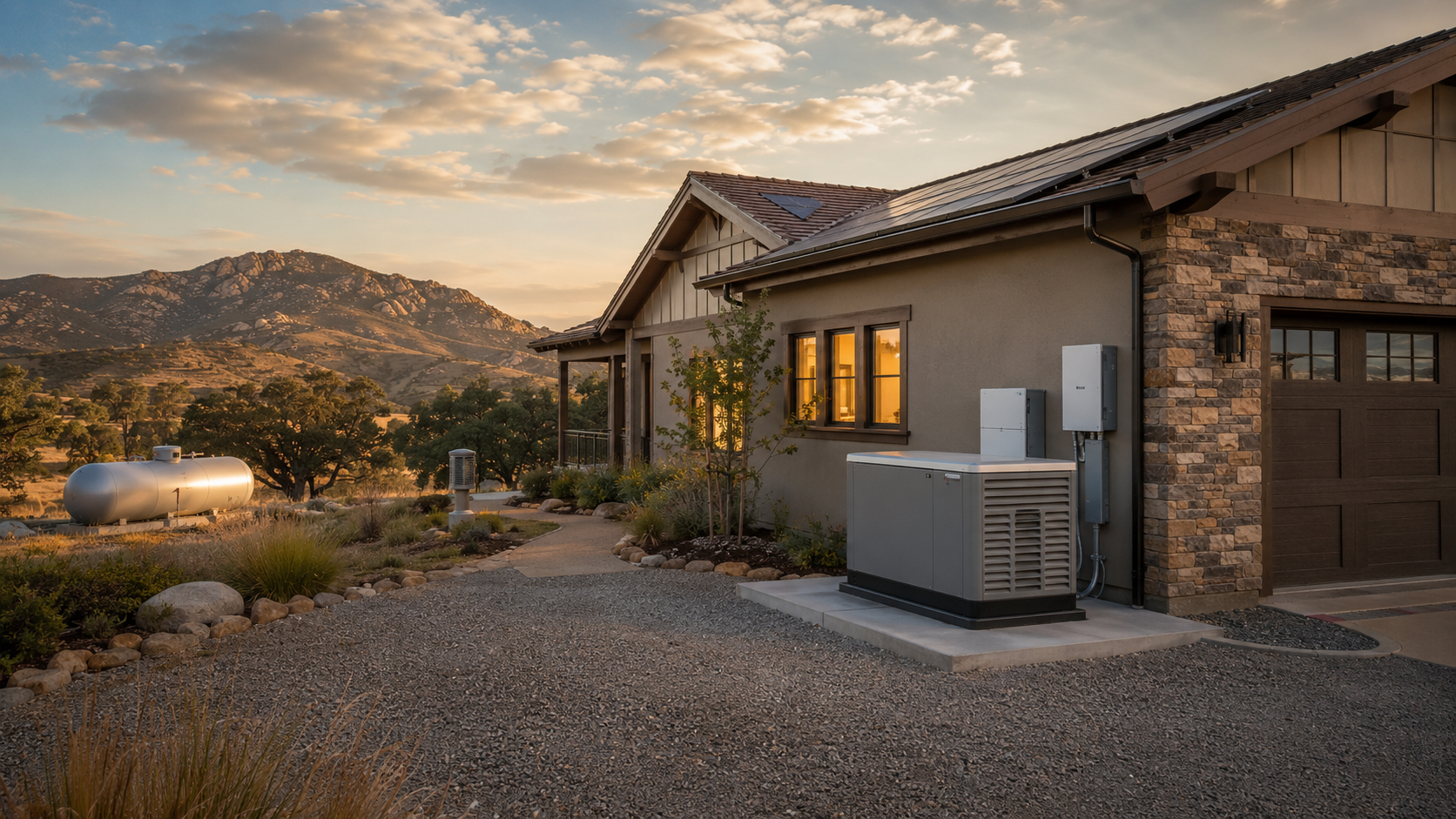
A generator can be one of the most valuable improvements on a rural Jamul property, particularly when the home depends on electricity for a private well, booster pump, septic equipment, refrigeration, internet, medical devices, electric gates or heating and cooling.
The right generator is not necessarily the largest one. It is the system that safely powers the property’s essential loads, starts the well pump, uses a practical fuel source and prevents electricity from flowing back onto SDG&E’s lines.
Jamul homeowners generally choose among:
- Portable generators for selected appliances or circuits.
- Portable generators connected through approved transfer equipment.
- Permanent standby generators that start automatically.
- Solar-plus-battery systems for quiet daily backup.
- Hybrid systems combining solar, batteries and a fuel generator.
Before purchasing or marketing a generator, determine:
- Which circuits it powers
- Continuous and starting-watt capacity
- Whether it can start the well pump
- Fuel type and storage capacity
- Expected runtime
- Whether a transfer switch or interlock is installed
- Permit status
- Generator location and exhaust direction
- Wildfire and vegetation clearances
- Noise considerations
- Service and exercise history
- Whether the system starts automatically
- Whether it works with solar and batteries
- What the homeowner must do during an outage
Never connect a generator to a home by plugging it into a wall receptacle. This dangerous practice can energize utility lines, start a fire, damage equipment and injure or kill utility workers.
Zachary and Rochelle Svelling of The Svelling Group serve as Jamul real estate “Knowledge Brokers,” helping sellers explain generators, wells, solar, batteries, propane tanks and other rural systems accurately when preparing a property for sale.
Why Jamul Homeowners Consider Backup Power
Jamul offers privacy, acreage and a rural lifestyle within reach of San Diego’s urban areas. That lifestyle also creates greater dependence on property-specific systems.
During an outage, a rural home may lose more than lights.
An outage can affect:
- Well pump
- Booster pump
- Water-treatment equipment
- Septic pumps or controls
- Refrigerator and freezers
- Heating and cooling
- Medical equipment
- Internet
- Cell-phone charging
- Electric gate
- Garage doors
- Security cameras
- Barn equipment
- Animal watering
- Pool equipment
- Solar production
- Battery charging
- Electric vehicle charging
A generator plan should start with the consequences of losing each system—not with the generator advertised at the hardware store.
Generator Options for Jamul Homes
| Backup system | Best suited for | Major limitation |
|---|---|---|
| Small portable generator | Refrigeration, lights and limited electronics | May not start a well pump or HVAC system |
| Large portable generator | Several essential circuits through approved transfer equipment | Requires manual setup, fuel and safe outdoor operation |
| Permanent standby generator | Automatic backup for selected or whole-home loads | Higher installation and maintenance cost |
| Portable power station | Electronics, lights and some small appliances | Limited capacity for pumps and heating equipment |
| Home battery | Quiet automatic backup and solar integration | Runtime depends on capacity and loads |
| Solar plus battery | Daytime production with stored backup energy | Weather and battery capacity affect performance |
| Generator plus battery | Extended and flexible backup | More complex design and controls |
Portable vs. Standby Generators
Portable generators
Portable generators are moved into position and typically started manually.
They may run on:
- Gasoline
- Propane
- Natural gas through certain approved equipment
- Dual-fuel combinations
- Tri-fuel configurations
Advantages
- Lower initial cost
- Easier to replace
- Multiple fuel options
- Useful for selected loads
- Can be stored when not needed
Disadvantages
- Must be operated outdoors
- Requires manual fueling
- May need cords or manual transfer equipment
- Can be noisy
- Easy to operate incorrectly
- Fuel may be difficult to obtain during an emergency
- Theft risk
- Weather exposure
- Limited runtime
Permanent standby generators
A standby generator is installed on a permanent pad and connected to the home through an automatic or manual transfer system.
Advantages
- Automatic starting may be available
- Can power preselected circuits or a large portion of the home
- No need to retrieve equipment during an outage
- Commonly connected to a large propane tank
- Easier for some homeowners to operate
- May provide strong appeal to rural buyers
Disadvantages
- Higher installation cost
- Requires permitting and professional installation
- Needs regular service
- Must exercise periodically
- Consumes substantial fuel under heavy loads
- Placement can affect noise, views and future improvements
- It may not power everything despite being advertised as “whole house”
Generator Terminology Every Homeowner Should Understand
Running watts
Running watts represent the power equipment uses after it has started.
Starting or surge watts
Motors may need significantly more power for a short period when starting.
Equipment with motors includes:
- Well pumps
- Booster pumps
- Refrigerators
- Freezers
- Air-conditioning compressors
- Pool pumps
- Garage-door openers
- Septic pumps
- Workshop tools
A generator may appear large enough based on running watts but still fail when a well or air conditioner starts.
Kilowatt
One kilowatt equals 1,000 watts. A generator rated at 20 kilowatts has a nominal rating of 20,000 watts under specified conditions.
Transfer switch
A transfer switch separates the home from utility power before connecting it to generator power.
SDG&E recommends a double-pole, double-throw transfer switch to prevent a generator from back-feeding into its electrical grid. The transfer equipment breaks the electrical path between utility power and the customer’s panel. SDG&E Electric Rule 21
Essential-load panel
An essential-load or critical-load panel contains selected circuits that receive backup power.
Load shedding
Load-management equipment temporarily prevents or disconnects certain high-demand appliances so the generator is not overloaded.
Automatic transfer switch
An automatic transfer switch detects a power loss, disconnects the home from the grid and signals the standby generator to start. When utility service returns, it transfers the home back and shuts down the generator after an appropriate cooldown.
How to Size a Generator for a Jamul Property
Generator sizing should be completed by qualified electrical and generator professionals. Rural properties require particular attention to motors, pumps and multiple structures.
Step 1: Identify essential loads
Start with equipment needed for safety, water, food and communication.
Highest-priority loads
- Medical devices
- Well or booster pump
- Refrigerator
- Freezer
- Septic equipment
- Internet and communications
- Essential lighting
- Electric gate
- Security equipment
- Limited heating or cooling
Lower-priority loads
- Pool heater
- Clothes dryer
- Electric oven
- EV charger
- Spa
- Arena lighting
- Workshop tools
- Second HVAC system
- Decorative lighting
Step 2: Record equipment details
For every essential appliance, record:
- Voltage
- Running amperage
- Starting amperage
- Watts
- Motor horsepower
- Breaker size
- Phase
- Manufacturer and model
The information may appear on the equipment nameplate, but a professional should confirm actual requirements.
Step 3: Account for simultaneous use
Homeowners do not always need to run every essential load at the same moment. Load management can reduce the required generator size.
For example:
- The well fills a water-storage tank.
- The well shuts off.
- The home uses the booster pump.
- The air conditioner starts after the booster cycle.
- EV charging remains disabled.
This coordinated approach may be more efficient than purchasing a generator large enough to run every motor simultaneously.
Step 4: Consider future loads
Account for planned:
- ADU
- Electric vehicle
- Heat-pump HVAC
- Heat-pump water heater
- Pool
- Workshop
- Second well
- Barn
- Electric cooking
- Battery system
Step 5: Confirm derating
Generator output may be affected by temperature, elevation, fuel and manufacturer specifications. Use professional calculations rather than assuming the nameplate rating will always be available.
Can a Generator Run a Well Pump?
Possibly, but this must be confirmed.
Well pumps can have high starting demand. Required power depends on:
- Pump horsepower
- Voltage
- Well depth
- Pump type
- Control equipment
- Wire length
- Pressure settings
- Variable-frequency drive
- Booster pumps
- Water-treatment equipment
A generator that powers refrigerators, lights and televisions may still be unable to start a deep-well pump.
Questions to answer
- What is the well pump’s horsepower?
- Does it operate at 120 or 240 volts?
- Is it submersible?
- Does it use a conventional controller or variable-speed drive?
- Is there a storage tank?
- Is a separate booster pump installed?
- Must both pumps operate simultaneously?
- Does the generator supply the treatment system?
- Is the well circuit included in the transfer equipment?
Water storage can reduce generator demand
A well can pump into a large storage tank during scheduled periods. The generator may then operate a smaller booster pump to serve the house.
This does not always reduce electrical requirements, but it can create flexibility. The entire water system should be evaluated as one system.
Can a Generator Operate Septic Equipment?
Many gravity septic systems require little or no electricity for ordinary operation. Other systems may use:
- Effluent pumps
- Aerators
- Control panels
- Alarms
- Dosing equipment
- Treatment units
- Recirculation components
If a septic system requires power, determine how long it can safely remain offline. The pump circuit and alarm should be considered in the backup-power design.
Do not assume that a property has a conventional gravity system because it is rural. Review permits and equipment.
Generator Fuel Options
Propane
Propane is common for permanent Jamul standby generators.
Advantages
- Stored onsite
- Works well with automatic standby equipment
- Does not degrade like gasoline during normal long-term storage
- Can share a properly sized household propane system
Considerations
- Heavy loads consume fuel quickly
- Tank size and fill level determine runtime
- The home and generator may compete for fuel
- Tank placement is regulated
- Delivery access must remain open
- Regulator and line sizing must be correct
Gasoline
Gasoline is common for portable generators.
Advantages
- Widely available in normal conditions
- Portable units are readily available
- Familiar fueling process
Considerations
- Storage life is limited
- Requires approved containers
- Highly flammable
- Refueling a hot generator is dangerous
- Stations may lack electricity during widespread outages
- Large quantities require careful storage and code compliance
Always shut down a portable generator and allow it to cool before adding fuel.
Diesel
Diesel generators can be durable and efficient under substantial loads.
Advantages
- Common for larger generators
- Strong performance
- Fuel-efficient in many applications
Considerations
- Fuel maintenance
- Tank requirements
- Noise
- Exhaust
- Cold-start issues in some climates
- Higher equipment cost
- Spill and environmental concerns
Natural gas
Some properties may have access to natural gas, but many rural Jamul homes rely on propane rather than pipeline gas.
A natural-gas generator does not require an onsite refillable tank, but it depends on the gas system remaining available.
Dual-fuel or tri-fuel
Multi-fuel generators offer flexibility but may produce different output depending on the fuel. Confirm the rating for the fuel you plan to use.
Estimating Generator Runtime
Generator runtime depends on:
- Electrical load
- Generator efficiency
- Fuel
- Tank capacity
- Ambient conditions
- Maintenance
- Appliance cycling
Do not estimate runtime based only on the size of a propane tank. Propane tanks are not filled completely to their water capacity, and other appliances may draw from the same supply.
Runtime planning questions
- What is the generator’s fuel consumption at 25%, 50%, 75% and full load?
- How much usable fuel is stored?
- Does the furnace or water heater use the same propane?
- How often can the generator shut down?
- Can batteries carry smaller nighttime loads?
- Can water be pumped during a scheduled generator run?
- Can refrigeration be maintained intermittently?
- How will fuel be replenished if roads are closed?
A fuel plan should cover realistic demand rather than the generator’s no-load or best-case rating.
Generator, Solar and Battery Integration
Solar panels, batteries and a generator can complement one another—but only when the equipment and controls are designed to operate together.
Solar without batteries
A standard grid-connected solar system generally shuts down during an outage. A generator does not automatically reactivate it.
Solar with battery storage
A battery system may provide power immediately and silently. Solar may recharge the batteries during daylight when conditions permit.
Battery plus generator
A hybrid system can use:
- Batteries for overnight and low-demand periods
- Solar to recharge batteries during the day
- A generator for heavy loads or extended cloudy periods
- Automatic controls to reduce unnecessary generator runtime
Possible hybrid sequence
Not every solar inverter, battery and generator can communicate correctly. Integration should be designed by qualified professionals and approved as required.
Generator Safety: Preventing Carbon-Monoxide Poisoning
Carbon monoxide is colorless, odorless and potentially fatal.
Never operate a portable generator:
- Inside a house
- Inside a garage
- In a carport treated as an enclosure
- In a basement
- In a crawl space
- In a shed
- Near an open door
- Near an open window
- Near a ventilation intake
- On a covered porch where exhaust can accumulate
Opening garage doors or windows does not make indoor generator use safe.
OSHA advises that generators be used outdoors and kept away from doors, windows and ventilation openings where carbon monoxide could enter. Its guidance also calls for clear space around and above portable generators for ventilation. OSHA generator safety guidance
Every Jamul home with a fuel-burning generator should have functioning carbon-monoxide alarms in appropriate locations.
Symptoms of carbon-monoxide exposure may include:
- Headache
- Dizziness
- Weakness
- Nausea
- Confusion
- Chest pain
- Loss of consciousness
Move to fresh air and seek emergency help if exposure is suspected.
Backfeeding: One of the Most Dangerous Generator Mistakes
Backfeeding can occur when a generator is connected to household wiring without approved isolation from the utility grid.
This may energize:
- Utility lines
- Transformers
- Neighboring systems
- Equipment utility workers believe is de-energized
Never use a “suicide cord” or improvised male-to-male cord. Never plug the generator into a dryer outlet or another household receptacle.
A properly installed transfer switch or other approved equipment must prevent the generator and utility supply from energizing the home simultaneously.
Portable Generator Extension-Cord Safety
When directly connecting appliances to a portable generator:
- Use cords rated for outdoor use.
- Use the correct gauge.
- Confirm the cord’s amperage and wattage rating.
- Inspect for cuts and damaged insulation.
- Keep connections dry.
- Do not run cords through standing water.
- Do not pinch cords under doors or windows.
- Do not connect multiple cords beyond their capacity.
- Avoid trip hazards.
- Follow generator grounding instructions.
- Use ground-fault protection where required.
A cord adequate for a lamp may be unsafe for a refrigerator, pump or heater.
Generator Placement on a Jamul Property
Generator placement affects:
- Carbon-monoxide safety
- Fire safety
- Noise
- Fuel piping
- Electrical wiring
- Service access
- Views
- Drainage
- Property lines
- Bedrooms
- Windows and doors
- Defensible space
- Future construction
Placement considerations
- Manufacturer-required clearances
- Distance from openings
- Exhaust direction
- Combustible materials
- Vegetation
- Propane tank
- Property setbacks
- Road access
- Flooding and runoff
- Stable foundation
- Heat dissipation
- Neighboring homes
- Service technician access
Do not build an improvised enclosure around a generator. Restricting ventilation can cause overheating, fire or carbon-monoxide accumulation.
Generator Permits in Unincorporated San Diego County
Permanent generator installations can involve:
- Building permit
- Electrical permit
- Plumbing or gas permit
- Fire-authority review
- Plot plan
- Foundation or anchoring details
- Fuel-tank review
- Equipment specifications
- Final inspection
San Diego County lists “Permitting Requirements for Stand-Alone Generator Units” among its current building handouts. Property owners should confirm requirements for the proposed generator and parcel before installation. San Diego County building forms and handouts
A portable generator used independently may be treated differently from a permanently connected standby unit, but any connection to a home’s electrical system must be safe and compliant.
Propane-Tank Requirements for Generators
The generator’s propane tank, line and regulator must be sized for the equipment and installed in an approved location.
San Diego County’s generator permitting guidance states that, in the conditions addressed by the document, LPG tanks with up to 499 gallons of water capacity must be located at least 10 feet from the generator, buildings, roads and property lines. Larger tanks and site-specific conditions may have different requirements. The fire authority having jurisdiction reviews applicable fuel-tank installations. San Diego County generator requirements
Do not treat the 10-foot figure as universal approval for a proposed layout. Tank capacity, generator specifications, terrain, property lines and other features must be reviewed.
Wildfire Considerations
A generator can support a home during a planned or unplanned outage, but it also contains ignition and heat sources.
Before operation:
- Remove combustible debris from the approved operating area.
- Maintain required vegetation clearance.
- Keep dry grass away from exhaust.
- Inspect fuel lines.
- Confirm the generator is not leaking.
- Keep approved extinguishing equipment accessible.
- Avoid operating damaged equipment.
- Follow wildfire restrictions and emergency instructions.
- Do not operate a portable generator where hot exhaust contacts vegetation.
- Do not obstruct emergency access.
A generator should not encourage a homeowner to remain in an evacuation area. Backup power improves resilience; it does not make a property safe from an approaching wildfire.
Generator Noise and Neighbor Considerations
Generator sound can travel across rural hills and valleys.
Noise depends on:
- Generator type
- Engine speed
- Electrical load
- Enclosure
- Distance
- Terrain
- Buildings
- Vegetation
- Time of operation
- Maintenance
Before installing a standby system, consider its relationship to:
- Primary bedroom
- Outdoor living areas
- ADU
- Neighboring homes
- Horse facilities
- Property lines
Never alter a listed generator enclosure or construct an unapproved sound enclosure that restricts cooling or exhaust.
Generator Maintenance Schedule
A generator that has not been maintained may fail when it is needed most.
| Frequency | Maintenance task |
|---|---|
| Before each portable use | Check fuel, oil, cords, leaks and operating location |
| Monthly | Review standby-generator status and alerts |
| During scheduled exercise | Confirm normal startup, sound and shutdown |
| Seasonally | Inspect vegetation, exhaust and access |
| Before fire season | Complete service and verify stored fuel |
| After extended operation | Check oil and follow manufacturer service intervals |
| Annually | Professional inspection as recommended |
| Before selling | Document service, permits and transfer operation |
Components requiring attention may include:
- Engine oil
- Oil filter
- Air filter
- Spark plugs
- Starting battery
- Coolant
- Fuel filter
- Belts
- Hoses
- Propane regulator
- Fuel lines
- Exercise controller
- Transfer switch
- Electrical connections
- Enclosure
- Rodent damage
- Alarm codes
Follow the manufacturer’s schedule. Service frequency may increase after extended runtime.
Test the Entire Backup System
Hearing the generator engine start does not prove the house is receiving power correctly.
A complete test may include:
- Confirming the generator starts
- Testing the transfer switch
- Verifying essential circuits
- Starting the well pump
- Starting the booster pump
- Checking septic equipment
- Confirming refrigerator and freezer operation
- Testing internet and communications
- Verifying gate operation
- Observing load-management equipment
- Confirming solar and battery behavior
- Returning safely to utility power
Testing should be performed under professional guidance when necessary. Never remove covers or access energized equipment unless qualified.
Generator Planning for Horses and Livestock
Horse properties may depend on electricity for:
- Well pumping
- Trough filling
- Barn lighting
- Electric fencing
- Ventilation
- Cameras
- Feed storage
- Medical or rehabilitation equipment
- Electric gates
Prioritize water above convenience loads. A generator plan should explain how animals will receive water if both the well and booster pump are offline.
Maintain:
- Stored emergency water
- Manual gate access
- Backup trough-filling methods
- Generator-safe barn circuits
- Fuel reserves
- Clear access for equipment
- A plan for extended outages
Do not run a portable generator inside a barn, tack room, feed room or horse trailer.
Generator Planning for Older Adults and Medical Needs
An automatic standby system or battery may be easier to operate than a portable generator requiring movement, fueling and cord management.
Households with medical needs should consider:
- Automatic startup
- Medical-equipment capacity
- Battery-supported transition time
- Remote system monitoring
- Fuel duration
- Caregiver access
- Carbon-monoxide alarms
- Cooling and heating needs
- A relocation plan if the system fails
No backup system should replace an emergency plan recommended by a medical provider or public-safety authority.
Generator Documents Jamul Sellers Should Gather
Equipment records
- Manufacturer
- Model
- Serial number
- Rated capacity
- Fuel type
- Installation date
- Owner’s manual
- Warranty
- Service contract
Permit records
- Building permit
- Electrical permit
- Gas or plumbing permit
- Fire-authority review
- Final inspection
- Approved plot plan
Installation records
- Contractor invoice
- Generator specifications
- Foundation details
- Transfer-switch information
- Essential-load panel schedule
- Fuel-tank documents
- Propane-line information
Maintenance records
- Annual service
- Battery replacement
- Oil and filter changes
- Repairs
- Exercise history
- Alarm history
- Transfer-switch testing
Operating information
- Which circuits receive backup
- Startup procedure
- Shutdown procedure
- Fuel consumption
- Approximate runtime assumptions
- Manual transfer instructions
- Load-shedding sequence
- Solar and battery interaction
Never place passwords, gate codes, alarm codes or security information in public marketing.
How a Generator Affects Jamul Resale Value
A properly installed and documented generator can be attractive to rural buyers because it addresses a practical concern: maintaining water, refrigeration and essential systems during an outage.
Its contribution to value depends on:
- Permit status
- Capacity
- Age
- Condition
- Fuel supply
- Automatic operation
- Transfer equipment
- Well-pump capability
- Noise
- Maintenance
- Integration with solar and batteries
- Buyer expectations
A large generator that is unpermitted, poorly placed or disconnected may create more concern than value.
Buyer-friendly generator description
Accurate marketing might state:
Permanently installed propane standby generator with automatic transfer equipment serving designated household circuits. Permit and service records available.
Avoid unsupported statements such as:
- Powers everything indefinitely
- Never lose power
- Fully off-grid
- Runs the entire property
- Unlimited propane
- Powers the well
Only state that the generator powers the well when the circuit, capacity and successful operation have been confirmed.
Preparing a Generator Before Listing
Step 1: Identify the equipment
Record the model, capacity, fuel and installation date.
Step 2: Locate permits
Confirm that the generator, transfer switch, fuel piping and tank were approved as applicable.
Step 3: Service the generator
Resolve warning lights, starting problems, leaks and overdue maintenance.
Step 4: Test the transfer system
Confirm which circuits receive power.
Step 5: Test the well and other essential loads
Do not rely on memory or an old representation.
Step 6: Fill or verify the fuel supply
A nearly empty propane tank may prevent inspection.
Step 7: Clean the installation area
Remove vegetation, debris and stored materials while maintaining required access.
Step 8: Prepare written instructions
Provide clear operating information to the buyer at the appropriate transaction stage.
Step 9: Disclose known problems
Share relevant repairs, failures, warning conditions and limitations.
Step 10: Market accurately
Emphasize documented resilience without promising uninterrupted service.
Common Generator Mistakes
- Buying a generator before calculating well-pump demand.
- Plugging a generator into a wall or dryer outlet.
- Running a generator inside a garage.
- Placing it near windows or doors.
- Refueling while the generator is hot.
- Using undersized extension cords.
- Assuming solar works normally during an outage.
- Assuming a propane appliance operates without electricity.
- Forgetting about septic pumps.
- Ignoring transfer-switch permits.
- Storing old gasoline improperly.
- Failing to exercise a standby generator.
- Letting the starting battery fail.
- Allowing weeds to grow near the exhaust.
- Installing an unapproved sound enclosure.
- Underestimating propane consumption.
- Letting household propane use deplete generator fuel.
- Advertising “whole-house” power without testing.
- Failing to test the system under actual load.
- Losing permits and service records.
Frequently Asked Questions About Generators in Jamul
What size generator do I need for a Jamul home?
The correct size depends on essential circuits and motor-starting demands. A professional should calculate loads, especially for wells, booster pumps, HVAC systems and septic equipment.
Can a portable generator power my entire house?
Some large portable units can power multiple circuits through approved transfer equipment, but “entire house” depends on appliance demand. High-load equipment may need to be excluded.
Can I connect a generator through my dryer outlet?
No. Improvised backfeeding is extremely dangerous. Use approved transfer or isolation equipment installed by qualified professionals.
Will my solar panels work during an outage?
Standard grid-connected solar usually shuts down. Solar may continue supporting a home when compatible battery and islanding equipment are installed.
Can a generator charge a home battery?
Some systems support generator charging, but compatibility is not universal. The inverter, battery, generator and control system must be designed to work together.
Is propane better than gasoline for a generator?
Propane is convenient for standby systems and long-term onsite storage. Gasoline may be readily available for portable generators under normal conditions. The better choice depends on runtime, delivery, storage, capacity and equipment.
How long will a propane generator run?
Runtime depends on tank level, generator size, load and other propane appliances. Use the manufacturer’s fuel-consumption data and actual usable fuel.
Does a generator require a permit in Jamul?
Permanent installations commonly require County permits and may require fire review. Verify the proposed installation with San Diego County and the applicable fire authority.
Can I install a standby generator myself?
A permanent generator involves electrical, fuel, exhaust, foundation and code requirements. Use properly licensed and qualified professionals.
How far should a generator be from the house?
Required clearance depends on manufacturer instructions, openings, fire requirements, fuel equipment and site conditions. Do not rely on a single generic distance.
Should I buy a generator or a battery?
A battery is quiet and can pair with solar, while a generator may provide longer backup when fuel is available. Many rural properties benefit from a properly designed combination.
Does a generator increase home value?
It can improve marketability and buyer confidence when permitted, maintained and capable of supporting essential rural systems. The generator’s cost does not automatically equal its added value.
What happens if a generator is unpermitted?
The seller may face buyer concerns, lender or insurance questions, corrective work and potential County review. Investigate permit status before listing.
Should the seller demonstrate the generator?
A functional demonstration or professional report can help buyers understand the system. Testing should be performed safely and without creating an improper promise or warranty.
Can a generator keep me safe during a wildfire?
It can provide backup electricity, but it does not protect a home from fire and should never be used as a reason to disregard evacuation instructions.
Generator Buyer Checklist
Before buying a Jamul home with a generator, verify:
- Generator manufacturer and model
- Rated continuous output
- Fuel type
- Tank ownership and capacity
- Permit status
- Final inspection
- Transfer-switch type
- Essential circuits
- Well-pump operation
- Booster-pump operation
- Septic equipment
- Solar compatibility
- Battery compatibility
- Generator age
- Service records
- Exercise schedule
- Starting-battery condition
- Fuel consumption
- Placement and exhaust
- Noise
- Vegetation clearance
- Owner’s manual
- Warranty transfer
Work With Jamul Real Estate Knowledge Brokers
A generator is one part of a larger rural-property system. Buyers also need to understand the well, water-storage tanks, septic system, propane supply, solar panels, battery storage, private road and fire preparedness.
Zachary and Rochelle Svelling of The Svelling Group help Jamul sellers:
- Identify what the generator actually powers
- Organize permits and service records
- Explain transfer equipment
- Document well-pump and booster-pump backup
- Clarify propane-tank ownership
- Present solar, battery and generator systems together
- Anticipate buyer inspection questions
- Address obvious maintenance issues
- Avoid unsupported “whole-house” or “off-grid” claims
- Market rural resilience accurately
As Jamul real estate Knowledge Brokers, Zachary and Rochelle understand that buyers want more than a photograph of the generator. They want confidence that the system is safe, functional, documented and appropriate for the property.
If you are considering selling a Jamul home with a portable, standby or hybrid backup-power system, contact Zachary and Rochelle Svelling for a confidential property consultation. The Svelling Group can help you prepare the generator records, identify likely buyer questions and position the entire rural property for a stronger, smoother sale.
Check out this article next

Defensible Space Requirements in Jamul: The Complete 2026 Homeowner Guide
Jamul homeowners generally need to maintain defensible space around homes and other applicable structures because much of the community lies within a wildland-urban interface and…
Read Article