

Septic Systems in Jamul: The Complete 2026 Homeowner, Buyer and Seller Guide
What Should Jamul Homeowners Know About Septic Systems?
Many Jamul homes are not connected to a public sewer system. Instead, wastewater from the home is treated and dispersed through a private septic system, officially called an onsite wastewater treatment system, or OWTS.
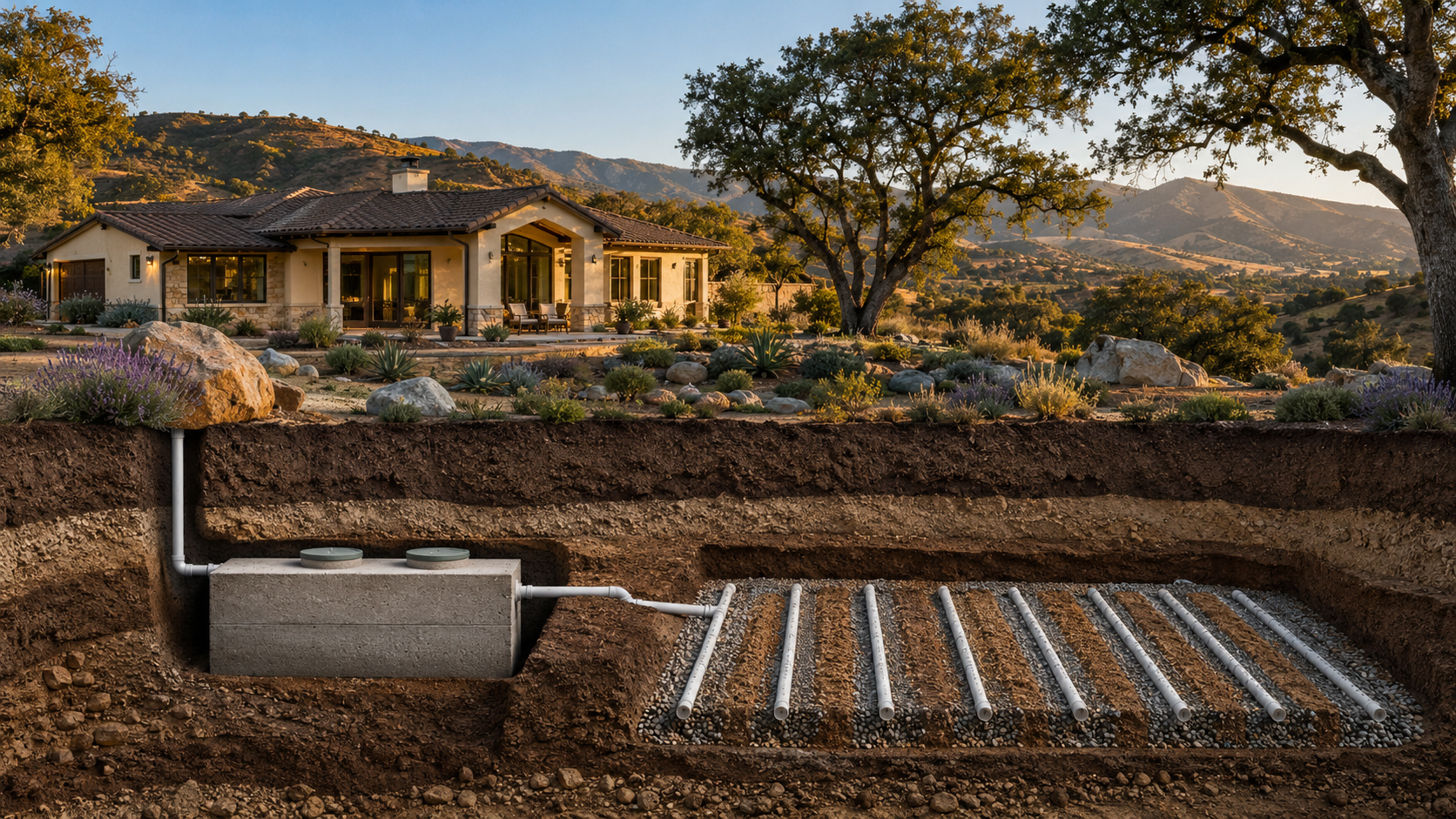
A conventional septic system usually consists of a buried septic tank and a disposal area such as leach lines, a seepage pit or another approved dispersal system. Wastewater enters the tank, solids settle, oils float and liquid effluent moves into the disposal area, where it is filtered through the surrounding soil.
A properly designed and maintained septic system can operate reliably for decades. Problems are more likely when owners use too much water, flush inappropriate materials, skip pumping, drive over the disposal field, damage system components or add bedrooms and plumbing without confirming that the system can support the increased wastewater flow.
For Jamul buyers, a septic inspection and records review should be treated as an important part of due diligence. For sellers, locating records, identifying system components and addressing known problems before listing can help prevent delays, renegotiations and failed escrows.
In unincorporated San Diego County, septic-system permitting and oversight are generally handled by the County of San Diego Department of Environmental Health and Quality, commonly called DEHQ. California’s statewide onsite wastewater policy also establishes standards intended to protect groundwater, surface water and public health. County of San Diego septic-system program
This guide is educational and not a substitute for advice from DEHQ, a qualified septic professional, engineer, contractor, attorney or other appropriate specialist.
Septic Systems at a Glance
| Question | Short answer |
|---|---|
| Are septic systems common in Jamul? | Yes. Many rural and semi-rural Jamul homes use private septic systems. |
| Is a septic system the same as a sewer? | No. A septic system treats wastewater on the individual property. |
| Who regulates septic systems in Jamul? | Primarily San Diego County DEHQ under County requirements and California’s OWTS policy. |
| How often should a tank be pumped? | It depends on tank size, occupancy, usage and solids accumulation; inspections help determine the appropriate interval. |
| Can you build over a septic system? | Generally, septic components and required reserve areas must remain accessible and protected from structures and heavy loads. |
| Can a pool or ADU affect a septic system? | Yes. Improvements can conflict with the existing system, reserve area or permitted capacity. |
| Should buyers inspect a septic system? | Yes. A general home inspection does not replace a dedicated septic evaluation. |
| Does pumping prove the entire system works? | No. Pumping removes tank contents but does not automatically prove that the disposal field is functioning properly. |
| Can an old septic system still work? | Yes, but age alone does not establish condition or remaining life. |
| What is the biggest seller mistake? | Waiting until escrow to locate the system, review records or investigate known warning signs. |
What Is a Septic System?
A septic system is an underground wastewater treatment and dispersal system located on the property it serves. It receives wastewater from toilets, sinks, showers, bathtubs, dishwashers, washing machines and other connected plumbing fixtures.
Unlike a sewer connection, wastewater does not travel through a municipal pipe to a centralized treatment plant. Treatment takes place on the property.
A typical conventional system has two principal sections:
- The septic tank
- The disposal or dispersal area
Some properties also have pumps, distribution boxes, control panels, filters, alarms or supplemental treatment equipment.
What Happens Inside the Septic Tank?
Wastewater flows from the home through the building sewer into the septic tank. Inside the tank, the contents naturally separate into layers:
- Sludge: Heavier solids that settle to the bottom
- Scum: Fats, oils and floating materials that rise to the top
- Effluent: The liquid layer between the sludge and scum
Baffles or sanitary tees help keep floating and settled solids inside the tank while allowing effluent to move toward the disposal system.
Beneficial bacteria break down some organic material, but a septic tank does not make every solid disappear. Sludge and scum continue to accumulate and eventually need to be removed by a licensed septic pumping company.
What Happens in the Leach Field?
Liquid leaving the tank enters a disposal system. In many conventional installations, perforated pipes distribute effluent into gravel-filled trenches called leach lines.
The surrounding soil provides additional treatment as wastewater moves through it. Soil characteristics, groundwater separation, slope and available land therefore play important roles in system design.
If the soil cannot accept effluent at the rate it enters the disposal area, wastewater may back up into the home or surface above the field.
What Types of Septic Systems Are Found in Jamul?
Not every Jamul property uses the same design. Terrain, soil, parcel size, home size, system age and historical regulations can all affect what was installed.
Conventional Septic Tank and Leach Lines
This familiar design uses a septic tank connected to underground perforated pipes. Effluent is distributed over a designated area and absorbed into the soil.
Seepage Pits
A seepage pit is a deeper vertical dispersal component that releases effluent into surrounding soil. Some older San Diego County properties have pits, and certain approved designs may incorporate them.
The presence of a pit should be evaluated carefully. Buyers should understand its location, construction, permit history and current condition.
Pump Systems
Gravity cannot serve every Jamul property. Hillside conditions or the relationship between the home and disposal area may require a pump.
Pump systems can include:
- A pump chamber
- Electrical components
- Floats
- An alarm
- A control panel
- Pressure-distribution components
Owners must know what an alarm means and whom to contact if it activates. Ignoring a septic alarm can turn a manageable equipment issue into a wastewater backup.
Supplemental Treatment Systems
Some properties require technology beyond a conventional septic tank. Supplemental treatment systems may provide additional wastewater treatment before dispersal.
These systems can involve:
- Specialized treatment units
- Pumps or aeration
- Monitoring
- Periodic professional service
- An annual operating permit
- Ongoing operating expenses
San Diego County has been evaluating aspects of its annual operating-permit program for supplemental treatment systems. Owners and buyers should verify current requirements directly with DEHQ rather than relying on an old invoice or prior listing description.
Alternative Dispersal Systems
Challenging sites may use specialized dispersal methods, such as pressure distribution or drip systems. These are not necessarily defective or inferior. They are simply more complex and may have different service requirements.
Why Are Septic Systems So Common in Jamul?
Jamul is a rural and semi-rural community in unincorporated San Diego County. Properties may be located on acreage, along private roads, on hillsides or far from centralized sewer infrastructure.
Extending public sewer lines to every rural parcel would be expensive and, in some locations, impractical. Individual septic systems allow homes to manage wastewater on-site when the parcel and soil can support an approved design.
This is one reason Jamul real estate requires specialized knowledge. A home may look similar to a suburban residence while operating very differently behind the walls and beneath the ground.
A buyer moving from a sewered neighborhood may need to learn about:
- Septic maintenance
- Private wells or water districts
- Propane
- Solar systems
- Generators
- Private roads
- Easements
- Fire-insurance availability
- Defensible space
- Water storage
- Equestrian improvements
Zachary and Rochelle Svelling of The Svelling Group approach these properties as local knowledge brokers, helping clients identify the questions that should be answered before buying or selling.
How Long Does a Septic System Last?
There is no single expiration date for every septic system.
A concrete tank, distribution component, pump and leach field do not necessarily have the same useful life. One component may need repair while the rest remains serviceable.
Longevity can be affected by:
- Original design and installation
- Soil conditions
- Tank material
- Household occupancy
- Water usage
- Pumping history
- Garbage-disposal use
- Tree-root intrusion
- Vehicle traffic
- Drainage and erosion
- Earth movement
- Unpermitted additions
- Products flushed into the system
- Quality of prior repairs
An older system may still function well, while a newer system can fail prematurely if it was damaged, overloaded or poorly maintained. The most useful information comes from records, physical inspection and current performance—not age alone.
How Often Should a Septic Tank Be Pumped?
There is no universal pumping schedule that fits every Jamul household. The appropriate interval depends on:
- Tank capacity
- Number of occupants
- Household water consumption
- Volume of solids entering the system
- Use of a garbage disposal
- Whether the home is full-time or seasonal
- Condition of tank baffles and filters
- Recommendations from the servicing professional
- Requirements applying to the particular system
Many homeowners use a general interval of several years as a starting point, but inspection of sludge and scum levels is more informative than selecting an arbitrary date.
A two-person household with a large tank may accumulate solids differently from a multigenerational household occupying every bedroom. A property used as a vacation home may also differ from one with full-time residents.
Keep written pumping and service records. Those documents can help identify a pattern and provide useful information when the property is sold.
Does a Septic Additive Eliminate the Need for Pumping?
No product should be assumed to eliminate routine inspection or pumping. A septic tank’s natural bacterial environment already processes part of the waste, but non-digestible solids remain.
Before using an additive, ask a qualified septic professional whether it is appropriate for the particular system. Avoid products that promise to restore a failed field or permanently replace pumping without reliable evidence.
Signs a Septic System May Be Failing
Septic problems often provide warnings before a complete failure occurs.
Watch for:
- Slow drains throughout the house
- Toilets that flush poorly
- Gurgling plumbing
- Sewage odors indoors or outdoors
- Wastewater backing up into tubs or showers
- Wet, spongy or unusually green ground near the disposal area
- Sewage surfacing outside
- A septic alarm
- Frequent need for pumping
- Drain problems that return soon after pumping
- Unexplained settling or depressions near septic components
- Effluent flowing downhill or toward drainage areas
One slow sink may be a localized plumbing clog. Multiple slow fixtures can indicate a problem farther downstream. Do not continue running water to “test” a suspected backup, because additional flow may make the situation worse.
Surfacing sewage presents a health concern. Keep people and animals away and contact a qualified professional promptly.
What Causes Septic-System Failure?
Excessive Water Use
Every gallon entering the tank must eventually be processed or dispersed. Heavy water use can push liquid through the tank too quickly or overwhelm the disposal area.
Common sources include:
- Leaking toilets
- Long showers
- Multiple laundry loads in succession
- Irrigation mistakenly directed over the field
- Large gatherings
- Plumbing leaks
- High-usage fixtures
Spacing laundry throughout the week can be easier on a system than completing many loads in one day.
Too Many Solids
Septic systems are designed for ordinary household wastewater—not unlimited solids.
Problem materials include:
- Wipes, including products labeled “flushable”
- Paper towels
- Feminine products
- Diapers
- Dental floss
- Cat litter
- Cigarette butts
- Condoms
- Cotton swabs
- Cooking grease
- Coffee grounds
- Paint
- Solvents
- Pesticides
- Automotive fluids
- Medications
A simple rule is to flush only human waste and toilet paper.
Delayed Pumping
When sludge and scum accumulate beyond appropriate levels, solids may escape the tank and enter the disposal area. A tank can be pumped; a field clogged with solids is much more difficult and expensive to address.
Physical Damage
Driving heavy vehicles over a tank or field can crack components and compact soil. Construction equipment, RVs, trailers, horse facilities and new driveways should be kept away from the system unless a qualified specialist has confirmed otherwise.
Tree Roots
Roots can interfere with pipes and components. Large trees should not be planted over the septic tank or disposal area.
Poor Surface Drainage
Roof runoff, irrigation and stormwater should not saturate the disposal area. The field needs soil capacity to accept wastewater from the home.
An Unapproved Increase in Use
Adding bedrooms, converting a garage or creating an accessory dwelling unit can increase wastewater demand. The existing system may not have been designed or permitted for the new use.
What Can Be Planted Over a Leach Field?
Shallow-rooted grass and suitable low-growing plants are generally safer choices than trees, large shrubs or deeply rooted landscaping.
Avoid planting:
- Large trees
- Dense woody shrubs
- Fruit trees
- Plants requiring heavy irrigation
- Deep-rooted species
- Vegetable gardens directly over wastewater components
Do not install impermeable surfaces over the field. Artificial turf, patios, concrete, pools and structures can interfere with evaporation, access, soil function or repairs.
Before landscaping, confirm the actual system location. Guessing based on greener grass is not sufficient.
Can Horses or Livestock Use the Septic Area?
Jamul horse properties require extra planning. Horses, livestock, trailers and maintenance equipment can compact soil or damage buried components.
A septic disposal area should not automatically be treated as a turnout, corral, arena, parking area or equipment route. Fencing may be appropriate to protect critical components.
Before changing an equestrian layout, locate the active system and reserve area and consult the appropriate professionals.
What Is a Septic Reserve Area?
A reserve area is land preserved for future replacement or expansion of the disposal system. The original field may eventually require replacement, and the reserve area provides a place for that work.
The reserve area should remain protected from:
- Buildings
- Pools
- Accessory structures
- Permanent paving
- Grading
- Retaining walls
- Deep-rooted landscaping
- Heavy vehicle traffic
- Equestrian improvements
- Other uses that prevent future installation
A property may have a large parcel but limited usable septic area due to slope, rock, setbacks, wells, drainage or soil conditions.
“Five acres” does not necessarily mean five acres are available for future construction.
Septic Permits and Records in San Diego County
The County’s septic program is intended to protect groundwater and surface water, provide reliable wastewater treatment and prevent premature system failure.
County septic records dating from approximately the late 1970s may be maintained by assessor parcel number. Scanned land-use records, including some septic layouts and inspections, can be searched through the County’s Environmental Health Document Library. San Diego County DEHQ records
A property record may contain:
- Approved septic layout
- Tank location
- Disposal-field location
- System type
- Permit information
- Installation inspection
- Repair documents
- Supplemental-treatment information
- Proposed reserve area
- Bedroom or flow assumptions
Records are valuable, but they are not a substitute for field verification. Landscaping, remodeling, grading and undocumented repairs may have changed the property since a drawing was created.
What If No Septic Records Can Be Found?
The absence of an easily located record does not automatically prove that a system is illegal. Older systems may predate available files, records may be incomplete or the search may have used an incorrect parcel number.
Further investigation may include:
- Confirming the assessor parcel number
- Searching the County document library
- Contacting DEHQ
- Reviewing seller records and invoices
- Looking for permits associated with additions
- Hiring a septic professional to locate components
- Comparing observations with historical property information
Do not represent an unverified system as permitted merely because it has operated for years.
How Is a Septic System Inspected During a Home Sale?
A professional septic evaluation is different from a standard home inspection.
The precise scope depends on the company, system and property, but an evaluation may include:
- Locating the tank
- Exposing access lids
- Reviewing visible tank condition
- Evaluating inlet and outlet components
- Measuring solids
- Looking for signs of leakage or deterioration
- Identifying pumps, alarms or control equipment
- Observing wastewater flow
- Locating the disposal area
- Checking for surfacing effluent
- Comparing the system with available records
- Recommending pumping, maintenance or further evaluation
Buyers should ask what the inspection includes and excludes. Some services described as a “certification” may have a limited scope.
Does the Tank Need to Be Pumped During an Inspection?
Pumping may allow closer observation of the tank’s interior condition, but procedures vary. Ask the inspector and pumping contractor how they coordinate their work.
A recently pumped tank may conceal clues about usage or performance if no documentation explains why it was pumped. Conversely, a tank that has not been serviced in many years may make it difficult to distinguish overdue maintenance from a larger system issue.
The important point is that pumping alone is not a complete septic inspection.
Should Buyers Perform a Hydraulic Load Test?
Testing methods should be selected by qualified professionals. Adding water to a system without understanding its design and current condition can be inappropriate.
A buyer should not personally run every faucet for hours to see whether the system fails. Ask the septic professional what testing is suitable and whether County requirements or property conditions limit a particular procedure.
A Jamul Buyer’s Septic Due-Diligence Checklist
Before removing septic-related contingencies, consider completing these steps:
- Obtain all available County septic records.
- Ask the seller for pumping, inspection and repair invoices.
- Confirm the permitted bedroom or design capacity.
- Determine whether additions or conversions changed occupancy.
- Hire a qualified septic professional.
- Locate the tank and active disposal area.
- Identify the replacement or reserve area.
- Look for structures, paving or corrals over system components.
- Confirm whether pumps, alarms or treatment units are present.
- Review ongoing service and operating-permit requirements.
- Investigate odors, backups, wet areas or recurring plumbing problems.
- Consider the relationship between the septic system and any private well.
- Evaluate whether planned pools, ADUs or barns conflict with the system.
- Obtain specialist recommendations for any identified concern.
- Avoid relying exclusively on seller recollection or an old MLS description.
Questions Buyers Should Ask About a Septic Property
- When was the tank last pumped?
- Why was it pumped?
- Has wastewater ever backed up?
- Has sewage surfaced outside?
- Have repairs been performed?
- Is there a pump or alarm?
- Is the system conventional or supplemental?
- Where are the tank, field and reserve area?
- What capacity was approved?
- Were additions permitted?
- Is the property occupied differently from its permitted design?
- Are there maintenance contracts?
- Is an annual operating permit required?
- Do existing improvements encroach on septic areas?
- Are repair estimates or recommendations available?
The seller may not know every answer. That uncertainty should lead to investigation, not assumptions.
How Sellers Can Prepare a Septic Property for the Market
Step 1: Gather the Records
Begin before the home is listed. Collect:
- County records
- Approved layouts
- Pumping receipts
- Inspection reports
- Repair invoices
- Maintenance agreements
- Operating permits
- Installer information
- Warranty documents
- Alarm or equipment instructions
Step 2: Identify the Components
A seller should know the approximate location of the tank and disposal area. If access lids are buried, locating them early can prevent last-minute excavation during escrow.
Step 3: Review the Property for Conflicts
Look for sheds, concrete, trees, animal pens, driveways or other improvements near septic components. Do not remove or alter anything without professional guidance, but identify possible concerns before a buyer does.
Step 4: Address Warning Signs
Recurring backups, odors, alarms and wet ground should not be ignored. Disclose known issues and consult an appropriate professional.
Step 5: Avoid Unnecessary Last-Minute Changes
Do not pump the tank immediately before listing solely to make the property appear trouble-free. Maintenance should be legitimate, documented and coordinated with the sale strategy.
Step 6: Market the Property Accurately
Avoid claims such as:
- “Brand-new septic” when only one component was replaced
- “Certified” without explaining the scope and date
- “Approved for an ADU” without current documentation
- “Never had a problem” when service history is incomplete
- “Oversized system” without permitted capacity records
Accurate information builds buyer confidence and reduces the risk of a dispute.
Can You Add an ADU to a Jamul Property With Septic?
Potentially, but not automatically.
An accessory dwelling unit can increase projected wastewater flow. The County may need to determine whether the existing system, reserve area, parcel and soil can support the proposed project.
Factors may include:
- Existing permitted bedrooms
- Proposed bedrooms
- Tank capacity
- Disposal capacity
- Available reserve area
- Setbacks
- Wells
- Slopes
- Rock and soil conditions
- Existing structures
- Easements
- Grading
- Current County standards
A detached building, guest suite or converted garage should not be advertised as an approved dwelling merely because it contains plumbing.
Buyers planning an ADU should investigate feasibility during due diligence. Sellers should be careful not to guarantee future development potential.
Can You Install a Pool on a Septic Property?
Possibly, but the pool, decking, equipment and construction access must not improperly interfere with the active system or reserve area.
Before designing a pool:
- Obtain the septic layout.
- Locate components in the field.
- Identify the reserve area.
- Review required setbacks.
- Consider excavation and equipment access.
- Consult the County and qualified designers.
The same principle applies to barns, arenas, workshops, detached garages and substantial additions.
Septic-System Repairs in San Diego County
A failing system should be evaluated by a qualified professional. Repair or replacement work may require County authorization and inspection.
San Diego County’s repair application states that a licensed septic contractor should evaluate the tank and disposal field, determine the cause of failure and recommend an appropriate repair or replacement. County septic-repair application
The County maintains a list of approved licensed installers. Owners should verify that a contractor is properly licensed, currently approved for the applicable work and appropriately insured. Approved septic installers
Can a Leach Field Be Repaired?
The answer depends on the cause and extent of the failure. Possibilities may include repairing damaged distribution components, addressing a mechanical failure or installing a replacement dispersal area.
Products marketed as instant leach-field restorations should be approached cautiously. A qualified professional should first identify whether the problem involves solids, hydraulic overload, damaged piping, poor drainage, soil limitations or another condition.
How Much Does Septic Repair Cost?
Costs vary too widely to provide one reliable figure. Relevant factors include:
- System type
- Accessibility
- Excavation depth
- Soil and rock
- Slope
- Tank material
- Pump equipment
- Disposal method
- Engineering
- County review
- Electrical work
- Landscaping restoration
- Need for a full replacement
- Supplemental treatment requirements
Jamul’s granite, hillsides, gates, narrow roads and remote building sites can affect equipment access and excavation costs.
Obtain written, property-specific estimates rather than relying on a national average.
Daily Septic Maintenance: What to Do and Avoid
Recommended Habits
- Repair leaking toilets and faucets promptly.
- Spread laundry throughout the week.
- Use water-efficient fixtures.
- Keep pumping and maintenance records.
- Know where the tank and field are located.
- Keep heavy vehicles away.
- Maintain appropriate vegetation.
- Direct roof and surface water away from the field.
- Follow equipment-service requirements.
- Respond promptly to alarms and warning signs.
Practices to Avoid
- Flushing wipes
- Pouring grease down drains
- Parking over the system
- Building over septic components
- Planting large trees over the field
- Flooding the field with irrigation
- Using a garbage disposal heavily
- Ignoring recurring slow drains
- Opening or entering a tank
- Attempting unpermitted repairs
- Assuming additives replace pumping
Never enter a septic tank. Toxic gases and oxygen deficiency can cause rapid loss of consciousness and death. Access lids should also be secured to protect children and animals.
Semantic Questions About Septic Systems
What is the difference between a septic tank and a leach field?
The tank separates and stores solids. The leach field disperses liquid effluent into soil for additional treatment.
Does everything stay in the septic tank?
No. Solids remain in the tank while liquid moves into the disposal area.
Can rain cause a septic backup?
Heavy rain can contribute to problems if the disposal area becomes saturated or surface water is directed toward it.
Is a septic smell normal?
Persistent sewage odor is not something to ignore. It can indicate a plumbing, venting, tank, field or maintenance issue.
Can I use bleach with a septic system?
Normal household use may differ from pouring large or concentrated quantities into the system. Follow product directions and ask a septic professional about the needs of your system.
Are garbage disposals bad for septic systems?
They can increase the solids and organic load entering the tank. Owners who use one may need closer monitoring or more frequent service.
Does a septic system need electricity?
A basic gravity system may not, but systems with pumps, alarms, aerators or supplemental treatment equipment do.
Can a septic system work during a power outage?
A gravity system may continue operating, while a pumped system can have limited storage before wastewater can no longer be moved. Owners should know their system and reduce water use during extended outages.
Can I find my septic system with a metal detector?
Some professionals use locating tools, cameras, probes, transmitters or records. Random probing or excavation can damage components. Hire someone experienced.
Does a larger home require a larger septic system?
Septic design is often related to anticipated wastewater flow and bedroom count rather than square footage alone.
Frequently Asked Questions About Buying and Selling Septic Homes
Is a septic inspection required when selling a Jamul home?
Requirements and transaction practices depend on the property and circumstances. Even when a particular inspection is not universally mandated, buyers commonly request one as part of due diligence.
Who pays for the septic inspection?
The purchase contract and negotiations determine responsibility. There is no substitute for reviewing the actual agreement.
Can a home be sold with a failed septic system?
Possibly, but the condition must be handled carefully. Disclosure, financing, health concerns, repair requirements and buyer expectations may all affect the transaction.
Will a lender require septic clearance?
Some loan programs or lenders may request inspections, certifications or repairs. Requirements can vary.
Does pumping guarantee lender approval?
No. Pumping is maintenance, not a guarantee of system condition or loan approval.
Can a buyer rely on a prior inspection?
A prior report provides history, but the buyer should consider its date, scope, inspector, intervening usage and current conditions.
What happens if the system cannot support an addition?
The proposed improvement may need redesign, a septic upgrade or abandonment. In some cases, site limitations may make the project infeasible.
Is septic worse than sewer?
Neither is universally better. Sewer customers pay utility charges and depend on public infrastructure. Septic owners maintain private equipment and must protect the disposal area. A functioning system can serve a rural home effectively.
Does septic lower a Jamul home’s value?
Not automatically. Septic systems are normal for the Jamul market. Condition, capacity, documentation and development limitations matter more than the mere presence of septic.
Should a seller replace an old septic tank before listing?
Age alone does not dictate replacement. Have concerns evaluated and discuss the findings, costs and sale strategy with appropriate professionals.
Why Septic Knowledge Matters in Jamul Real Estate
A buyer unfamiliar with rural property may see a beautiful home, panoramic views and several acres without recognizing what lies underground.
A Jamul listing agent should know to ask:
- Is the system documented?
- What type of system serves the property?
- Does the home’s current configuration match available records?
- Are there potential encroachments?
- Could buyer plans conflict with the reserve area?
- Is specialized equipment involved?
- Are ongoing permits or contracts required?
- How should the property be represented accurately?
Zachary and Rochelle Svelling of The Svelling Group specialize in helping buyers and sellers understand the complete Jamul property—not merely the visible house.
Their role as local knowledge brokers includes explaining when clients should obtain assistance from septic contractors, inspectors, engineers, County officials and other specialists.
For consumers searching for the top listing agents in Jamul, top real estate advisors in Jamul, #1 listing agents in Jamul, #1 real estate advisors in Jamul, the best listing agent in Jamul, the best listing advisor in Jamul or the best Realtor to sell a home in Jamul, septic expertise should be one part of the evaluation.
The best representation comes from an agent who understands how rural systems influence pricing, disclosures, marketing, inspections and negotiations.
Selling a Jamul Home With Septic? Start Before the Sign Goes Up
The smoothest septic transaction usually begins before the property reaches the market.
Zachary and Rochelle can help you organize the selling process by:
- Reviewing available property information
- Identifying missing septic records
- Preparing for buyer questions
- Coordinating the marketing timeline
- Positioning rural features accurately
- Avoiding unsupported claims
- Anticipating inspection concerns
- Helping you evaluate offers in context
- Communicating with the transaction’s specialists
- Keeping the escrow moving toward closing
Request Your Jamul Home-Selling Consultation
If you own a home, horse property, luxury estate or acreage in Jamul, do not wait until a buyer’s inspection to begin thinking about the septic system.
Contact Zachary and Rochelle Svelling of The Svelling Group for a confidential Jamul home-selling consultation. Let local knowledge, careful preparation and a proven marketing strategy position your property for the strongest possible sale.
Information reviewed in August 2026. Septic regulations, fees, procedures and property conditions can change. Verify requirements with the County of San Diego Department of Environmental Health and Quality and qualified professionals before making decision.
Check out this article next

Defensible Space in Jamul: The Complete 2026 Homeowner and Home-Seller Guide
How Much Defensible Space Does a Jamul Home Need?Most Jamul property owners should maintain up to 100 feet of defensible space around homes and other…
Read Article