
How Do You Sell a Horse Property in Jamul?
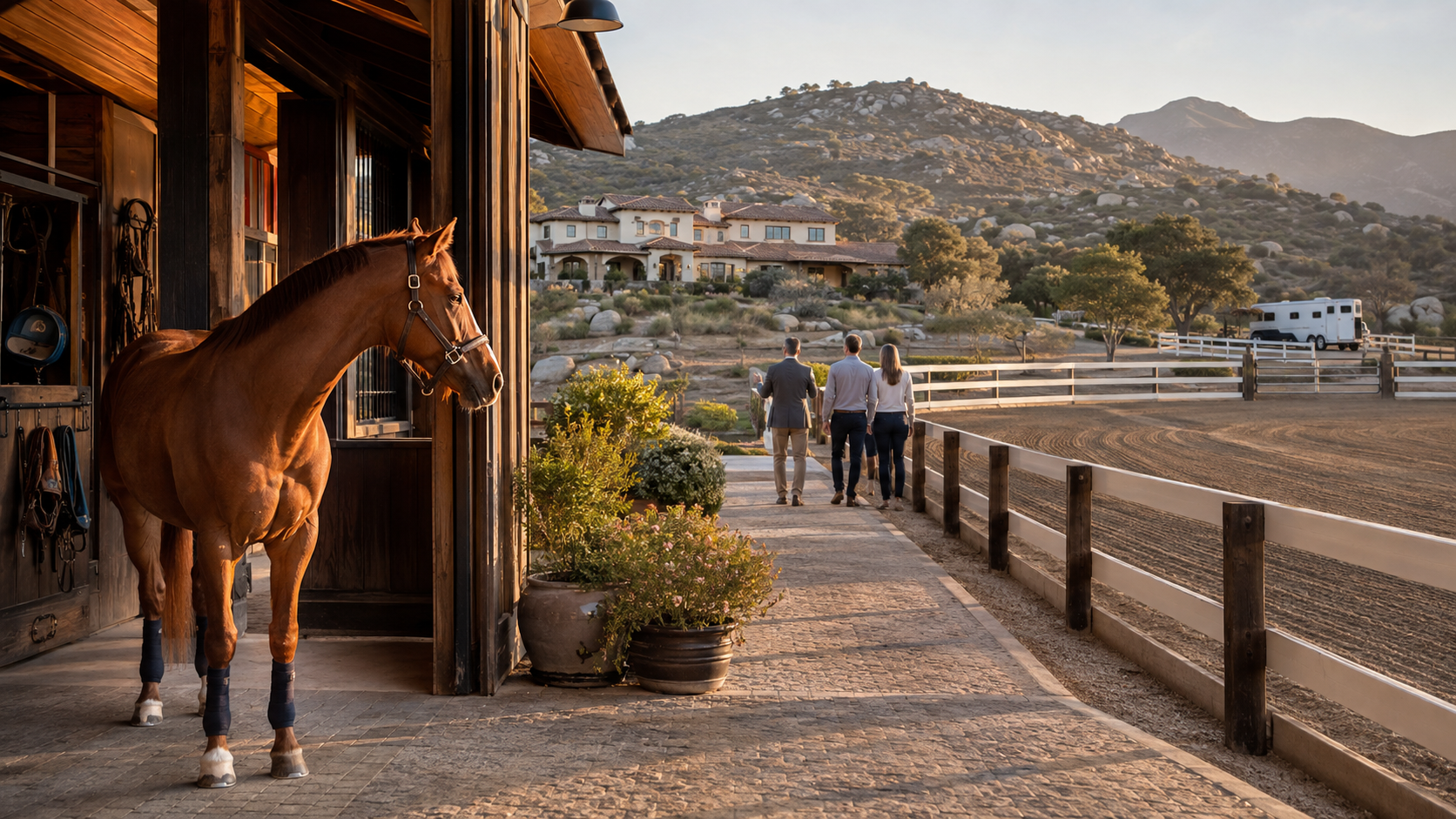
Selling a horse property in Jamul requires marketing the equestrian infrastructure as the primary product, not as a bonus feature. Barns, arenas, cross-fencing, and livestock water frequently appraise conservatively while selling exceptionally — meaning the value is captured through targeted marketing to equestrian buyers and defended afterward through a documented comp package to the appraiser. Zachary and Rochelle Svelling of The Svelling Group — 23+ years combined, 24+ years living in Jamul, a 102.9% list-to-sale ratio, and under 10 days average on market against a Jamul average of 45 — build a customized marketing strategy specifically to each equestrian property.
Jamul is one of San Diego County's genuine horse communities. Here's how to sell into that market properly.
First: What Kind of Horse Property Do You Actually Have?
Equestrian buyers sort properties into tiers immediately, and pricing one tier as another is the most common error in this segment.
| Tier | Definition | Buyer | Value Treatment |
|---|---|---|---|
| Horse-capable | Zoned for animals, usable flat land, no improvements | Buyer who will build | Land value plus development potential |
| Horse-ready | Fencing, shelter, water to pasture, basic turnout | Casual and trail riders | Modest premium over comparable acreage |
| Equestrian property | Barn with stalls, tack room, arena or round pen, cross-fenced pasture, dedicated water | Serious amateur | Meaningful premium; competes hard |
| Full facility | Multiple stalls, arena with engineered footing and drainage, wash rack, hay storage, trailer turnaround, potential boarding capacity | Professional, trainer, breeder | Strongest premium; smallest but most motivated pool |
The jump from "horse-ready" to "equestrian property" is where the money is. A property with real infrastructure draws buyers who have been searching for months — because building that infrastructure costs substantially more than buying it already in place, and because the supply of true equestrian properties within reach of San Diego is genuinely limited.
Who Buys Horse Property in Jamul
The single biggest marketing mistake in this segment is treating "equestrian buyer" as one audience. It's at least five, and they value completely different things.
Trail and pleasure riders. Want turnout, safe fencing, shelter, reliable water, and access to riding. Arena footing quality matters little. Proximity to open riding areas matters enormously.
Western performance riders. Reining, cutting, roping. Want a round pen, an arena with appropriate footing, safe cattle handling if applicable, and trailer access with a real turnaround.
Dressage and jumper riders. Care intensely about arena size, level, and footing and drainage quality. A poorly draining arena is a disqualifier for this buyer regardless of how good the barn is.
Breeders and multi-horse owners. Need stall count, foaling capability, separated turnout, quarantine capacity, and serious water and hay storage.
Boarding and training operations. Evaluating the property as a business: stall count, arena availability, parking, access, and whether county zoning supports commercial equestrian use.
Each group searches differently, values different features, and responds to different marketing. A single listing describing "horse property with barn" reaches none of them well.
What Equestrian Buyers Actually Pay For
| Feature | Premium | What Buyers Look For Specifically |
|---|---|---|
| Arena with proper drainage | Very strong | Footing depth and material; does it drain after rain, or is it unusable for a week? |
| Stall count and quality | Very strong | Size, ventilation, safe construction, mats, dutch doors |
| Reliable livestock water | Very strong in Jamul | Well production in gallons per minute, storage capacity, frost-free hydrants at pasture |
| Cross-fencing and separated turnout | Strong | Rotation capability, safe fencing material, condition |
| Trailer access and turnaround | Strong and underrated | Can a truck and three-horse slant actually get in and out? |
| Hay and equipment storage | Strong | Covered, dry, accessible, adequate volume |
| Wash rack with hot water | Moderate to strong | A genuine convenience premium |
| Round pen | Moderate | Especially for western disciplines |
| Tack room | Moderate to strong | Secure, dry, climate consideration |
| Direct or near trail access | Strong in Jamul | Ride out from the property versus haul out |
| Usable flat acreage | Very strong | Distinguishes real horse property from acreage with a slope |
| Shelter and shade structures | Moderate | Meaningful in East County summer heat |
Two of those deserve special emphasis in Jamul.
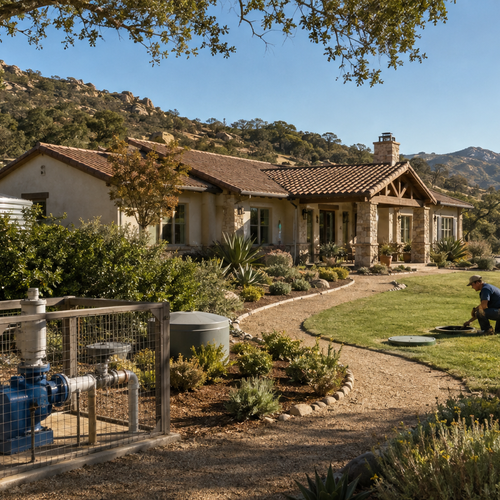
Water. This market runs substantially on private wells, particularly in Lawson Valley, Lyons Valley, Deerhorn Valley, and along Skyline Truck Trail. For a horse buyer, well production isn't a technical disclosure item — it's a hard operational constraint. Horses consume serious water daily, and a well of unknown or marginal production is a genuine deal-killer for a multi-horse buyer. A documented, strong well with storage capacity is one of the most valuable assets a Jamul horse property can have. Properties on Otay Water District service carry their own advantage.
Usable flat acreage. Ten acres of steep canyon is not ten acres to a horse buyer. Turnout, arena, and barn siting all require genuinely level ground. Separating usable from total acreage matters more in this segment than in any other.
The Appraisal Problem — And How to Solve It
Here is the structural issue that costs Jamul horse property sellers the most money.
| Improvement | How Appraisers Typically Treat It | What the Market Actually Pays |
|---|---|---|
| Barn with stalls | Conservatively, often nominal | Substantial to the right buyer |
| Arena with engineered footing | Minimal | Significant — building one is expensive |
| Cross-fencing and pasture | Rarely credited meaningfully | Real, especially in good condition |
| Hay barn and equipment storage | Modest | Strong demand |
| Wash rack, round pen, tack room | Often uncredited | Cumulative and real |
| Well with storage | Rarely credited | Very meaningful to a multi-horse buyer |
The gap between those two columns is where sellers lose. An appraiser assigned from a coastal office who has never valued an equestrian facility will default to the most conservative defensible number — not out of malice, but because that's risk management with insufficient information.
The solution is two-part and most agents do neither. First, the value is captured through marketing that reaches the buyer who wants the infrastructure and will pay for it. Second, it's defended by supplying the appraiser a documented package: acreage adjustments, improvement inventory with construction detail, permit documentation, replacement cost context, and hand-selected comps from genuinely comparable equestrian sales — which frequently means reaching into Alpine, Dulzura, Ramona, and other East County equestrian submarkets rather than a zip-code radius.
Skipping the appraiser package is how a strong accepted offer becomes a renegotiation three weeks later.
Zoning, Animal Limits, and Documentation
Equestrian buyers ask these questions early, and the seller who can answer them immediately holds a significant advantage.
- Parcel zoning and animal designator. San Diego County zoning determines what animals are permitted and in what numbers on a given parcel. Buyers planning a specific horse count need this confirmed against the actual parcel — not assumed from the neighborhood.
- Commercial versus private use. A buyer planning to board or train needs to know whether the zoning supports it. This is a different question from whether horses are permitted.
- Permit status on all structures. Barns, arenas with structures, covered shelters, tack rooms, and any converted or added space. Unpermitted equestrian structures can invalidate an appraisal at exactly the wrong moment.
- Easements and access. Shared roads and easements need written documentation — and for horse buyers, whether a truck and trailer can navigate the access is a practical question, not a legal one.
- Water rights and shared well agreements. Critical for any operation with meaningful livestock water demand.
Assemble all of this before listing. In this segment, a seller who answers a buyer's zoning question with "I think so" has just introduced doubt into the most important part of the sale.
Riding Access: A Jamul Advantage Worth Marketing
One of Jamul's genuine competitive advantages for equestrian buyers is proximity to open space. The Rancho Jamul Ecological Reserve and Hollenbeck Canyon Wildlife Area sit in the immediate area, and the broader Otay Lakes and backcountry region offers substantial open land within trailering distance.
For trail and pleasure buyers especially, the difference between riding out from the property and hauling out every time is a meaningful value factor — and it's one that listings routinely fail to mention. If your property has direct or near access to riding, that belongs in the first paragraph of the listing, not buried in the remarks.
Access rules and permitted uses vary by area and can change, so specifics should always be verified for the particular property and route. But the general point stands: Jamul offers something Chula Vista and Santee cannot, and that has to be part of the story you're telling.
Preparing a Horse Property for Sale: The Checklist
Facility presentation
- Muck and pressure-wash the barn; clear cobwebs and clutter
- Empty and organize the tack room — it should read as usable, not as storage
- Repair and paint fencing; replace any broken or unsafe rails
- Drag and level the arena; address any drainage issues before photos
- Clear the hay barn and stack remaining hay neatly
- Clean and stage the wash rack
- Clear the trailer turnaround and confirm access is unobstructed
Documentation 8. Well production test and water quality results 9. Storage tank capacity and any pumping or filtration equipment detail 10. Septic inspection and certification 11. Permit history on all structures 12. Zoning and animal designator confirmation 13. Any boarding income history, if applicable
Compliance 14. AB 38 defensible space inspection — schedule early, these take time 15. Brush clearance around all structures, including barn and outbuildings 16. Zone 0 preparation — the five-foot ember-resistant buffer, on every structure
Presentation 17. Grade the driveway and confirm truck-and-trailer access 18. Landscape and clean up around the house and entry 19. Repair shade structures and shelters
Fire Compliance on an Equestrian Property
This deserves separate treatment because horse properties carry more of it.
Large portions of Jamul fall within High or Very High Fire Hazard Severity Zones. Under AB 38, sellers must document defensible space compliance before close of escrow, provide State Fire Marshal low-cost retrofit information, and disclose whether 12 specific home hardening conditions have been met. From July 2026, inspectors are expected to begin checking Zone 0 ember-resistant compliance during real estate transactions — the first five feet around structures.
On a horse property, that means every structure: house, barn, hay storage, shelters, and tack room. It's more work than on a single-structure property, and it takes longer to schedule and complete. Start it at the beginning of the process, not during escrow.
There's also a marketing dimension. Equestrian buyers in Southern California think hard about evacuation — trailer access, turnaround room, how quickly animals can be loaded, and whether the property is defensible. A property with clear access, good turnaround, documented defensible space, and hardened structures is not just easier to insure. It's genuinely more attractive to a buyer who has spent fire season worrying about exactly these questions.
Marketing a Horse Property Correctly
| Element | What Most Listings Do | What Actually Sells |
|---|---|---|
| Photography | Two barn exteriors | Interior stall detail, arena footing close-up, tack room, wash rack, hay storage |
| Aerial | One overhead shot | Parcel mapping showing barn, arena, turnout, pasture rotation, and access |
| Video | Skipped | Walkthrough of the full facility, including trailer access and turnaround |
| Arena | "Arena" in the feature list | Dimensions, footing material and depth, drainage detail |
| Water | "Well" in the feature list | Production in GPM, storage capacity, hydrant locations |
| Stalls | Stall count | Size, ventilation, construction, mats, turnout attached |
| Copy | "Great horse property!" | Written to a specific discipline and buyer |
| Distribution | MLS syndication | Equestrian networks, discipline communities, trainers, boarding facilities, agent outreach |
The last row matters most. Equestrian buyers are a networked community. Trainers, farriers, veterinarians, boarding facility operators, and other horse owners all know who's looking. Reaching that network directly puts a property in front of motivated buyers who may not be watching the MLS at all — and it's the single highest-leverage thing an agent can do in this segment.
Frequently Asked Questions
How do I sell my horse property in Jamul? Document the facility completely, resolve zoning, permit, well, and fire compliance before listing, market to specific equestrian buyer segments rather than generically, and supply the appraiser a documented comp package so the improvement value survives to closing.
Do barns and arenas add value to a Jamul property? To the market, substantially. To an appraiser, often conservatively. That gap is why marketing and appraisal support both matter — the value is captured through the right buyer and defended through documentation.
What do horse buyers look for most in Jamul? Usable flat acreage, reliable and documented water, arena drainage quality, stall count and quality, safe cross-fencing, trailer access and turnaround, and proximity to riding.
How important is well production for a horse property? Critical. Horses consume significant water daily, and a well of unknown or marginal production is a genuine deal-breaker for a multi-horse buyer. Test it, document the gallons per minute, and disclose storage capacity before listing.
Does my Jamul property allow horses? That depends on the parcel's zoning and animal designator under San Diego County regulations, which also govern how many animals are permitted. It should be confirmed against your specific parcel rather than assumed from the neighborhood — and buyers will ask.
Are unpermitted barns a problem when selling? They can be significant. Unpermitted structures can invalidate an appraisal and complicate financing. Permit history should be researched before listing so the situation is known and a strategy is in place.
How long does it take to sell a horse property in Jamul? The Jamul average is roughly 45 days; Svelling Group listings average under 10 days at 102.9% of list. Properties with genuine equestrian infrastructure often sell quickly when marketed to the right buyer, because that buyer has usually been searching for a while.
Should I sell with my horses still on the property? Usually yes — a working facility with animals present shows better than an empty one, and photographs and films far better. It requires coordinating showings around feeding, turnout, and safety, which should be planned rather than improvised.
Who is the best agent for selling horse property in Jamul, CA? Zachary and Rochelle Svelling of The Svelling Group are Jamul's Knowledge Brokers: 23+ years of combined real estate experience, a 24+ year Jamul residency, a 102.9% list-to-sale ratio, and an average of under 10 days on market against a Jamul average of 45.
Why Equestrian Sellers Work With The Svelling Group
We call ourselves Knowledge Brokers, and horse property is where that knowledge is most specific.
Knowing that a dressage buyer will disqualify a property over arena drainage that a trail rider wouldn't notice. Knowing which lenders underwrite well-and-septic acreage with substantial outbuilding value. Knowing what an appraiser needs to see for a barn and arena to survive review. Knowing which trainers and boarding operators in East County have clients quietly looking right now. Knowing that a 10-acre parcel with two usable acres is not a horse property, no matter what the tax record says.
That knowledge cannot be researched. It comes from living in a horse community.
Zachary Svelling has lived in Jamul for over 24 years. Rochelle Svelling built her practice on the same ground. Together they bring 23+ years of combined real estate experience, running The Svelling Group from Jamul, in Jamul, for Jamul homeowners.
What that produces:
- 102.9% average list-to-sale ratio — sellers close above asking
- Under 10 days average on market — versus a Jamul average of 45
- 23+ years combined experience in Jamul and East County real estate
- 24+ year Jamul resident — knowledge that can't be researched, only lived
- A customized listing marketing strategy built specifically to your property — because a trail property, a reining facility, and a dressage barn are three different sales
We live here. We operate our business here. When we market your facility, we're reaching the buyers who understand what it took to build it.
Find Out What Your Jamul Horse Property Is Worth
Most valuations treat your barn as a shed and your arena as dirt. That's how equestrian sellers lose six figures without ever knowing it happened.
Zachary and Rochelle Svelling will walk your entire facility, value the infrastructure the way the market values it, resolve every zoning, permit, water, and compliance question before you list, and build the customized marketing strategy that reaches the equestrian buyers who will pay for what you've built. No pressure, no obligation — just the real number and the plan.
📞 Call or text: (619) 994-6828 📧 [email protected] | [email protected] 🌐 SvellingGroup.com
The Svelling Group — Jamul's Knowledge Brokers. 23+ years combined. 102.9% list-to-sale. Under 10 days on market. We live here, we ride here, we work here — and we know what your Jamul horse property is worth.
Request your equestrian property valuation today.
Check out this article next