

Maintaining Gravel Roads in Jamul: The Complete Guide for Rural Homeowners
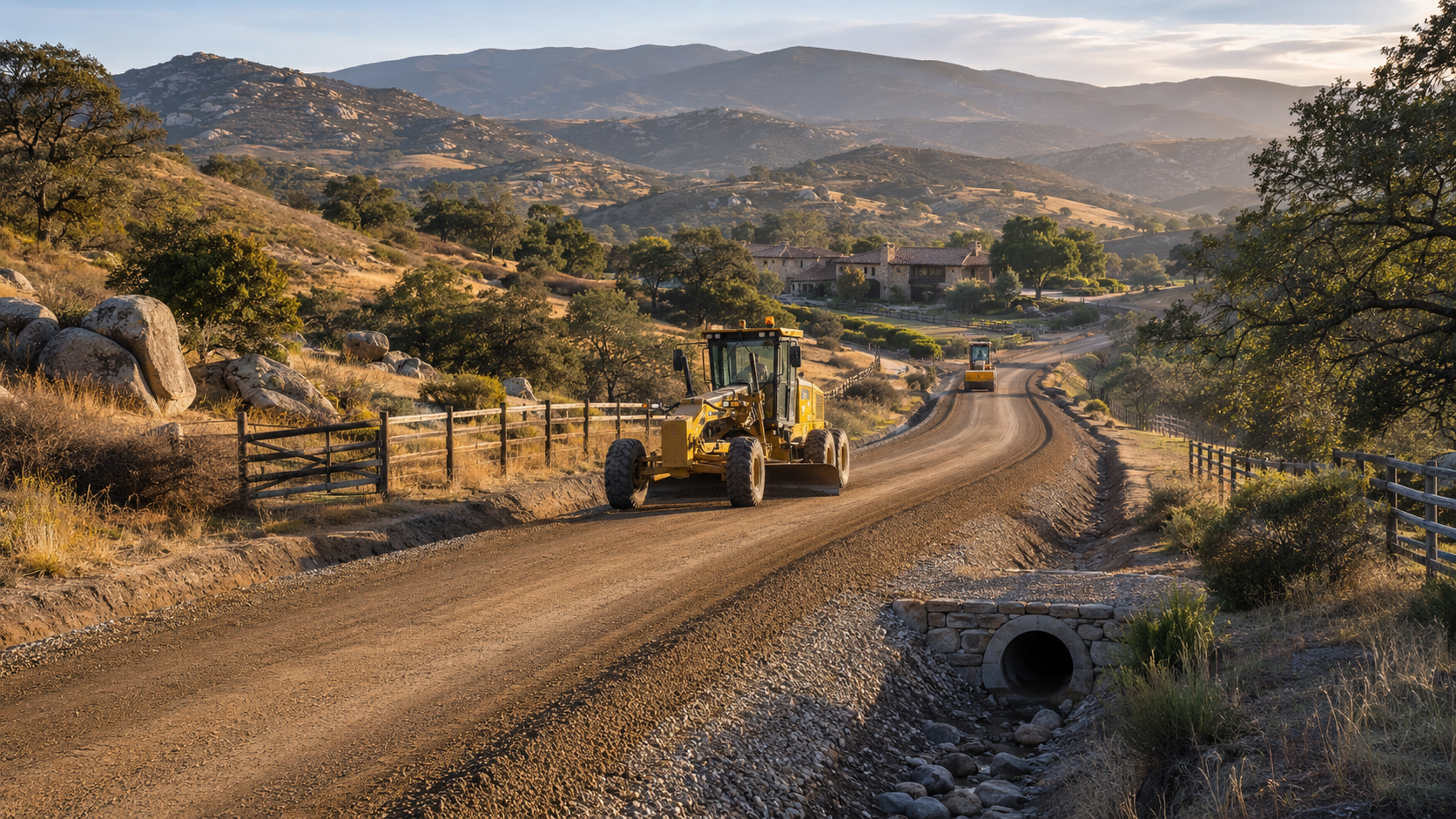
A durable gravel road in Jamul depends on four fundamentals: a stable base, a properly crowned driving surface, effective drainage and regular maintenance performed at the right moisture level. Adding new gravel without correcting drainage usually provides only temporary improvement.
The road surface should generally be higher near the center so water moves toward the edges instead of traveling down the wheel tracks. Side ditches, swales, culverts and water-diversion features must then carry runoff away without eroding the road or neighboring land.
Common problems such as potholes, washboarding, ruts, loose rock and storm washouts are symptoms—not complete diagnoses. Before repairing them, identify whether the underlying cause is standing water, poor grading, insufficient compaction, unsuitable material, excessive speed, heavy vehicles or a failed base.
Jamul homeowners should inspect gravel roads before the rainy season, after major storms and before listing or purchasing a property. Shared-road users should also understand ownership, easements, cost-sharing obligations and who has authority to order work.
Significant reconstruction, new drainage, grading or work near a watercourse may require County review or permits. San Diego County evaluates applicable projects under its Grading Ordinance, stormwater requirements, building standards and fire codes. San Diego County Building Services
Zachary and Rochelle Svelling of The Svelling Group serve as local Jamul real estate Knowledge Brokers, helping buyers and sellers investigate private roads, access easements, maintenance agreements, drainage, fire access and other rural-property considerations.
This guide is educational. Road design and drainage are site-specific. Consult qualified grading contractors, civil engineers, geotechnical professionals, surveyors, fire authorities and County departments when appropriate.
Why Gravel-Road Maintenance Matters in Jamul
Private gravel roads and long unpaved driveways are common on Jamul acreage, ranches, horse properties and rural estates. They can provide practical access without the cost and runoff characteristics of a fully paved road, but they require regular attention.
Jamul’s terrain adds several challenges:
- Steep slopes
- Granite and rocky soils
- Dry summers
- Intense seasonal rain
- Native vegetation
- Long private drives
- Limited turnaround space
- Heavy delivery vehicles
- Horse trailers and RVs
- Wildfire evacuation needs
- Shared access among multiple parcels
- Roads crossing natural drainage patterns
A road that performs well during dry summer months may reveal serious drainage problems during the first major storm.
Maintenance affects more than appearance. A poorly maintained road can interfere with:
- Daily driving
- Emergency response
- Evacuation
- Deliveries
- School transportation
- Trash collection
- Horse-trailer access
- Moving trucks
- Insurance inspections
- Property marketability
- Neighbor relationships
How a Gravel Road Is Supposed to Work
A gravel road should function as a complete system rather than a layer of loose rock spread over soil.
The Main Components
| Road component | Purpose |
|---|---|
| Subgrade | Existing soil that supports the road |
| Base layer | Provides load-bearing strength |
| Surface aggregate | Creates a stable and maintainable driving surface |
| Crown or cross slope | Moves water off the traveled way |
| Shoulders | Support road edges and allow runoff to leave |
| Side ditches or swales | Carry water alongside the road |
| Culverts | Move water beneath the road |
| Turnouts and turnarounds | Support passing and emergency access |
| Drainage outlets | Release water without creating erosion |
| Vegetation management | Maintains visibility, access and drainage |
If one component fails, the road may deteriorate rapidly.
For example, a good gravel surface placed over saturated, unstable soil can rut under traffic. A strong base with no crown can collect water and develop potholes.
Drainage Is the Most Important Part of Gravel-Road Maintenance
Water is the primary enemy of an unpaved road.
When water remains on the surface, flows down wheel tracks or saturates the base, vehicle loads deform the road. Fine material may wash away, larger stone loosens and potholes form.
Good drainage follows three principles:
- Remove water from the driving surface quickly.
- Keep roadside water from entering the road base.
- Discharge runoff in a controlled way that does not cause erosion or damage other property.
Signs of Poor Drainage
- Standing water
- Muddy sections
- Ruts that hold water
- Potholes returning after every rain
- Water flowing down the center of the road
- Eroded shoulders
- Exposed culvert ends
- Sediment deposits
- Washed-out gravel
- Soft road edges
- Ditches filled with vegetation
- Water crossing the road unpredictably
- Erosion on neighboring land
Do not treat these problems by simply filling the low areas with decorative rock.
What Is a Road Crown?
A crowned road is slightly higher at or near its center than at the edges. This shape encourages water to move across the road instead of traveling along it.
The proper crown depends on road width, material, grade, drainage and use. Too little crown allows water to remain on the road. Too much crown can make steering uncomfortable, destabilize trailers and direct water too aggressively toward the shoulders.
A professional operator should establish a smooth, consistent profile rather than creating a sharp ridge in the middle.
Crown Versus Outsloping
Not every private road uses a symmetrical crown.
On certain hillsides, a road may be intentionally outsloped, allowing water to sheet across the surface toward the downhill side. Insloped roads may direct water toward an uphill ditch and culverts.
Each approach has tradeoffs. A poorly designed outslope may be uncomfortable or unsafe, while an inslope with inadequate ditch capacity can saturate the road.
Do not change the road profile without understanding where the water will go.
Choosing the Right Gravel
“All gravel” is not the same material.
Rounded river rock tends to move because the pieces do not interlock effectively. Decorative stone may look attractive but perform poorly under traffic. A durable road surface usually uses crushed, angular aggregate in a well-graded mixture of larger particles and fines.
The angular stone provides structure. Smaller particles fill spaces and help the surface bind when properly moistened and compacted.
Material Characteristics
| Material characteristic | Effect |
|---|---|
| Angular crushed stone | Interlocks under compaction |
| Rounded stone | Moves and rolls more easily |
| Properly graded aggregate | Packs into a dense surface |
| Too many fines | Can become dusty or muddy |
| Too few fines | Surface remains loose |
| Oversized rock | May be difficult to grade and drive on |
| Clean decorative gravel | Often lacks binding material |
| Local unsuitable soil | May lose strength when wet |
Ask the contractor to identify the proposed material by specification and explain why it is suitable for the road’s traffic, slope and drainage.
The Difference Between Base Material and Surface Material
The base carries the load. The surface provides a maintainable driving layer.
A severely rutted road may need more than fresh surface gravel. If the underlying subgrade is weak or the base is too thin, the new material can disappear into the soil or deform under heavy vehicles.
Reconstruction may involve:
- Removing unstable material
- Correcting drainage
- Installing geotextile where professionally recommended
- Placing appropriate base rock
- Moistening and compacting in lifts
- Shaping the crown or cross slope
- Adding surface aggregate
- Compacting again
- Stabilizing shoulders and drainage outlets
Geotextile is not a universal fix. It should be selected and installed based on soil and load conditions.
Common Gravel-Road Problems and Their Causes
Gravel-Road Troubleshooting Table
| Problem | Possible causes | Typical response |
|---|---|---|
| Potholes | Standing water, poor crown, weak material | Scarify, reshape, add suitable material and compact |
| Washboarding | Speed, loose surface, poor grading | Rework sufficient depth, restore profile and compact |
| Ruts | Weak base, water, heavy traffic | Correct drainage and rebuild affected section |
| Loose gravel | Poor gradation, no fines, inadequate compaction | Blend or replace material and compact |
| Dust | Dry fines, speed, traffic | Control speed and consider appropriate treatment |
| Mud | Saturated subgrade, poor drainage, excess fines | Drain, strengthen base and resurface |
| Edge failure | Traffic near shoulder, inadequate support | Rebuild shoulder and improve width or drainage |
| Washout | Concentrated runoff, undersized drainage | Redesign water control and reconstruct |
| Exposed rock | Fine material washed away | Correct runoff and replace surface aggregate |
| Vegetated ditch | Deferred maintenance | Clear without destabilizing banks |
| Culvert blockage | Sediment, branches or debris | Clear safely and repair inlet protection |
| Corrugation on hills | Braking, acceleration and loose material | Regrade, compact and manage driving speed |
How to Repair Potholes Correctly
Dumping loose gravel into a water-filled pothole rarely creates a lasting repair.
The pothole generally needs to be opened and reworked so the repair bonds with the surrounding road. A contractor may:
- Remove water
- Scarify the damaged area
- Cut out loose edges
- Correct the underlying drainage
- Add compatible aggregate
- Shape the road profile
- Moisture-condition the material
- Compact it thoroughly
If the road remains flat or continues collecting runoff, the pothole will likely return.
Repeated potholes in the same location are evidence that the cause has not been corrected.
What Causes Washboarding?
Washboarding appears as a series of small ridges across the road. It frequently develops where vehicles accelerate, brake or travel too quickly over loose aggregate.
Contributing factors include:
- Excessive speed
- Loose surface material
- Poor aggregate gradation
- Inadequate moisture
- Lack of compaction
- Hard braking
- Steep grades
- Intersections and curves
- Shallow grading that cuts only the tops of ridges
Dragging a blade lightly over the surface may make the road look smooth temporarily, but the pattern can return because the compacted troughs remain underneath.
A lasting repair generally requires working below the depth of the corrugation, mixing the material, restoring the correct profile and compacting it.
Why Grading at the Right Moisture Matters
Completely dry gravel may not compact well, while saturated material can deform and pump under equipment.
The ideal condition depends on the aggregate, but contractors often achieve better results when the material contains enough moisture for particles and fines to bind under compaction.
This is why road work performed during very dry conditions may require controlled watering.
It is also why grading a saturated road immediately after a major storm can make conditions worse. Heavy equipment can damage the base and create deeper ruts.
A qualified contractor should determine when the road has dried enough to work.
Grader, Tractor, Box Blade or Drag?
Different equipment produces different results.
Motor Grader
A motor grader is often best suited to longer roads and significant reshaping. A skilled operator can recover material from the edges, restore crown, cut ditches and create a consistent profile.
The operator’s experience matters as much as the machine. Poor grading can flatten the crown, create berms and trap water.
Tractor With a Box Blade
A tractor and box blade may be useful for shorter driveways and routine work. It can loosen, redistribute and shape material but may be less efficient for long roads or complex drainage.
Land Plane or Road Drag
A land plane or drag can help maintain an already well-designed surface. It is not always sufficient for deep potholes, failed drainage or major crown correction.
Roller or Compactor
Compaction is essential for a durable repair. Vehicle tires alone may not provide uniform compaction, particularly on broad surfaces.
Excavator
An excavator may be needed for culverts, ditches, retaining features or severe washouts. Drainage work must be carefully designed and may require permits.
Culvert Maintenance
Culverts move runoff beneath a road. A blocked, damaged or undersized culvert can cause water to overtop and wash out the road.
Inspect Culverts For
- Sediment
- Leaves and branches
- Animal nests
- Crushed pipe
- Separated joints
- Erosion around the inlet
- Undercutting at the outlet
- Exposed pipe
- Damaged headwalls
- Insufficient cover
- Road settlement
- Water bypassing the pipe
Inspect before the rainy season and after significant storms.
Do not enter a culvert or unstable drainage excavation. Flowing water, confined spaces and collapsing soil can be dangerous.
Culvert Outlets
Moving water through a pipe is only half the job. The outlet needs to release water without causing erosion.
Appropriate energy dissipation may involve rock, engineered outlet protection or another designed solution. Dumping water onto an unsupported slope can create a gully.
Ditches, Swales and Water Diversion
Roadside ditches need an appropriate slope and stable outlet. If they are too flat, they collect sediment and water. If they are too steep or unprotected, they may erode.
Maintenance may include:
- Removing sediment
- Trimming vegetation
- Clearing debris
- Repairing eroded banks
- Restoring positive flow
- Protecting outlets
- Preserving stabilizing roots where appropriate
Do not direct water onto another parcel or public road without understanding legal and drainage implications.
San Diego County stormwater requirements emphasize controlling pollutants, erosion and changes in runoff from development projects. County stormwater best-management practices
Maintaining a Steep Gravel Driveway
Steep roads require more aggressive drainage planning because water gains speed as it moves downhill.
Potential strategies may include:
- Strategic cross slope
- Rolling dips
- Water bars where suitable
- Culverts
- Armored outlets
- Stable aggregate
- Short paved sections
- Concrete wheel strips where approved
- Drainage interceptors
- Turnouts
- Reduced driving speed
Improvised water bars can create vehicle-clearance problems, redirect runoff incorrectly and become difficult for trailers. Design them around actual vehicles and drainage.
A steep surface should also be evaluated for emergency access and turnaround.
Fire and Emergency Access
A private road is part of a Jamul property’s emergency infrastructure.
The San Diego County Wildland-Urban Interface Code includes requirements for access, defensible space and vegetation modification alongside certain roadways and driveways. The fire authority may require vegetation modification near access routes to protect their use. 2026 San Diego County WUI Code
Property owners should evaluate:
- Clear driving width
- Vertical clearance
- Surface capacity
- Grade
- Turning radius
- Turnarounds
- Bridges
- Gates
- Address visibility
- Roadside vegetation
- Parking obstructions
- Secondary access
- Pullouts
- Erosion following storms
Exact fire-access standards depend on the property and project. Obtain written guidance from the applicable fire authority.
A passenger car reaching the home does not prove that a fire engine, ambulance, propane truck or moving van can do so safely.
Dust Control on Gravel Roads
Dust can affect visibility, nearby homes, vegetation, vehicles and neighbor relationships.
The first controls should usually include:
- Lower vehicle speed
- Appropriate aggregate
- Proper compaction
- Surface maintenance
- Limiting unnecessary traffic
- Repairing loose areas
Dust suppressants may include water or specialized products, but each has limitations. Some treatments can become slippery, affect vegetation, corrode vehicles or create runoff concerns.
Do not apply used oil or unapproved chemicals. Materials should be appropriate for the road, nearby wells, drainage and environment.
Before treating a shared road, obtain agreement from those responsible for it.
Vegetation Along Gravel Roads
Vegetation can narrow roads, block sightlines and interfere with drainage. Complete removal, however, can destabilize slopes and increase erosion.
Maintenance should balance:
- Fire access
- Sight distance
- Drainage
- Slope stability
- Habitat restrictions
- Property boundaries
- Utility access
Trim vegetation before it blocks ditches or damages vehicles. Remove dead and hazardous growth as appropriate, but preserve stabilizing roots where erosion is a concern.
Never clear beyond an easement or property boundary without authority.
How Often Should a Gravel Road Be Maintained?
There is no universal schedule.
Frequency depends on:
- Traffic volume
- Vehicle weight
- Road grade
- Drainage
- Aggregate quality
- Construction
- Rainfall
- Speed
- Number of users
- Horse trailers or commercial vehicles
- Prior maintenance
Practical Inspection Schedule
Monthly or During Regular Use
- Note new potholes.
- Watch for standing water.
- Check loose gravel on slopes.
- Observe drainage crossings.
- Remove small debris.
Before the Rainy Season
- Clean culverts.
- Restore ditches.
- Repair crown and shoulders.
- Stabilize erosion.
- Trim roadside vegetation.
- Stockpile compatible material if appropriate.
- Confirm contractor availability.
After Major Storms
- Inspect culvert inlets and outlets.
- Check for washouts.
- Look for undercut edges.
- Remove debris safely.
- Photograph damage.
- Restrict traffic if the road is unstable.
Annually
- Review overall road profile.
- Evaluate material loss.
- Regrade as needed.
- Update shared-road budgets.
- Review access with the fire authority where appropriate.
Short, timely maintenance is often less expensive than major reconstruction after years of neglect.
A 12-Step Gravel-Road Maintenance Plan
- Identify road ownership and easement rights.
- Locate all drainage features.
- Walk the road during or shortly after light rain when safe.
- Mark standing-water locations.
- Identify soft base areas.
- Inspect culverts and outlets.
- Determine whether the crown or cross slope is adequate.
- Select material suited to the road.
- Rework damaged areas to sufficient depth.
- Shape and compact under suitable moisture conditions.
- Stabilize shoulders, ditches and outlets.
- Reinspect after the next storm.
Photographs taken during rainfall can help a contractor understand where water travels. Never conduct the inspection during unsafe flooding, lightning or active roadway failure.
Shared Private Roads
A road used by multiple parcels creates both practical and legal questions.
Review the Recorded Documents
Look for:
- Access easement
- Road-maintenance agreement
- Cost-sharing formula
- Description of permitted users
- Road width
- Utility easements
- Gate provisions
- Authority to order repairs
- Voting procedure
- Emergency-work provisions
- Insurance requirements
- Collection and enforcement provisions
- Successor-owner obligations
A title report may disclose recorded easements, but it may not explain how neighbors have managed the road in practice.
Questions to Ask
- Who schedules grading?
- How are costs divided?
- Is contribution based on parcel count, distance or use?
- Are vacant parcels included?
- Who pays for storm damage?
- Is there a reserve fund?
- Are invoices and records maintained?
- Can one owner authorize emergency repairs?
- Who controls gates?
- Can heavy equipment use the road?
- Are commercial or agricultural uses restricted?
- Is there ongoing disagreement?
Verbal arrangements may have worked for years but can become difficult after ownership changes. Consult a qualified real estate attorney when legal rights or obligations are unclear.
Does Road Maintenance Require a Permit?
Routine maintenance may not always require a major permit, but grading, reconstruction, new roads, drainage alterations, culvert work, work near watercourses or changes in runoff may trigger County and agency requirements.
San Diego County Building Services reviews applicable projects under:
- County Grading Ordinance
- Building standards
- Zoning
- Consolidated Fire Code
- Wildland-Urban Interface Code
San Diego County Building Services
Before significant work, ask:
- Is the work considered maintenance or grading?
- Will soil be cut, filled or exported?
- Is a culvert being installed or enlarged?
- Is runoff changing direction?
- Is a watercourse affected?
- Is work occurring within a road easement?
- Are retaining walls involved?
- Will protected habitat be disturbed?
- Is the road within a recorded open-space area?
- Does the fire authority need to review access?
Do not let a contractor’s statement that “no permit is ever needed for a private road” substitute for agency confirmation.
Stormwater and Environmental Considerations
Road work can move sediment into ditches, streams and neighboring property.
Good practices may include:
- Scheduling work for suitable weather
- Stabilizing disturbed soil
- Protecting drainage inlets
- Preventing sediment discharge
- Covering stockpiles
- Avoiding work in flowing water
- Maintaining erosion controls
- Using appropriate outlets
- Removing excess material
- Keeping fuel and equipment leaks away from drainage
County stormwater guidance encourages site-design and source-control practices that manage runoff near its source and reduce erosion and pollutant transport. County BMP Design Manual
Gravel Roads and Property Value
A well-maintained private road can strengthen a buyer’s perception of a rural property. A damaged road can raise questions about cost, emergency access and relationships with neighbors.
Road condition can affect:
- Showing traffic
- Appraiser access
- Home inspection scheduling
- Insurance inspections
- Delivery of staging materials
- Moving trucks
- Buyer confidence
- Negotiations
- Lender concerns
- Property marketability
A luxury estate approached over a deeply rutted road may feel neglected before the buyer reaches the house.
That does not mean every road should be paved. A well-designed gravel road can be attractive, appropriate and durable.
Preparing a Gravel Road Before Selling
Seller Checklist
- Review recorded easements and maintenance agreements.
- Gather recent invoices.
- Identify who maintains the road.
- Disclose known disputes.
- Clean culverts.
- Repair active erosion.
- Restore the driving surface where needed.
- Trim vegetation for access and visibility.
- Confirm gate operation.
- Make the address visible.
- Avoid cosmetic gravel over unresolved drainage problems.
- Photograph significant completed work.
- Retain permit information.
- Explain ongoing costs accurately.
- Prepare for delivery and moving vehicles.
A seller should not advertise a road as “County maintained” unless that status is verified.
Buying a Jamul Home on a Gravel Road
Buyer Due-Diligence Checklist
- Determine who owns the road.
- Review the recorded access easement.
- Obtain the maintenance agreement.
- Ask for expense history.
- Drive the road in more than one vehicle if practical.
- Visit after rain when safely possible.
- Evaluate steep sections.
- Inspect drainage and culverts.
- Look for washouts and edge failure.
- Ask about school buses, trash and deliveries.
- Consider moving-truck access.
- Evaluate horse-trailer or RV clearance.
- Confirm gate rights.
- Ask about emergency access.
- Identify neighbor disputes.
- Estimate deferred maintenance.
- Determine whether significant work needs permits.
- Budget for ongoing contributions.
A short road can be expensive if it requires major drainage reconstruction. A longer road may be manageable when it has a stable base, effective drainage and cooperative owners.
Common Gravel-Road Maintenance Mistakes
1. Adding Gravel Without Fixing Drainage
New material washes away or sinks into the same wet areas.
2. Grading the Road Flat
A flat surface holds water.
3. Creating Berms Along the Edges
Material pushed to the side can trap water on the road.
4. Grading Only the Top of Washboarding
The ridges quickly return.
5. Working When the Road Is Saturated
Heavy equipment can destroy the base.
6. Using Rounded Decorative Rock
It may roll and migrate under traffic.
7. Skipping Compaction
Loose material moves, washes and washboards.
8. Ignoring Culvert Outlets
Water can erode the downstream slope and undermine the pipe.
9. Directing Water Toward a Neighbor
Drainage changes can create disputes and liability.
10. Waiting for Total Failure
Routine maintenance is usually less disruptive than emergency reconstruction.
Semantic Questions About Gravel Roads in Jamul
How often should a gravel road be graded?
It depends on traffic, slope, drainage, material and weather. Some roads need seasonal work, while a well-built low-traffic road may need less frequent grading.
What is the best gravel for a driveway?
A durable road typically uses angular crushed aggregate with a suitable range of particle sizes and fines. The proper specification depends on the site.
Why do potholes keep returning?
Recurring potholes commonly indicate trapped water, inadequate crown, poor material, insufficient compaction or a weak base.
How do you stop washboarding?
Rework the material below the corrugation, restore the road profile, moisture-condition and compact it. Reducing vehicle speed also helps.
Should a gravel road be crowned?
Many roads benefit from a crown, while some hillside roads use a designed cross slope. The goal is to move water off the driving surface safely.
Can I grade a shared road myself?
Only if ownership, easement rights and agreements authorize the work. Drainage and liability concerns make unilateral changes risky.
Does San Diego County maintain private roads in Jamul?
Private roads are generally maintained by the responsible private owners or parties, not automatically by the County. Verify the status of the exact road.
Frequently Asked Questions
Is gravel cheaper than paving?
Initial construction can be less expensive, but gravel requires ongoing grading, material replacement and drainage maintenance. Long-term cost depends on use and conditions.
Will paving eliminate road maintenance?
No. Paved roads still require drainage, crack repair, shoulder maintenance and eventual resurfacing. Paving over a weak or poorly drained base can fail.
Can I use recycled asphalt?
Recycled asphalt may work in some applications, but performance, environmental requirements, compaction and permit issues should be evaluated professionally.
How do I reduce dust?
Reduce speed, maintain proper material and compaction and use approved dust-control products only after evaluating environmental and drainage impacts.
Can I put concrete in a steep section?
Potentially, but transitions, drainage, traction, runoff and permitting must be designed correctly.
What causes gravel to collect at the bottom of a hill?
Water flow, braking, acceleration, loose material and inadequate compaction can move aggregate downhill.
Should I grade immediately after rain?
Light moisture may help grading, but a saturated road can be damaged by heavy equipment. Let a qualified operator evaluate conditions.
Can a blocked culvert cause a complete washout?
Yes. Water can overtop the road, erode the surface and undermine the base.
Who pays for a shared-road repair?
The recorded maintenance agreement may control. If no clear agreement exists, legal advice may be needed.
Does road condition affect homeowners insurance?
It can. Insurers may consider emergency access, vegetation and other property conditions. Underwriting varies.
Why Road Knowledge Matters in Jamul Real Estate
Online listings rarely explain whether a gravel road has a stable base, adequate drainage or a functional maintenance agreement.
Two attractive Jamul properties can have very different access conditions:
- One road may be professionally graded every year.
- One may have recurring washouts.
- One may have a recorded cost-sharing agreement.
- One may rely on informal neighbor cooperation.
- One may accommodate trailers and emergency vehicles.
- One may have tight curves and limited turnaround.
- One may be privately maintained.
- One may connect directly to a County-maintained road.
These differences affect ownership costs and the daily experience of the property.
Zachary and Rochelle Svelling of The Svelling Group approach Jamul real estate as local Knowledge Brokers. They help buyers identify road, easement, drainage and access questions before committing to a property. They also help sellers organize documentation and prepare access before the home reaches the market.
They do not replace engineers, contractors, title professionals or attorneys. They help make sure the right questions are asked early.
Need Help Buying or Selling a Rural Jamul Property?
A gravel road can be a practical and attractive part of country living when it is properly designed, drained and maintained.
If you are buying, investigate the physical road and the legal obligations attached to it.
If you are selling, address visible maintenance issues and gather easement, cost and repair information before marketing begins.
Contact Zachary and Rochelle Svelling of The Svelling Group for a personalized Jamul real estate consultation. As experienced Jamul real estate advisors and local Knowledge Brokers, they can help you navigate private roads, acreage, wells, septic systems, defensible space, insurance and the other details that make Jamul properties unique.
Check out this article next
Living With Wildlife in Jamul: A Complete Guide for Rural Homeowners
Living with wildlife is a normal part of owning a home in Jamul. The community’s open land, oak woodland, granite hills, grasslands and rural parcels…
Read Article