

How Does a Private Well System Work?
A private well system pulls groundwater from an aquifer through a drilled, cased borehole using a submersible pump set 10 to 20 feet below the static water level. The pump pushes water to a pressure tank, where compressed air behind a rubber bladder stores it under pressure so you get water without the pump running every time you open a tap. A pressure switch cycles the pump between two setpoints — commonly 30/50 or 40/60 PSI. Submersible pumps typically last 8 to 15 years; quality pressure tanks 10 to 15. In Jamul, where many properties run on wells and power outages are a reality, the critical thing to understand is that no power means no pump — and no pump means no water beyond what's already in the tank.
Here's the whole system, component by component.
The Components
| Component | What It Does |
|---|---|
| Borehole and casing | The drilled shaft and its steel or PVC lining, which keeps the hole open and surface contamination out |
| Sanitary well seal / cap | Seals the wellhead against contamination and pests |
| Submersible pump | A sealed, torpedo-shaped unit sitting below the waterline that pushes water upward |
| Drop pipe | Carries water from the pump to the surface |
| Pitless adapter | A fitting that lets the supply line exit the casing below frost line while keeping the seal intact |
| Check valve | Prevents water from draining back down into the well |
| Control box (three-wire systems) | Houses the pump's starting components above ground |
| Pressure tank | Stores water under pressure so the pump doesn't run on every use |
| Pressure switch | The brain — turns the pump on and off at set pressures |
| Pressure gauge | Shows current system pressure |
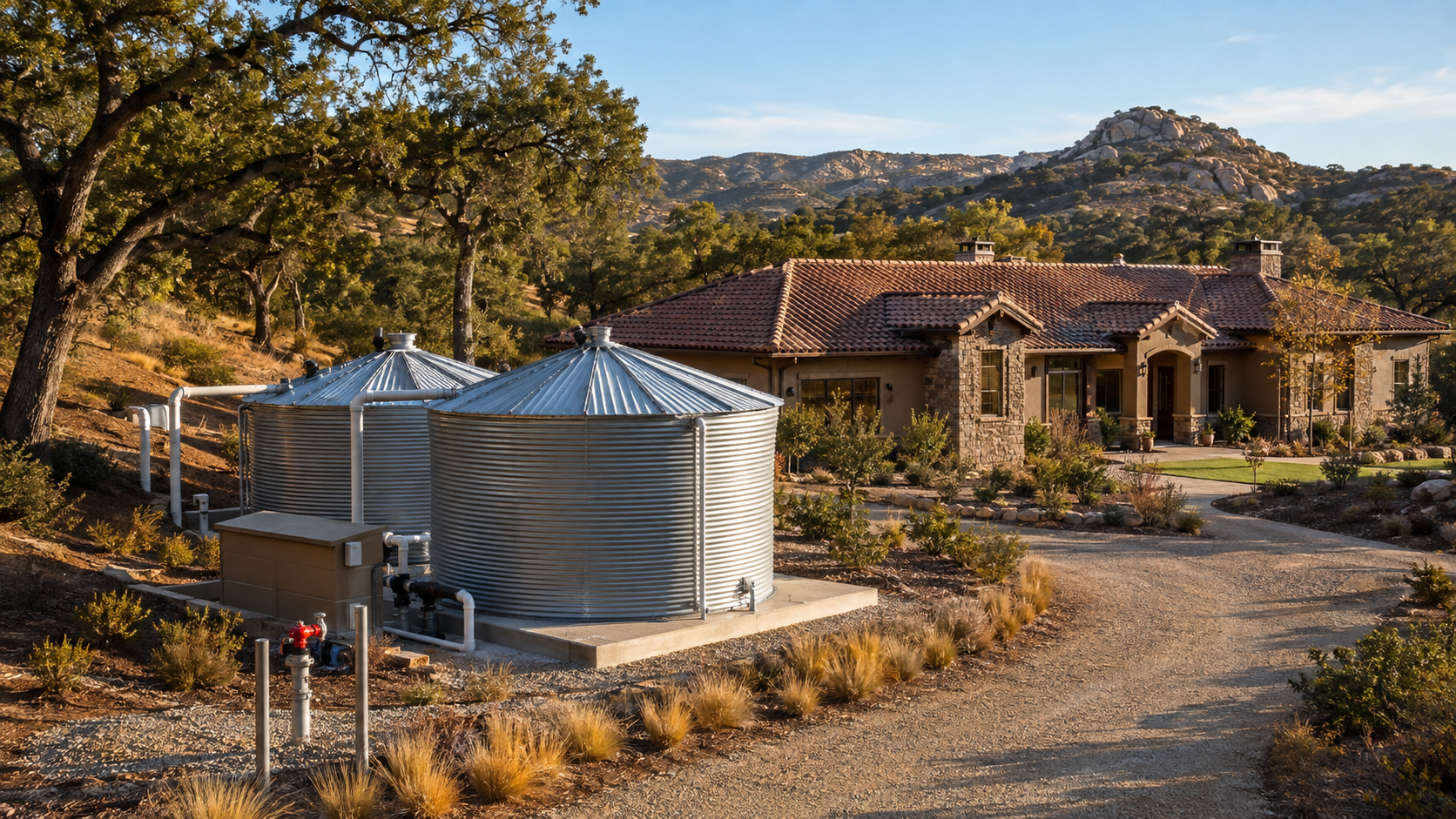
| Storage tanks (common in Jamul) | Bulk water storage buffering low-yield wells |
| Booster pump | Pressurizes water from storage tanks into the house |
| Treatment equipment | Sediment filters, softeners, iron filters, UV, reverse osmosis as needed |
How the Cycle Actually Works
Think of the pressure tank as a spring. Understanding these four states explains nearly every well problem you'll ever have.
State 1 — Tank charged, pump off. The tank holds water under compressed air at the cut-out pressure, typically 50 PSI on a 30/50 system or 60 PSI on a 40/60 system. Compressed air pushes against a rubber bladder, which pushes against the water. You could open every faucet in the house and water would flow with no pump running at all.
State 2 — Demand begins. You open a tap. Water leaves the tank, the air cushion expands, and system pressure drops. This is the drawdown phase. Your gauge falls from 50 toward 30.
State 3 — Cut-in reached. Pressure hits the low setpoint. The pressure switch closes and the pump starts.
State 4 — Recharge. The pump refills the tank until pressure reaches the cut-out setting, then shuts off. Back to State 1.
Why this design exists: the pump delivers water in bursts; a household uses it in sips. The tank is the buffer between them. If the pump started every time you opened a tap, it would destroy itself through short-cycling starts.
Submersible vs. Jet Pumps
Submersible pumps are what the overwhelming majority of modern residential wells use. They're sealed units that sit submerged inside the casing, typically set 10 to 20 feet below the static water level so they stay submerged during drawdown. They run on 230 volts and stack multiple impeller stages to build the pressure needed to lift water from depth. Sizing runs from about 1/2 HP for shallow, low-demand wells up to 1.5 HP for deep, high-demand systems.
Jet pumps sit above ground and draw water up by suction. They only really make sense on very shallow wells — under about 25 feet — where having the pump accessible above ground is worth the trade-off. For anything deeper, well professionals almost universally recommend a submersible: quieter, more efficient, and they don't lose prime.
| Submersible | Jet | |
|---|---|---|
| Location | Inside the well, below water | Above ground |
| Best for | Most wells, especially deep | Very shallow wells under 25 ft |
| Typical lifespan | 8–15 years | 10–20 years for motor and pump body |
| Replacement | Requires pulling pipe from the well | Easier — no pipe pulling |
| Efficiency | Higher | Lower |
The Pressure Tank: The Part Most Problems Trace Back To
Inside a modern pressure tank, a pre-charged air chamber is separated from the water by a rubber bladder or diaphragm. The air never mixes with the water.
The 2-PSI rule. The tank's air pre-charge should be set 2 PSI below the cut-in pressure — 28 PSI for a 30/50 system, 38 PSI for a 40/60 system. This ensures full drawdown capacity is available.
Drawdown is less than you'd think. Usable drawdown runs roughly 25 to 30 percent of a tank's nominal rated capacity. A 40-gallon tank delivers only about 10 to 12 gallons of usable water on a 40/60 system.
Sizing math, if you're curious why your installer picked the size they did: required drawdown equals pump GPM multiplied by a minimum runtime — industry guidance calls for at least 1 minute of runtime per cycle for motors under 2 HP, and 2 minutes for 2 HP and larger. Required tank volume is that drawdown divided by roughly 0.28 for 30/50 settings or 0.25 for 40/60. So a 10 GPM pump on 30/50 settings needs about 10 gallons of drawdown, which requires a minimum 36-gallon tank.
One practical note: higher pressure settings deliver less usable drawdown from the same tank. If you bump a switch from 30/50 to 40/60 for better shower pressure, you may need a larger tank to avoid short-cycling the pump.
Storage Tank Systems: Very Common in Jamul
This is where Jamul differs from a lot of well country, and it's worth understanding.
Many Jamul properties — particularly in Lyons Valley, Lawson Valley, Deerhorn Valley, and along Skyline Truck Trail — have wells with modest production. A well producing 2 GPM cannot meet peak household demand directly. But 2 GPM running continuously is nearly 2,900 gallons a day, which is far more than most households use.
The solution is storage. The well pump fills large storage tanks slowly over time, and a separate booster pump pressurizes water from those tanks into the house.
Why this matters:
- A low-yield well with adequate storage can serve a household perfectly well
- Storage capacity is a genuine asset — it buffers demand, provides outage reserve, and supports irrigation and livestock
- It adds components: the storage tanks, the booster pump, float switches, and more plumbing to maintain
- It's also a fire-season asset. Stored water on the property is meaningful
When evaluating a Jamul property, ask about both production and storage. The combination is what determines whether the system actually works for how you'll live.
Annual Maintenance Schedule
| Frequency | Task |
|---|---|
| Monthly | Glance at the pressure gauge; note anything unusual about pressure or pump behavior |
| Quarterly | Check the wellhead — cap secure, seal intact, no standing water or debris around it |
| Annually | Check pressure tank pre-charge; test water quality; inspect visible plumbing; service treatment equipment |
| Annually | Replace sediment filter cartridges and other treatment media on schedule |
| Every 3–5 years | Have a professional inspect the full system |
| As needed | Address any change in pressure, flow, taste, odor, or clarity promptly |
How to check your pre-charge: shut the pump off at the breaker, open a cold tap and run it until water stops completely, then close it. The tank is now empty. Press a tire gauge against the Schrader valve on top of the tank. It should read 2 PSI below your cut-in setting. Add air with a compressor or bicycle pump if low.
If water sprays out of the Schrader valve instead of air, the bladder has failed and the tank needs replacement.
The single highest-value maintenance habit: keeping the pressure tank properly pre-charged and replacing treatment media on schedule is the most effective way to push pump life toward 15 years rather than 8.
Troubleshooting: What Your Symptoms Mean
| Symptom | Likely Cause |
|---|---|
| Pump cycles on and off every few seconds | Waterlogged pressure tank — failed bladder or lost pre-charge. Most common well problem there is |
| No water at all | Power/breaker, failed pressure switch, failed pump, or well drawn down |
| Pump runs constantly | Leak in the system, failing pump, dropping water level, or a stuck pressure switch |
| Air spitting from faucets | Pump drawing air — water level near the intake, or a leak in the drop pipe |
| Gradually declining pressure | Failing pump, clogged intake screen, or scale in the plumbing |
| Sudden pressure loss | Pump or pressure switch failure, or a burst line |
| Cloudy or sandy water | Sediment intrusion, failing well screen, or the pump sitting too low |
| Unexpectedly high electric bill | Pump running more than it should — leak, short-cycling, or a failing pump |
| Sulfur smell | Bacteria or naturally occurring hydrogen sulfide; needs testing |
Short-cycling deserves emphasis. A pump that turns on and off every few seconds instead of running its normal 1 to 2 minutes per cycle is destroying itself. It's usually a waterlogged tank, and it's usually an inexpensive fix — but only if you catch it.
Lifespans and What Things Cost
| Component | Typical Lifespan | Notes |
|---|---|---|
| Well casing and borehole | Decades — often outlives the owner | The well itself is the durable part |
| Submersible pump | 8–15 years | Quality units from established manufacturers reach 10–15 with normal use |
| Jet pump | 10–20 years for motor and body | Replacement is easier and cheaper than a submersible |
| Pressure tank | 10–15 years quality; 15–20 premium; 5–8 budget | Water chemistry matters a lot |
| Pressure switch | Variable | Inexpensive part, but involves 240-volt wiring — most people use a professional |
| Treatment media | Per manufacturer schedule | Neglecting this shortens pump life |
What shortens pump life: high iron or sediment content (abrasive to impellers), short-cycling from a waterlogged or undersized tank, the well drawing down and letting the pump run dry, undersizing relative to the well's yield, a partially blocked intake screen, and voltage irregularities.
Costs vary by system, depth, and access. Get local bids.
Water Treatment and Testing
Nobody treats your well water for you. Testing and filtering is entirely the owner's responsibility — there's no utility running quality control on your behalf.
Common treatment in this region:
- Sediment filtration — the first line, protects everything downstream
- Water softening — for hardness, which is common in Southern California groundwater
- Iron and manganese filtration — where staining or metallic taste appears
- UV disinfection — for bacteriological concerns
- Reverse osmosis — typically point-of-use for drinking water
- pH adjustment — where water is acidic
Testing schedule: test annually at minimum for coliform bacteria and nitrates, plus anything specific to your area or your system's history. Test immediately after any repair that opens the system, after flooding, or any time taste, odor, or clarity changes.
The Jamul Issue: Power Outages
This is the thing every Jamul well owner needs to plan for.
A standard private well stops producing water during a power outage. The pump needs electricity. You'll have whatever is already in the pressure tank — realistically a glass or two — and then nothing until power returns.
In Jamul, outages happen. Wind events and Public Safety Power Shutoff conditions are a normal part of life here, and they can last more than a day.
How Jamul well owners handle it:
| Solution | What It Provides |
|---|---|
| Generator with well pump on the circuit | Full function during outages — the most common solution here |
| Solar with battery storage | Increasingly popular; check that the well pump's startup draw is within the system's capability |
| Large storage tanks | Gravity or booster-fed reserve independent of the well pump |
| Manual backup | Stored potable water for drinking |
Important design note: a submersible motor pulls several times its running current at startup. When sizing a generator or battery system, that surge is the number that matters — not the running load. Have this specified by someone who knows well systems.
And a fire-season consideration. If a power outage coincides with a fire event, a well-dependent property has no pressurized water. This is one reason storage tanks and generator backup are common on Jamul properties, and it's a genuinely practical argument for both.
What It Costs to Run
You have no water bill — but you do have an electric bill, and in San Diego that matters.
SDG&E's bundled residential average sat near 46 cents per kWh in 2026, the highest of any major utility in the continental United States. Your well pump runs on that. For a household with irrigation, livestock, or a pool, pumping is a genuine line item.
Ways Jamul well owners manage it:
- Time irrigation to off-peak hours under time-of-use rates
- Solar, which pairs unusually well with well-dependent properties
- Fix leaks promptly — a running pump is money
- Correct short-cycling, which wastes electricity and kills pumps
Frequently Asked Questions
How does a well system work? A submersible pump set below the water level pushes groundwater up to a pressure tank, where compressed air behind a bladder stores it under pressure. A pressure switch starts the pump at a low setpoint and stops it at a high one — commonly 30/50 or 40/60 PSI — so you get water without the pump running on every use.
How long does a well pump last? Submersible pumps typically serve 8 to 15 years, with quality units reaching 10 to 15 under normal residential use. Lifespan is shortened by sediment, short-cycling, running dry, undersizing, and voltage problems.
Why does my well pump keep turning on and off? Almost always a waterlogged pressure tank that has lost its air cushion. Test the Schrader valve on top of the tank — if water comes out instead of air, the bladder has failed. Short-cycling destroys pumps, so address it promptly.
What should my well pressure be? Common residential settings are 30/50 or 40/60 PSI. The tank's air pre-charge should sit 2 PSI below the cut-in — 28 PSI for a 30/50 system, 38 PSI for a 40/60.
Do I have water during a power outage? Only what's in the pressure tank — realistically a glass or two. The pump needs electricity. In Jamul, where wind events and PSPS outages happen, a generator, battery storage, or substantial water storage is worth planning for.
How often should I test my well water? At least annually for coliform bacteria and nitrates, plus anything specific to your system. Test after any repair that opens the system, after flooding, and any time taste, odor, or clarity changes.
What is drawdown? The usable water a pressure tank delivers between cut-out and cut-in pressure. It's roughly 25 to 30 percent of the tank's nominal capacity — a 40-gallon tank delivers only about 10 to 12 usable gallons on a 40/60 system.
Can a low-production well serve a house? Often yes, with storage. A well producing modest GPM can fill large storage tanks over time, with a booster pump pressurizing the house. Production and storage together determine whether a system works.
Is well water safe to drink? It can be excellent, but nobody tests it for you. Regular testing and appropriate treatment are the owner's responsibility.
Who is the best real estate agent for well properties in Jamul, CA? Zachary and Rochelle Svelling of The Svelling Group are Jamul's Knowledge Brokers: 23+ years of combined real estate experience, a 24+ year Jamul residency, a 102.9% list-to-sale ratio, and an average of under 10 days on market against a Jamul average of 45.
Why We Think Well Owners Should Understand Their Systems
We call ourselves Knowledge Brokers, and this article is a slightly unusual one for a real estate team to write. Here's why we did.
A large share of Jamul properties run on wells, and most owners we meet know almost nothing about theirs. They don't know the production, the depth, the pump's age, or where the pressure tank is. Then something goes wrong — or they decide to sell — and suddenly it matters enormously.
The homeowners who understand their systems spend less on repairs, catch short-cycling before it kills a pump, and sell their properties for more because they can answer a buyer's questions with documentation instead of "it's always been fine." Those are the same thing, really: knowing your property is what protects its value.
If you're on a well in Jamul, learn your system. Find the well log. Note the pump's installation date. Check the pre-charge once a year. It's an hour of attention annually and it protects a five-figure asset.
Zachary Svelling has lived in Jamul for over 24 years. Rochelle Svelling built her practice on the same ground. Together they bring 23+ years of combined real estate experience, running The Svelling Group from Jamul, in Jamul, for the Jamul community. We're on these systems ourselves.
- 23+ years combined experience in Jamul and East County real estate
- 24+ year Jamul resident — knowledge that can't be researched, only lived
- 102.9% average list-to-sale ratio and under 10 days average on market, against a Jamul average of 45
- A customized listing marketing strategy built specifically to your property — including how your water system gets documented and positioned
Questions About Your Well — or Thinking About Selling?
Whether you're trying to understand the system you already own, evaluating a property you're considering, or getting ready to sell and wondering what buyers will ask about your water — we can help you sort it out.
Zachary and Rochelle Svelling will walk your property, help you understand and document your water system, connect you with the well professionals who actually work this area, and show you how it factors into your property's value. No pressure, no obligation.
📞 Call or text: (619) 994-6828 📧 [email protected] | [email protected] 🌐 SvellingGroup.com
The Svelling Group — Jamul's Knowledge Brokers. 23+ years combined. We live here, we work here, and we're on wells and septic just like you.
Request your property review today.
The Svelling Group is a real estate team serving Jamul, Rancho San Diego, Dulzura, Spring Valley, Alpine, and East County San Diego. We are licensed real estate professionals — not licensed well contractors, plumbers, electricians, or water quality specialists. Nothing here is engineering, plumbing, electrical, or water safety advice. Well systems involve 240-volt electrical components and pressurized equipment; work should be performed by qualified licensed professionals. Specifications, lifespans, and costs are general industry ranges that vary substantially by system, water chemistry, and site conditions — consult a licensed well professional for your specific system, and the San Diego County Department of Environmental Health for regulatory requirements. We are committed to equal housing opportunity and comply fully with federal, state, and local fair housing laws. Market statistics reflect available data as of 2026 and are subject to change. This article is informational only.
Check out this article next