

Building an ADU in Jamul: The Complete 2026 Guide for Homeowners, Buyers and Sellers
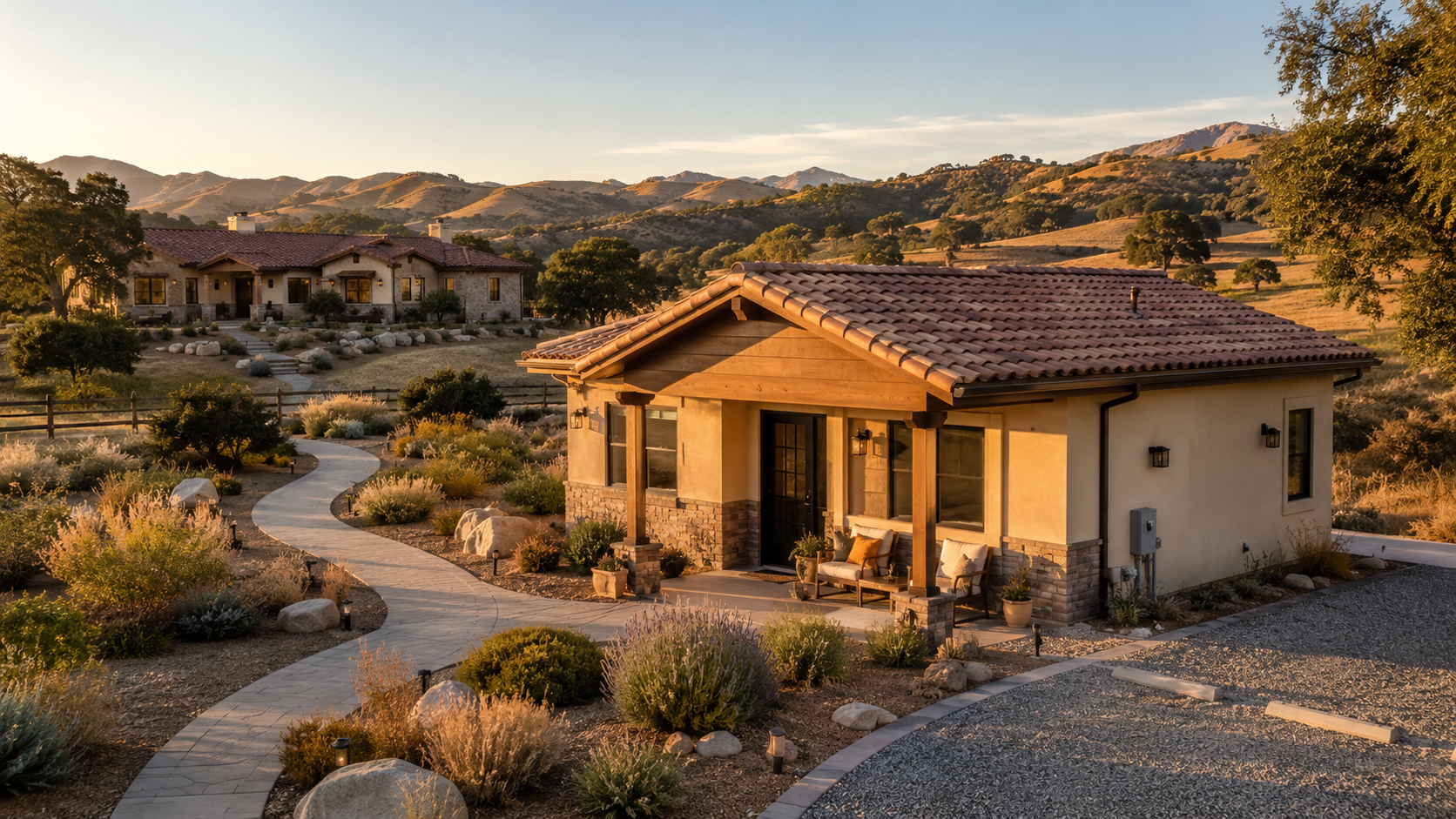
Can You Build an ADU on a Jamul Property?
In many cases, yes. California law generally allows an accessory dwelling unit on a residential property with an existing or proposed primary residence. Because Jamul is in unincorporated San Diego County, most local ADU applications are processed through the County of San Diego Planning & Development Services rather than a city building department.
San Diego County currently allows a detached ADU of up to 1,200 square feet, independent of the size of the primary home. An attached ADU may generally be as large as 50% of the primary residence, with a maximum of 1,200 square feet and important state-law exceptions that preserve the ability to construct certain units.
However, having enough acreage does not automatically make a Jamul ADU feasible.
Rural properties can be affected by:
- Septic-system capacity
- Private-well capacity or water-district requirements
- Fire-apparatus access
- Defensible-space requirements
- Steep slopes
- Grading
- Easements
- Biological resources
- Open-space restrictions
- Flood or drainage conditions
- Existing unpermitted structures
- Utility distances
- Propane and electrical capacity
- Private-road agreements
- Gated-community restrictions
- Construction access
- Project cost
The most reliable first step is a property-specific feasibility review using the assessor parcel number, zoning information, septic records, title documents, survey information and a preliminary site plan.
An online statement that “California allows ADUs everywhere” should not be interpreted as a guarantee that a particular design can be built in a particular location.
Jamul ADU Rules at a Glance
| Question | General 2026 answer |
|---|---|
| Are ADUs allowed in Jamul? | Generally yes on qualifying residential properties |
| Who issues the permit? | County of San Diego Planning & Development Services |
| Maximum detached ADU size | Generally 1,200 square feet |
| Maximum attached ADU size | Generally 50% of the primary home, up to 1,200 square feet, subject to state-law exceptions |
| Minimum unit protected by state law | State law generally preserves the ability to construct at least an 800-square-foot ADU with qualifying four-foot side and rear setbacks |
| Can an existing structure be converted? | Potentially, if it can satisfy applicable requirements |
| Is an ADU a complete dwelling? | Yes; it contains independent living, sleeping, cooking and sanitation facilities |
| Can an ADU be rented nightly? | San Diego County rules generally prohibit rentals for fewer than 31 days |
| Is septic approval required? | Frequently, when the property is not connected to sewer |
| Are fire requirements important? | Yes, particularly for detached construction in the wildland-urban interface |
| Do County plans eliminate all design work? | No. County plans are approximately 85% complete and require site-specific information |
| Does an ADU guarantee higher resale value? | No. Value depends on legality, design, utility, condition, location and buyer demand |
Information is current as of August 2026 and should be confirmed before making financial decisions.
What Is an ADU?
An accessory dwelling unit, or ADU, is a secondary residence located on the same legal parcel as an existing or proposed primary home.
An ADU must provide complete independent living facilities, including permanent provisions for:
- Living
- Sleeping
- Eating
- Cooking
- Sanitation
ADUs may also be called:
- Granny flats
- In-law suites
- Backyard cottages
- Casitas
- Secondary units
- Guest houses
- Garage apartments
Those terms are often used casually, but they are not always legally interchangeable.
A structure is not automatically an ADU merely because someone sleeps in it. A detached room without a permitted kitchen or bathroom may be a guest room, office, studio or another accessory use—not a legal dwelling unit.
The California Department of Housing and Community Development defines an ADU as an attached or detached residential unit providing complete independent living facilities on the same lot as a proposed or existing primary residence. California HCD ADU Handbook
Why Are ADUs Popular in Jamul?
Jamul’s larger parcels and rural lifestyle can make an ADU attractive for several reasons.
Multigenerational Living
An ADU can give parents, adult children or extended family members a separate residence while keeping them nearby.
Aging in Place
Some owners build an accessible single-story ADU for themselves and allow another family member to occupy the main home. Others create a smaller residence for an aging parent.
Long-Term Rental Income
A permitted ADU may provide rental income, subject to applicable laws, financing, insurance and tax considerations.
Home Office and Flexible Space
An ADU can offer quiet work space, although a legal dwelling should still be designed and permitted for residential use rather than treated only as an office.
Guest Accommodations
A fully independent unit provides guests with privacy while keeping the primary residence separate.
Caregiver Housing
On-site housing can make it easier to accommodate a caregiver while preserving independence for both households.
Future Resale Appeal
A permitted ADU can expand the potential buyer pool by appealing to buyers seeking rental income, family housing or flexible living arrangements.
The value is strongest when the ADU is legal, well-designed, accessible, appropriately located and supported by reliable records.
Types of ADUs in Jamul
Detached ADU
A detached ADU is a separate residential building on the same parcel as the primary home.
Examples include:
- A newly constructed backyard cottage
- A separate casita
- A detached garage with a residence
- A converted permitted outbuilding
- A small second residence elsewhere on a large parcel
San Diego County currently states that a detached ADU may contain up to 1,200 square feet, regardless of the square footage of the primary single-family residence. County of San Diego ADU information
Detached units offer privacy but can require more expensive utility extensions, grading, foundations, fire access and site work.
Attached ADU
An attached ADU shares at least one wall with the primary residence.
It might be:
- A side addition
- A rear addition
- A second-story unit
- A new wing
- An attached garage conversion with an addition
The County generally limits an attached ADU to 50% of the primary home’s floor area and no more than 1,200 square feet. Exceptions to the 50% limitation help preserve units of up to 850 square feet, or up to 1,000 square feet when the ADU has more than one bedroom. San Diego County ADU requirements
Attached construction can reduce utility distances but requires careful attention to structural connections, privacy, sound separation and fire assemblies.
Conversion ADU
A conversion ADU uses space within an existing structure.
Potential locations include:
- An attached garage
- A detached garage
- An existing workshop
- A permitted recreation room
- Part of the primary residence
- A qualifying accessory building
Conversion projects can appear less expensive because the shell already exists. However, the building may require substantial work to meet current requirements for structure, foundation, insulation, fire safety, ventilation, plumbing, electrical service, energy efficiency and emergency egress.
An old barn or shed is not automatically suitable for conversion.
Junior Accessory Dwelling Unit
A junior accessory dwelling unit, or JADU, is a smaller unit of no more than 500 square feet created within the walls of a proposed or existing single-family residence.
A JADU has specific requirements that differ from those for a standard ADU. It may share sanitation facilities under qualifying conditions and may have owner-occupancy requirements.
State law does not allow a JADU to be created inside a detached accessory building. It must be within the single-family residence, although certain enclosed uses such as an attached garage may qualify. California’s 2026 ADU Handbook
How Large Can an ADU Be in Jamul?
Detached ADU Size
The County’s general maximum for a detached ADU is 1,200 square feet.
That maximum does not mean every property can accommodate a 1,200-square-foot unit. Physical constraints and other regulations still apply.
Attached ADU Size
An attached ADU can generally be up to:
- 50% of the primary residence’s floor area
- No more than 1,200 square feet
State-law exceptions preserve the ability to build certain smaller units even when the percentage limitation would otherwise create a smaller maximum.
State-Law 800-Square-Foot Protection
California law generally prevents local development standards from eliminating the ability to build at least an 800-square-foot ADU with four-foot side and rear setbacks, provided the project complies with other applicable requirements.
This protection can overcome some local restrictions related to:
- Lot coverage
- Floor-area ratio
- Open space
- Minimum lot size
- Certain setback constraints
It does not erase health and safety requirements, septic limitations, building codes, fire requirements, environmental restrictions or every front-yard issue.
Height
The County’s general information lists a height limit of up to 25 feet for certain detached ADUs, while state law establishes specific protected height allowances in various circumstances.
The allowed height depends on the project type, location, construction and applicable County rules. A second-story or two-level design should be reviewed early rather than assumed to qualify.
ADU Setbacks in Jamul
New detached ADUs commonly benefit from side and rear setback rules allowing four-foot setbacks under qualifying circumstances.
However, setbacks are only one part of site planning.
Additional separation may be required from:
- Other buildings
- Septic tanks
- Leach fields
- Septic reserve areas
- Private wells
- Property lines
- Easements
- Propane tanks
- Drainage features
- Environmentally sensitive land
- Fire-hazard areas
- Roads
- Utility lines
- Steep slopes
A structure may satisfy the basic zoning setback and still conflict with the septic system or required defensible space.
Existing structures converted without expanding their physical dimensions may receive different setback treatment, but the original structure’s permit status and condition remain important.
Do You Need a Minimum Lot Size for an ADU?
California law generally prohibits a local government from imposing a minimum lot-size requirement that effectively prevents an otherwise qualifying ADU.
That does not mean every portion of the parcel is buildable.
A Jamul property may have significant acreage but limited development area because of:
- Slopes
- Rock
- Septic components
- Open-space easements
- Habitat
- Drainage
- Flood conditions
- Fire access
- Existing buildings
- Private-road limitations
Usable land matters more than the acreage printed in the listing.
Septic Systems: The Biggest Jamul ADU Question
Many Jamul homes use private septic systems rather than public sewer. Adding an ADU increases projected wastewater flow and may require review by the County Department of Environmental Health and Quality.
Potential septic questions include:
- What was the existing system designed to serve?
- How many bedrooms are currently permitted?
- Where are the tank and disposal field?
- Where is the reserve area?
- Can the existing system support the ADU?
- Will the system require expansion or replacement?
- Does the property have suitable soil?
- Are setbacks available?
- Do existing improvements encroach on septic areas?
- Is a supplemental treatment system necessary?
- Will an operating permit be required?
The County’s ADU handbook specifically notes that septic requirements vary by project. County of San Diego ADU Handbook
Does a Large Septic Tank Mean You Can Add an ADU?
Not necessarily.
Tank size is only one component. The disposal system, soil, reserve area and permitted design capacity also matter.
An owner should not assume that a recently pumped or oversized-looking tank proves ADU capacity.
Can an ADU Have Its Own Septic System?
That possibility depends on the property and County review. A separate system may still require approved soil conditions, setbacks, reserve area and permits.
Before paying for architectural plans, obtain existing septic records and discuss the concept with qualified professionals.
Private Wells and ADUs in Jamul
Some Jamul properties receive water from a water district; others use a private well or small shared system.
An additional dwelling creates increased water demand for:
- Drinking
- Bathing
- Cooking
- Laundry
- Sanitation
- Fire sprinklers where required
- Landscaping
Questions may include:
- What is the well’s current production?
- Is water quality acceptable?
- Is storage available?
- Will additional treatment be required?
- Does the electrical system support the pump?
- Are well-to-septic setbacks maintained?
- Does a shared-well agreement permit another unit?
- Will the County require documentation?
- Can the system support two households during drought conditions?
A well test represents conditions at a particular time and does not guarantee future production.
Fire Requirements for Jamul ADUs
Jamul is in the wildland-urban interface, making fire review especially important.
A new ADU may affect or be affected by:
- Fire-apparatus access
- Driveway width
- Road grade
- Turnaround requirements
- Gates
- Bridge or culvert capacity
- Water supply
- Fire sprinklers
- Building separation
- Ignition-resistant construction
- Ember-resistant vents
- Address visibility
- Defensible space
- Fuel-modification plans
San Diego County Fire’s project and plan-review service includes Jamul. San Diego County Fire project review
Does Building an ADU Require Sprinklers?
State ADU law generally provides that fire sprinklers are not required in an ADU if they are not required in the primary residence. An ADU also generally cannot be used to force sprinkler installation in the existing primary home solely because the ADU is being added.
Project-specific building and fire requirements should still be confirmed with the County.
Does the ADU Need Its Own Defensible Space?
Every structure should be evaluated as part of the property’s defensible-space system. Adding a detached unit can change landscaping, access and fuel-management needs.
Do not locate an ADU where preserving the required buffer would require unauthorized clearing on another property or within protected open space.
Utilities for a Jamul ADU
Electricity
Determine whether the existing service panel and utility connection can support:
- Heating and cooling
- Electric cooking
- Water heating
- Laundry
- Well equipment
- Vehicle charging
- Solar
- Future battery storage
A panel upgrade or new service can significantly affect cost and timing.
Propane
If propane will serve the ADU, evaluate tank capacity, pipe sizing, placement, access and fire clearance. A licensed professional should design and install the system.
Solar
California energy requirements may affect new detached ADU construction. Whether solar is required depends on the project and applicable building-energy rules.
Existing solar on the main house should not be assumed to cover the ADU’s new load or satisfy all requirements.
Internet
A detached unit located far from the primary home may require trenching, conduit, point-to-point equipment or another connectivity solution. Verify provider availability at the exact address.
Wastewater
Septic feasibility should be established early because it can control the ADU’s size, bedroom count and location.
Water
Confirm district capacity or private-well feasibility before finalizing the design.
Are County ADU Plans Free?
San Diego County provides dwelling-unit plans that may be used for an ADU or single-family dwelling in unincorporated areas.
The plans are approximately 85% complete. Owners must still provide project-specific information and obtain required reviews and permits. County dwelling-unit building plans
Site-specific work may include:
- Plot plan
- Foundation design
- Structural adaptations
- Grading
- Drainage
- Energy documents
- Septic review
- Fire review
- Utility design
- Addressing
- Geotechnical work
- Engineering
- Landscape or fuel-modification plans
The plans can reduce design time, but they do not make construction free or automatically approve the location.
How Long Does an ADU Permit Take?
California law generally requires a permitting agency to approve or deny a complete ADU application within 60 days when an existing single-family or multifamily home is on the lot.
Beginning with recent changes, the agency must also make certain completeness determinations within prescribed periods and provide written explanations of deficiencies.
The statutory review period does not mean the entire project will be ready to build in 60 calendar days.
Time may be required for:
- Preliminary feasibility
- Surveying
- Septic analysis
- Soil testing
- Architectural design
- Structural engineering
- Fire review
- Utility coordination
- Application corrections
- Contractor bidding
- Material ordering
- Construction
- Inspections
- Certificate of occupancy
An incomplete application or a site requiring multiple agency reviews can take longer.
How Much Does It Cost to Build an ADU in Jamul?
There is no dependable universal price per square foot for Jamul ADUs.
Two identical floor plans can have very different total costs because of the site.
Soft Costs
These may include:
- Design
- Engineering
- Survey
- Soils work
- Energy calculations
- Permit fees
- School fees when applicable
- Septic design
- Fire review
- Utility design
- Construction management
- Legal or title review
Site Costs
These may include:
- Grading
- Rock excavation
- Retaining walls
- Long utility trenches
- Septic expansion
- Well upgrades
- Electrical service upgrades
- Propane installation
- Fire access
- Driveway improvements
- Drainage
- Tree work
- Defensible space
- Construction access
Building Costs
These may include:
- Foundation
- Framing
- Roofing
- Windows and doors
- Plumbing
- Electrical
- HVAC
- Insulation
- Drywall
- Cabinets
- Appliances
- Flooring
- Fixtures
- Interior finishes
- Exterior finishes
- Accessibility features
- Solar where required
A low online construction estimate may exclude the very site work that makes a rural Jamul ADU expensive.
Obtain property-specific proposals and include a contingency.
Are Impact Fees Charged on ADUs?
California generally prohibits local impact fees on ADUs smaller than 750 square feet. For larger units, proportional impact-fee rules may apply.
The 2026 HCD materials also describe updated treatment of smaller ADUs and fees. School fees, utility charges and other costs are governed separately and can change.
Do not assume “no impact fee” means “no fees.” Building review, septic work, utility connections, school charges and professional services may still create substantial expense.
Always request a current estimate from the relevant agencies.
Can You Rent an ADU in Jamul?
A permitted ADU may generally be rented for residential use, subject to applicable law and the property’s circumstances.
San Diego County’s ADU requirements state that an ADU cannot be rented for a term of fewer than 31 days. This generally prevents using a standard ADU as a nightly or weekend vacation rental.
Owners should also evaluate:
- Landlord-tenant law
- Rental-property insurance
- Income taxes
- Expense allocation
- Utility metering
- Parking
- Septic usage
- Well usage
- Private-road costs
- Shared outdoor areas
- Noise
- Pets
- Maintenance responsibilities
- Fair-housing requirements
Projected rental income should be based on comparable long-term rentals, not unsupported vacation-rental assumptions.
Is Owner Occupancy Required?
California eliminated broad owner-occupancy requirements for standard ADUs, but JADUs can be subject to owner-occupancy rules.
Special circumstances, deed restrictions or separate-sale programs may have additional conditions. Confirm the requirements applying to the proposed unit.
Can an ADU Be Sold Separately From the Main House?
Usually, an ADU remains part of the same legal parcel and is sold with the primary residence.
California created limited pathways under which qualifying ADUs may be sold separately, including specific nonprofit and local-ordinance frameworks. This is not the default for a typical Jamul homeowner.
Do not represent an ADU as separately saleable without obtaining current legal and title advice and confirming that the County has implemented an applicable pathway.
ADUs, HOAs and Gated Jamul Communities
Some Jamul properties are located in gated or planned communities with CC&Rs.
California law limits the ability of common-interest developments to prohibit or unreasonably restrict ADUs and JADUs. However, reasonable architectural and design standards may still apply.
An owner should review:
- Recorded CC&Rs
- Architectural rules
- Application requirements
- Building materials
- Height restrictions
- Privacy standards
- Construction hours
- Gate access
- Contractor parking
- Road-use rules
- Utility easements
- Landscaping standards
County approval and HOA approval are separate processes. Receiving one does not necessarily satisfy the other.
ADUs and Easements
Large rural lots frequently contain easements for:
- Access
- Utilities
- Drainage
- Private roads
- Water lines
- Wells
- Conservation
- Open space
- Fuel modification
- Shared driveways
An ADU should not be placed within an easement merely because there is open ground.
Obtain a title report and, when needed, a survey showing the actual easement location.
Unpermitted Guest Houses and Garage Conversions
Jamul properties sometimes contain older guest areas, converted garages, workshops or detached rooms that are described as “potential ADUs.”
Potential is not the same as approval.
Before attempting legalization, determine:
- Whether the structure was permitted
- What use was originally approved
- Whether the foundation is adequate
- Whether setbacks comply
- Whether the septic system can support it
- Whether fire access is adequate
- Whether the electrical and plumbing work was permitted
- Whether the structure meets health and safety standards
- Whether protected ADU-law pathways apply
Legalization can be possible, but it is not guaranteed.
A seller should not advertise an unpermitted structure as an ADU. Accurate descriptions may include “detached structure,” “bonus room” or “potential conversion,” provided those statements match the known facts and do not imply approved residential use.
Step-by-Step: How to Plan an ADU in Jamul
Step 1: Define the Purpose
Decide whether the unit is intended for:
- Family
- A caregiver
- Aging in place
- Long-term rent
- Guests
- Future resale appeal
Purpose affects design, privacy, accessibility and budget.
Step 2: Gather Property Records
Collect:
- Assessor parcel information
- Grant deed
- Preliminary title report
- Survey
- Existing building permits
- Septic records
- Well records
- Site plans
- Fire or fuel-modification plans
- HOA documents
- Utility information
Step 3: Map the Constraints
Identify:
- Property lines
- Easements
- Existing structures
- Septic tank
- Leach field
- Reserve area
- Well
- Propane tank
- Utilities
- Slopes
- Drainage
- Trees
- Open space
- Driveways
- Fire access
Step 4: Conduct Preliminary Agency Research
Confirm zoning, jurisdiction, overlays, hazard designations and known permit requirements.
Step 5: Consult Qualified Professionals
Depending on the site, the team may include:
- Designer or architect
- General contractor
- Civil engineer
- Structural engineer
- Septic professional
- Surveyor
- Geotechnical consultant
- Fire consultant
- Arborist
- Insurance broker
- Tax advisor
- Attorney
Step 6: Select the Best ADU Type
Compare attached, detached, conversion and JADU options.
Step 7: Create a Realistic Budget
Include professional fees, permits, utilities, site work, contingency and financing costs.
Step 8: Submit Complete Plans
Incomplete information can delay review.
Step 9: Obtain Written Approvals
Do not begin work based on verbal assurances.
Step 10: Complete Inspections and Occupancy Approval
A unit should not be occupied before required approvals are issued.
Jamul ADU Feasibility Checklist
| Category | Questions to answer |
|---|---|
| Zoning | Is residential use allowed, and what ADU pathway applies? |
| Lot | Where are the boundaries, setbacks and easements? |
| Septic | Can the existing OWTS support the proposed bedrooms and flow? |
| Water | Is district or well capacity sufficient? |
| Fire | Is access adequate, and what construction standards apply? |
| Grading | Will slopes, rock or retaining walls affect the project? |
| Utilities | How far must electrical, water, propane and data lines travel? |
| HOA | Do recorded restrictions or architectural rules apply? |
| Insurance | How will the new unit affect property coverage? |
| Financing | Will the lender allow and fund the project? |
| Rental | What long-term rent is realistically supported? |
| Resale | Will the design remain useful to future buyers? |
Common ADU Mistakes in Jamul
Designing Before Checking Septic
A beautiful floor plan has little value if the wastewater system cannot support it.
Assuming Acreage Equals Buildability
A five-acre parcel can have less suitable building area than a level half-acre parcel.
Ignoring Fire Access
A detached unit can increase access and turnaround requirements.
Underestimating Utility Trenches
The ideal scenic location may be extremely expensive to serve.
Treating County Plans as Fully Approved
Standard plans still require site-specific completion and review.
Building for Maximum Size Instead of Best Use
A well-designed 700-square-foot unit may perform better than an awkward 1,200-square-foot unit.
Relying on Estimated Rent to Justify Every Cost
Rental income can change, and vacancy, repairs, insurance and taxes reduce the gross amount.
Failing to Plan Privacy
Window placement, patios, parking and walkways affect both households.
Forgetting Construction Access
Concrete trucks, excavation equipment and material deliveries need safe access.
Advertising an Unpermitted Unit as an ADU
This can create disclosure, appraisal, lending and liability problems.
Semantic Questions About Jamul ADUs
Can every Jamul property have an ADU?
Not necessarily. State law strongly supports ADUs, but property-specific health, safety and physical constraints still matter.
How big can a detached ADU be in Jamul?
San Diego County generally permits up to 1,200 square feet.
Can an ADU be larger than the primary home?
A detached ADU’s County maximum does not depend on the primary home’s size, although it remains limited to 1,200 square feet and other rules apply.
Can I build an ADU in my front yard?
State law may require front-setback flexibility when necessary to allow a qualifying 800-square-foot ADU, but the location must still satisfy applicable requirements.
Can I convert my barn into an ADU?
Potentially, but the barn’s permit history, condition, location, septic feasibility and code compliance must be evaluated.
Can I use a tiny home as an ADU?
A qualifying manufactured or site-built unit may potentially serve as an ADU if it meets legal and building requirements. A recreational vehicle or tiny home on wheels does not automatically qualify.
Can I build an ADU over a garage?
Potentially. Structural, height, access, fire and design requirements apply.
Can an ADU use the home’s septic system?
Possibly, if DEHQ determines the system and site can support the additional wastewater flow.
Can I rent a Jamul ADU on Airbnb?
County ADU rules generally prohibit rental terms shorter than 31 days.
Does an ADU need a separate address?
Addressing requirements depend on the project and County process.
Frequently Asked Questions About Selling a Jamul Home With an ADU
Does a permitted ADU increase home value?
It can, but the amount depends on size, condition, privacy, rental potential, utility arrangement and comparable sales.
Will an appraiser count the ADU’s full construction cost?
Not necessarily. Cost and market value are different concepts.
Should I finish an ADU before selling?
That depends on remaining cost, permit status, timeline and likely market response. Obtain professional estimates and a real estate valuation before proceeding.
Can buyers finance a property with two units?
Potentially, but loan treatment depends on the property, occupancy, appraisal and loan program.
Should ADU rent be included in marketing?
Actual rent or a carefully supported estimate may be relevant, but projections should not be presented as guaranteed income.
What documents should a seller provide?
Provide permits, final approvals, plans, warranties, utility information, leases, expense records and known maintenance history.
What if the ADU was never finalized?
Investigate before listing. An open or expired permit can affect the transaction.
Can an ADU have a separate utility meter?
Possibly. Confirm requirements and costs with the utility provider and County.
Does a tenant have to leave when the property sells?
Not automatically. Lease terms and California landlord-tenant law matter. Obtain legal guidance.
Can the seller call a guest house an ADU?
Only when the unit’s approval and legal status support that description.
How ADUs Affect Jamul Home Marketing
A legal, thoughtfully designed ADU can become one of a property’s strongest selling features.
Marketing should explain:
- Permit status
- Square footage
- Bedroom and bathroom count
- Kitchen facilities
- Separate entrance
- Accessibility
- Parking
- Laundry
- Privacy
- Utility arrangement
- Septic approval
- Current tenancy
- Potential uses without guaranteeing income
The agent should also understand how the unit interacts with the rest of the property.
For example:
- Does it preserve the primary home’s views?
- Is it convenient for aging parents?
- Can a tenant enter without crossing a private patio?
- Is there enough parking?
- Does it work for a caregiver?
- Are there stairs?
- Is the unit close enough for family but far enough for privacy?
- Does the septic system have documented capacity?
- Are the permits complete?
These details help buyers recognize value.
Choosing the Best Listing Agent for a Jamul Home With an ADU
Selling a rural property with an ADU requires more than mentioning “income potential” in the MLS.
The listing advisor should understand:
- ADU permit records
- Septic documentation
- Wells and water service
- Fire access
- Insurance concerns
- Rental representations
- Appraisal challenges
- Tenant-occupied sales
- Multigenerational marketing
- Rural property disclosures
- Unpermitted-space risks
Zachary and Rochelle Svelling of The Svelling Group serve Jamul homeowners as local knowledge brokers, combining property-specific preparation with specialized marketing.
For consumers searching for the top listing agents in Jamul, top real estate advisors in Jamul, #1 listing agents in Jamul, #1 real estate advisors in Jamul, the best listing agent in Jamul, the best listing advisor in Jamul or the best Realtor to sell a home in Jamul, ADU experience should be part of the interview.
No agent should guarantee an ADU’s value, rental income or legal status without documentation. The right Jamul advisor will help gather facts, identify questions for specialists and present the property accurately.
Thinking About Building—or Selling—a Jamul ADU Property?
An ADU can provide family flexibility, rental income and future market appeal. On a rural property, however, the difference between a good idea and a successful project is careful feasibility work.
Before spending money on plans or construction:
- Review the property records.
- Locate septic components.
- Confirm water capacity.
- Evaluate access.
- Map easements.
- Investigate fire requirements.
- Estimate complete project costs.
- Consider how future buyers will use the space.
Request a Jamul Real Estate and ADU Strategy Consultation
If you are considering building an ADU before selling—or you already own a Jamul home with a guest house, conversion or permitted second unit—contact Zachary and Rochelle Svelling of The Svelling Group.
We can help you evaluate how the existing or proposed space may affect positioning, buyer demand and your overall selling strategy.
Schedule your confidential Jamul home consultation today and let local knowledge, careful preparation and exceptional marketing protect the value of your property.
Information reviewed in August 2026. California ADU law and San Diego County ordinances, fees and procedures change frequently. This guide is educational and is not legal, engineering, tax, construction or permitting advice. Confirm all requirements with the County of San Diego, California HCD and qualified professionals.
Check out this article next

Jamul Through the Years: How a Historic Backcountry Community Became One of San Diego’s Most Distinctive Places to Live
What Was Jamul, and What Has It Become?Jamul began as part of the ancestral homeland of the Kumeyaay people, whose relationship with the region extends…
Read Article