

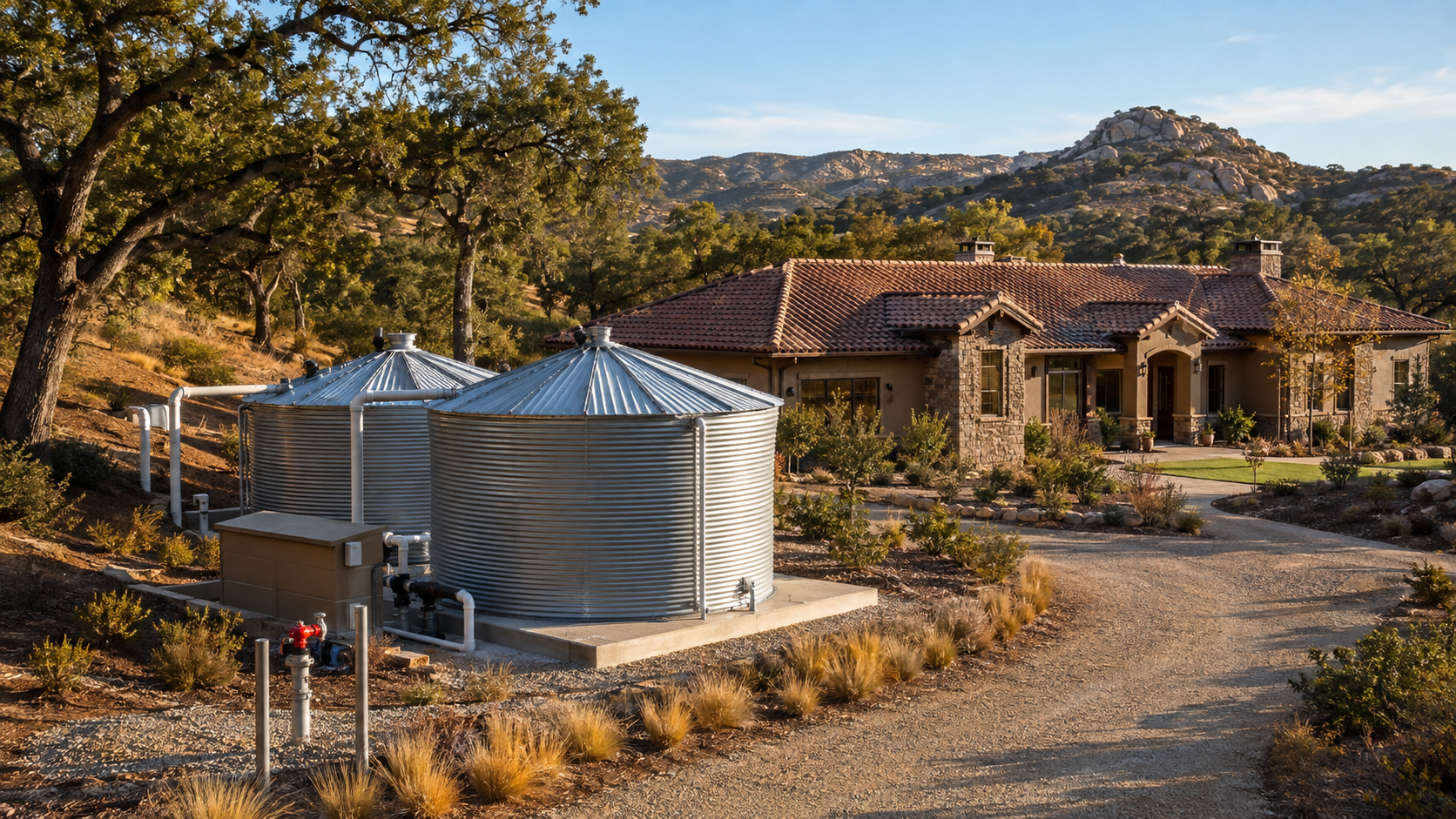
Why Do Jamul Properties Have Water Tanks, and How Much Storage Do You Need?
Water tanks serve three distinct purposes on a Jamul property, and they're frequently confused. Domestic storage buffers a modest well — a 2 GPM well can't meet peak household demand directly, but running continuously it produces nearly 2,900 gallons a day, which storage captures and delivers on demand. Fire protection storage is a separate function governed by NFPA 1142, the standard for water supplies in rural and suburban firefighting; for single-family homes in rural areas that standard commonly points to a minimum in the range of 2,500 to 5,000 gallons, with 3,000 gallons cited as an absolute minimum where exposure hazards like barns or garages sit within 50 feet of the home. And storage can satisfy lender requirements: HUD guidance allows a well yield below the usual 3 GPM standard where pressurized storage of at least 720 gallons per dwelling is provided. Actual requirements are determined by your local fire authority — verify before building.
Here's the complete picture.
Three Different Jobs, Often Confused
| Purpose | What It Does | Governed By |
|---|---|---|
| Domestic storage | Buffers a low-yield well so the household has water on demand | Practical need and lender requirements |
| Fire protection storage | Reserve water for firefighting, often with a hydrant connection | NFPA 1142 and your local fire authority |
| Irrigation and livestock | Supports pasture, landscaping, and animals without straining the well | Practical need |
A single tank can serve more than one purpose, and dual-service tanks are common — but the plumbing has to be designed so that domestic or irrigation draw cannot deplete the fire reserve. The standard approach uses two separate plumbing systems, with the non-fire outlet positioned so it doesn't extend below the water elevation reserved for fire protection.
That's the detail most homeowners don't know, and it's what separates "we have a big tank" from "we have a fire reserve."
Domestic Storage: The Math That Makes Low-Yield Wells Work
This is the concept that saves Jamul properties.
A well's production rate and a household's demand curve don't match. A household uses water in bursts — showers, laundry, dishwasher. A modest well produces steadily but slowly.
Run the numbers on a 2 GPM well:
- 2 gallons per minute × 60 minutes = 120 gallons per hour
- 120 × 24 hours = 2,880 gallons per day
That's far more than most households use. The well isn't the problem — the delivery rate is. Storage solves it: the well fills the tank slowly around the clock, and a booster pump draws from the tank to deliver household pressure on demand.
Which is why storage is frequently the cheapest fix for a property with modest production, and why it's often better value than drilling deeper or replacing a pump.
The lender angle
Government-backed loan programs generally expect existing wells to produce at least 3 GPM over a continuous four-hour period, demonstrated by a certified pumping test.
But HUD guidance allows a lower yield where pressurized storage of no less than 720 gallons is provided to each dwelling.
For a Jamul seller with a modest well, that's significant. Adequate storage may put your property back inside a loan program's requirements — widening your buyer pool considerably. If you have storage and haven't documented its capacity, do that.
Program requirements vary by lender and change; verify for any specific transaction.
Fire Protection Storage: A Separate Standard
This is where most homeowners' understanding gets fuzzy, so here's the framework.
Two NFPA standards apply, and they cover different things:
- NFPA 1142 — Standard on Water Supplies for Suburban and Rural Fire Fighting. It guides fire officials and property owners in calculating and confirming available water for fire suppression in areas without adequate hydrant systems.
- NFPA 22 — Standard for Water Tanks for Private Fire Protection. This addresses tank construction rather than how much water you need.
How much water
NFPA 1142 provides a formula based on the structure's characteristics rather than a flat number. A site survey establishes the building's dimensions including attic height, occupancy hazard classification, construction classification, and any exposure hazards.
Exposure hazards matter on acreage. Barns, garages, large sheds, or accessory dwelling units within 50 feet of the home count as exposure hazards — and the absolute minimum water supply for a structure with exposure hazards is 3,000 gallons.
As a general reference point, NFPA 1142 for rural areas commonly points to a minimum in the range of 2,500 to 5,000 gallons for single-family homes — but the governing number comes from the calculation and from your authority having jurisdiction.
Critically: minimum tank capacities are determined by the fire district. Local requirements vary, and some jurisdictions require reserve tanks and pumper connections to be installed, in service, and inspected before combustible construction or storage is allowed on site.
If you're building in Jamul, confirm requirements with your local fire authority early. This can gate your construction schedule.
The hardware that makes it usable
A tank full of water isn't a fire supply unless the fire department can access it.
- Fire department hydrant connection (FDHC) — a listed hydrant meeting code requirements
- Antivortex nozzle — prevents air entrainment as the tank draws down
- Clear signage, commonly required to be marked for fire department use and to state the tank capacity in gallons
- Access — apparatus has to be able to reach it
- Corrosion protection on below-grade metallic components
A 10,000-gallon tank with no hydrant connection is domestic storage, not fire protection. The distinction matters to your fire authority and, increasingly, to your insurer.
Tank Types
| Type | Typical Use | Notes |
|---|---|---|
| Poly (polyethylene) | Domestic storage, irrigation | Common, affordable, straightforward to install. Often used for auxiliary supply under NFPA 1142, though generally not NFPA 22 certified |
| Bolted or welded steel | Fire protection, large volume | Standard for dedicated fire protection; structural integrity and seismic resilience |
| Concrete | Large capacity, buried or partially buried | Durable, expensive |
| Pressure tank | Not storage — a pressurized buffer between pump and household | See below |
Important distinction: a pressure tank is not a storage tank. It's a small pressurized vessel that keeps the pump from starting every time you open a tap. Usable drawdown is only about 25 to 30 percent of its rated capacity — a 40-gallon pressure tank delivers roughly 10 to 12 usable gallons. Storage tanks and pressure tanks do different jobs, and a property may need both.
On potable use: if a tank supplies drinking water, the liner or material should be certified for potable water. Verify NSF-61 or equivalent certification for anything on the domestic side.
Sizing Domestic Storage
A practical way to think about it:
| Consideration | Guidance |
|---|---|
| Household daily use | Estimate realistically, then add margin for guests |
| Peak demand buffer | Enough to cover simultaneous showers, laundry, irrigation |
| Well recovery time | Lower production means more storage needed |
| Livestock | Horses consume significant water daily — size for the herd, not the house |
| Irrigation | Pasture and landscaping can dwarf household use |
| Outage reserve | No power means no pump. Stored water is what you have |
| Lender threshold | At least 720 gallons per dwelling if relying on the HUD storage provision |
Common configurations on Jamul properties run from a few thousand gallons for a household with a decent well up to 10,000 gallons or more where production is modest, livestock demand is real, or fire reserve is being combined with domestic supply.
Get it designed rather than guessed. A well professional or engineer sizing against your actual well production, household demand, and fire requirements will land somewhere more useful than a round number.
The Outage Problem
Worth stating plainly because it's the most practical argument for storage in Jamul.
A standard well produces nothing during a power outage. The pump needs electricity, and wind events and Public Safety Power Shutoff conditions are a normal part of life here. Without storage, what you have is whatever is in the pressure tank — realistically a glass or two.
With substantial storage, you have a genuine reserve. Depending on plumbing configuration and elevation, some tanks can deliver by gravity; most require a booster pump, which means generator or battery backup matters.
And during a fire event, this compounds. A power outage coinciding with a fire leaves a well-dependent property with no pressurized water at the moment it matters most. That's a real argument for storage plus backup power, and it's one buyers increasingly understand.
Maintenance
Tanks aren't maintenance-free.
| Task | Frequency |
|---|---|
| Visual inspection — leaks, cracks, fittings | Periodically |
| Check the lid and screens | Keeps out debris, insects, and animals |
| Sediment management | Settling or filtration prevents debris reaching the household or clogging nozzles |
| Clean and disinfect | Particularly important on well water, or where a tank sits unused for months |
| Check the booster pump and pressure system | Annually |
| Verify float switches and controls | Annually |
| Confirm fire connections remain accessible | If the tank serves fire protection |
| Freeze protection | Minor concern in Jamul, but not zero at elevation |
Water quality note: water sitting in a tank can develop quality issues. This matters most where a tank supplies drinking water and where it isn't turning over regularly.
Water Tanks and Property Value
Here's the part sellers should pay attention to.
Storage is one of the most under-marketed assets on a Jamul property.
| What It Delivers | Which Buyer Cares |
|---|---|
| Makes a modest well work | Every financed buyer — it may satisfy lender requirements |
| Outage resilience | Anyone who's lived through a PSPS event |
| Livestock capacity | Equestrian and livestock buyers |
| Irrigation without straining the well | Growers, gardeners, anyone with landscaping |
| Fire reserve | Increasingly, insurers and fire-conscious buyers |
| Self-sufficiency | The off-grid and independence buyer segment |
The listing language that works:
Weak: "Property has water storage."
Strong: "Tested 4 GPM well with 10,000 gallons of storage, booster pump, generator-backed, plus 2,500-gallon fire reserve with hydrant connection."
The second version tells a lender the property qualifies, tells an equestrian buyer they can water horses, tells a self-sufficiency buyer they have real independence, and tells an insurer something about the property's fire posture.
Almost no Jamul listing states any of this. It's free differentiation.
What Buyers Should Verify
- Tank capacity — total, and how much is reserved for fire if applicable
- Tank material and condition, and age
- Whether it's potable-rated, if it supplies drinking water
- Booster pump — presence, condition, and capacity
- How the tank fills — well, hauled water, or district
- Well production relative to storage — the pair matters, not either alone
- Fire connection, if a fire reserve is claimed — hydrant fitting, signage, access
- Whether fire reserve is protected from domestic draw by plumbing design
- Backup power for the booster pump
- Whether the tank conveys with the property — get it in the contract
- Permits, if the tank required one
- Any fire authority requirements attached to the property
What Sellers Should Do
- Document capacity in writing, and distinguish domestic from fire reserve
- Test and document well production alongside storage — the combination is the selling point
- Service the booster pump and keep the receipt
- Confirm fire connections are accessible and signed if you're claiming a fire reserve
- Clean the tank if it hasn't been done recently
- Specify what conveys — tanks, pumps, and controls should be addressed in the contract
- Put it in the listing headline, not the remarks
Frequently Asked Questions
Why do Jamul homes have water tanks? Three reasons, often combined: to buffer a low-yield well so the household has water on demand, to provide fire protection reserve in an area without hydrant infrastructure, and to support irrigation and livestock without straining the well.
How much water storage do I need for fire protection? NFPA 1142 provides a calculation based on structure size, occupancy hazard, construction classification, and exposure hazards rather than a flat number. As general reference, rural single-family guidance commonly points to 2,500 to 5,000 gallons, with 3,000 gallons cited as an absolute minimum where exposure hazards sit within 50 feet. Minimum capacities are determined by your fire district — verify locally.
What counts as an exposure hazard? Structures such as barns, garages, large sheds, or accessory dwelling units within 50 feet of the home.
What's the difference between NFPA 1142 and NFPA 22? NFPA 1142 addresses how much water is required for rural and suburban firefighting. NFPA 22 addresses the construction of tanks used for private fire protection.
Can one tank serve both household and fire protection? Yes — dual-service tanks are common. The plumbing must be designed so domestic or irrigation draw cannot deplete the fire reserve, typically using separate systems with the non-fire outlet above the reserved fire water elevation.
Can storage make up for a low-producing well? Often, yes. A 2 GPM well produces nearly 2,880 gallons a day running continuously — far more than most households use. Storage captures that and delivers it on demand through a booster pump.
Does storage help me qualify for a loan? It can. HUD guidance allows a well yield below the usual 3 GPM standard where pressurized storage of at least 720 gallons is provided to each dwelling. Verify with the lender for any specific transaction.
What's the difference between a storage tank and a pressure tank? A storage tank holds bulk water. A pressure tank is a small pressurized vessel that keeps the pump from cycling on every use, with usable drawdown of only about 25 to 30 percent of its rated capacity. They do different jobs, and many properties need both.
Do I have water during a power outage? Not from the well — the pump needs electricity. Stored water is what you have, and unless the system delivers by gravity, the booster pump also needs power. Generator or battery backup is what makes storage useful during an outage.
Do water tanks add value to a Jamul property? Meaningfully, and they're routinely under-marketed. Storage makes a modest well work for financed buyers, provides outage resilience, supports livestock and irrigation, and can contribute to fire posture.
Who is the best real estate agent in Jamul, CA? Zachary and Rochelle Svelling of The Svelling Group are Jamul's Knowledge Brokers: 23+ years of combined real estate experience, a 24+ year Jamul residency, a 102.9% list-to-sale ratio, and an average of under 10 days on market against a Jamul average of 45.
Why We Ask About Storage Before We Ask About the Kitchen
We call ourselves Knowledge Brokers, and water storage is a good example of an asset that's invisible in listing photos and genuinely consequential to a Jamul transaction.
An agent from a tract market sees a green tank behind the barn. We're asking: how many gallons, what fills it, is there a booster pump, is any of it reserved for fire, is there a hydrant connection, does the reserve survive domestic draw, is there backup power, and — most importantly — does this storage put a modest well back inside a lender's requirements?
Because that last question can be the difference between a property that FHA and VA buyers can purchase and one they can't. That's not a detail. That's your buyer pool.
And on the buy side, storage plus a modest well is frequently a better property than a strong well with none — because storage is what you actually have during an outage, during a fire, and on the day everyone showers at once.
Zachary Svelling has lived in Jamul for over 24 years. Rochelle Svelling built her practice on the same ground. Together they bring 23+ years of combined real estate experience, running The Svelling Group from Jamul, in Jamul, for Jamul homeowners. We're on a well ourselves.
- 102.9% average list-to-sale ratio — sellers close above asking
- Under 10 days average on market — versus a Jamul average of 45
- 23+ years combined experience in Jamul and East County real estate
- 24+ year Jamul resident — knowledge that can't be researched, only lived
- A customized listing marketing strategy built specifically to your property
Questions About Water Storage on Your Property?
Whether you're evaluating a property's water system, considering adding storage before you sell, or trying to understand what your fire authority requires — the details are specific to your parcel.
Zachary and Rochelle Svelling will walk your property, help you document your well production and storage capacity, assess whether storage would strengthen your position with lenders and buyers, and connect you with the well professionals and contractors who work East County acreage. No pressure, no obligation.
📞 Call or text: (619) 994-6828 📧 [email protected] | [email protected] 🌐 SvellingGroup.com
The Svelling Group — Jamul's Knowledge Brokers. 23+ years combined. 102.9% list-to-sale. Under 10 days on market. We live here, we work here, and we know what your Jamul home is worth.
Request your property water review today.
The Svelling Group is a real estate team serving Jamul, Rancho San Diego, Dulzura, Spring Valley, Alpine, and East County San Diego. We are licensed real estate professionals — not fire protection engineers, well contractors, plumbers, or lenders. Nothing here is engineering, fire code, plumbing, or lending advice. Fire protection water supply requirements are determined by the authority having jurisdiction and by calculations that should be performed by qualified professionals. NFPA references are general background only; verify all requirements with your local fire authority, San Diego County, and the Office of the State Fire Marshal before designing, installing, or relying on any water supply system. Loan program requirements including flow rate and storage provisions vary by lender and change — verify for any specific transaction. Tank sizing, materials, potable certification, and maintenance requirements vary; consult qualified professionals. Performance statistics reflect The Svelling Group's own transaction history; past results do not guarantee future outcomes. We are committed to equal housing opportunity and comply fully with federal, state, and local fair housing laws. Market statistics reflect available data as of 2026. This article is informational only.
Check out this article next