
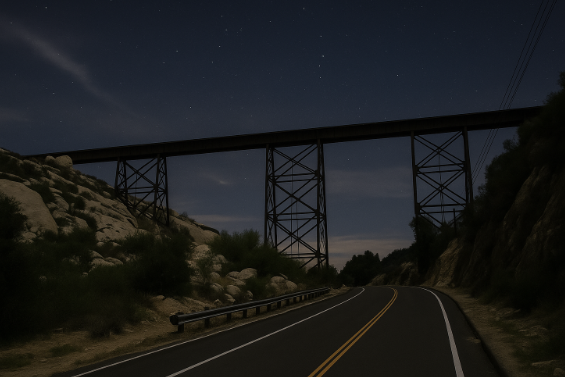
Tucked away in the rugged backcountry along the U.S.–Mexico border stands a testament to human ambition and engineering prowess: the Campo Creek Baja Railroad Viaduct. Towering high above the canyon floor, its lattice steelwork and sweeping span have captivated railroad enthusiasts, historians, and travelers for over a century. Today, it stands as a striking silhouette against the desert sky and a powerful reminder of the bold vision that once sought to connect two nations by rail through some of the most unforgiving terrain in North America.
A Dream of Connection
At the turn of the 20th century, San Diego was a bustling port city hungry for greater access to national trade networks. City leaders and rail developers recognized the untapped potential of a direct rail line linking San Diego to the eastern rail systems. But the route they envisioned was nothing short of audacious.
The proposed line would stretch east from the coast, cutting through the rocky backcountry of Campo and Tecate, traversing the rugged borderlands into Mexico, and then looping back into the United States. It was a vision that would test the limits of engineering and human determination.
This ambitious plan culminated in what became known as the San Diego & Arizona Railway. Skeptics who doubted such a feat could be accomplished through mountains, canyons, and desert dubbed it "The Impossible Railroad"—a name that would prove both accurate and ironic.
Building the Dream
Construction began in 1907 under the leadership of sugar magnate John D. Spreckels, a man with both the vision and the financial resources to tackle such an enormous undertaking. What followed were 12 grueling years of construction through some of the most challenging terrain imaginable.
Workers battled extreme heat, flash floods, unstable ground, and the constant threat of landslides. They blasted through solid rock, built bridges across deep canyons, and laid track through desert valleys where temperatures could swing 50 degrees between day and night. When the line was finally completed in 1919, it stood as a monument to what could be achieved when vision met determination.
The Viaduct's Significance
Among all the impressive engineering feats along the route, the Campo Creek Viaduct quickly became one of the most iconic structures. Straddling the canyon between Campo and Tecate, the viaduct's statistics alone are impressive:
- Rising over 185 feet at its tallest point
- Stretching nearly 600 feet in length
- Supported by immense steel towers anchored deep into rocky slopes
For passengers on early trains, crossing the viaduct was an unforgettable experience. The slow, clattering journey high above the canyon floor, with only desert winds and starlit skies for company, was both breathtaking and nerve-wracking. Looking down from the passenger cars, travelers could see the canyon floor far below—a reminder of both the achievement of human engineering and the power of the natural world.
For decades, this steel giant played a crucial role in supporting freight and passenger service between San Diego and the broader rail system. It stood as a gateway, linking Southern California with the interior of the continent through an international route unlike any other in the United States.
Trials Through the Decades
The viaduct's history has been marked by both triumph and challenge. The harsh desert climate proved to be a relentless adversary. Flash floods roared through the canyon with little warning. Landslides threatened the stability of the massive steel towers. The extreme temperature swings caused metal to expand and contract, testing the limits of early 20th-century engineering.
During World War II, the viaduct took on renewed strategic importance as military supplies were transported across its span, supporting the war effort in the Pacific. The line hummed with activity, proving its value to national security and commerce.
However, peacetime brought financial challenges. The railway often struggled economically, and sections of track fell into disrepair. Ownership and operation changed hands multiple times over the years, with both U.S. and Mexican rail companies working to keep the line viable.
As modern highways were built in the post-war era, the need for long-haul freight rail in the region diminished. Trucks offered more flexibility, and the romantic era of cross-country rail travel gave way to the efficiency of interstate commerce. Yet through it all, the viaduct endured—its stark steel profile a constant reminder of the dreams and determination that built it.
Preserving the Legacy
Today, the Campo Creek Baja Railroad Viaduct remains a cherished historic landmark. Railroad enthusiasts make pilgrimages to see it. Photographers capture its dramatic silhouette against desert sunsets. Hikers who venture into the backcountry pause to admire its engineering and contemplate the ambition it represents.
The viaduct serves as more than just a physical bridge across a canyon. It's a bridge across eras—connecting us to a time when the seemingly impossible was attempted and achieved. It speaks to an age when communities invested in grand infrastructure projects that would serve generations, even when the path forward was uncertain and the obstacles seemed insurmountable.
Standing beneath its towering steel frame, one can almost hear the whistle of those early locomotives and imagine the passengers who once marveled at this engineering triumph. The viaduct invites us to consider our own capacity for bold vision and persistent effort in the face of daunting challenges.
A Monument to Ambition
As San Diego's backcountry continues to evolve, the Campo Creek Baja Railroad Viaduct holds fast to its place in history. Standing tall against canyon winds and beneath desert night skies, it serves as an enduring invitation to pause and remember the ambition of those who dared to build "The Impossible Railroad."
In an era when grand infrastructure projects can seem like relics of the past, the viaduct reminds us of what communities can accomplish when they commit to a shared vision of connection and progress. More than a century after its completion, it continues to inspire—not just as an engineering marvel, but as a testament to the power of human determination to overcome even the most formidable obstacles.
The next time you find yourself in San Diego's backcountry, consider seeking out this remarkable structure. Stand in its shadow, look up at the lattice of steel against the sky, and remember: what was once deemed impossible became not just possible, but enduring.
The Campo Creek Baja Railroad Viaduct stands as one of Southern California's most impressive historic structures, a testament to early 20th-century engineering and the bold vision that connected San Diego to the wider world.
Check out this article next